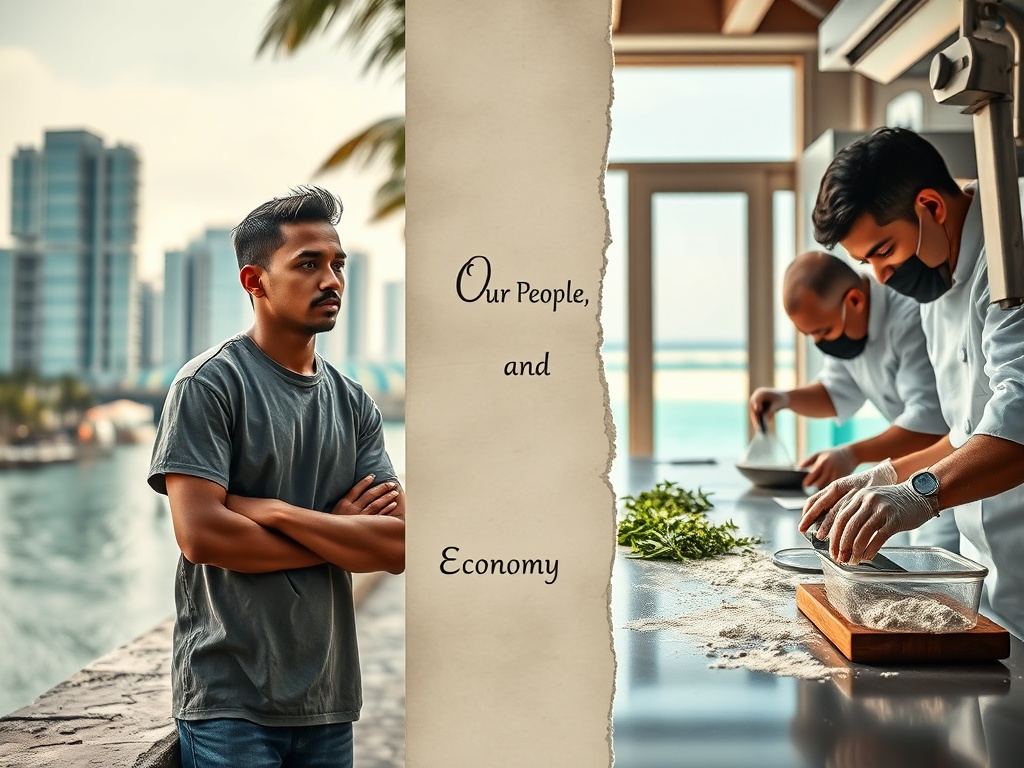
15,000 Rufiyaa Minimum Wage Proposal Challenges Maldives' Economic Model
A profound tension simmers beneath the postcard-perfect surface of the Maldives, stretching between sovereignty and survival, between the ideal of economic self-reliance and the reality of an economy that cannot provide for its own. This debate transcends simplistic narratives of lazy locals versus exploited expatriates, revealing systemic failures and a collective anxiety about the nation's future.
The social contract has frayed. The promise that education and citizenship would lead to secure employment has weakened for O-level graduates seeking resort jobs today compared to a generation ago. The state's response has often been to expand its own payroll, creating bloated ministries and state-owned enterprises described as 'factories' for employment. This is defended as the lesser of two evils—better for the state to lose money than for families to lose their livelihoods. Yet, this approach creates its own pathologies: contract staff in precarious roles sweeping streets, and a civil service where advancement is not consistently tied to merit.
Parallel to this is the powerful call for economic sovereignty, articulated in proposals like a 15,000 Rufiyaa minimum wage for Maldivians. Proponents argue this is not about handing out managerial posts indiscriminately, but about creating a system where companies with good management produce good managers from the local population. It is a belief that Maldivians, given the right incentives and training, are the first priority in their own land.
However, this ideal crashes against the engine room of the Maldivian economy: the tourism sector. Here, the math is stark. A worker can earn $650 a month in basic salary, with service charges potentially doubling that. For many, this is not a choice between a desk and a beach; it is a choice between survival and stagnation. Discourse that labels this choice as laziness ignores the calculus of family welfare, the allure of tangible income, and the failure of alternative sectors to provide comparable stability.
This leads to the nation's most visible paradox: reliance on a vast expatriate workforce. They fill the gaps the local population either cannot or will not, often under conditions that spark allegations of trafficking and authorization abuses. Their presence is a constant reminder of the system's inability to cultivate and retain its own human capital across all necessary skill levels. The very institutionalization of this parallel society underscores the depth of the challenge.
The core conflict is not about individual work ethic. It is about a system at a crossroads. Can the Maldives build an economy that offers its youth not just jobs, but careers with progression and purpose? Can it reform its public sector from a political employment scheme into an efficient service provider? Can it enforce standards that protect both local and foreign workers, ensuring fairness and draining the swamp of exploitation?
The answers will define the next chapter of Maldivian society. It is a choice between perpetuating a cycle of stopgap solutions and political patronage, or undertaking the harder task of building a resilient, equitable economy where self-reliance means more than a slogan—it means a viable, dignified future for all who call these islands home.
— Source fragments: User inputs discuss: defense of state-led employment as necessary for family welfare; critique of public sector bloat; the 'Dhivehification' argument for prioritizing Maldivians with better wages and management; realities of resort employment income; changing job markets for youth; the role and conditions of expatriate workers; and the tension between ideal policy and practical livelihood needs.