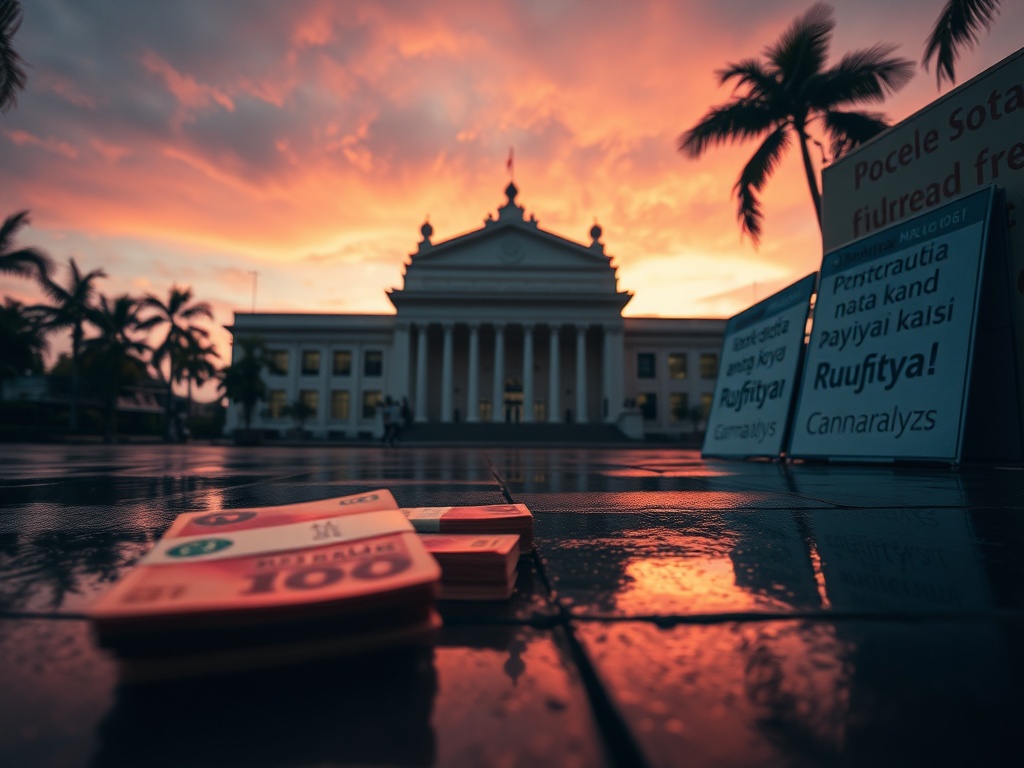
2.7 Billion Rufiyaa Disappeared in One Day
In the span of a single day, 2.7 billion Rufiyaa vanished from public coffers, transferred directly to ruling party MPs and affiliated companies under the guise of development projects. This massive allocation, executed without competitive bidding, has ignited a firestorm of public outrage and exposed what critics describe as a sophisticated system of state capture.
The pattern repeats across multiple sectors: government contracts awarded to companies owned by ruling party figures, bank loans guaranteed for private businesses undertaking government projects, and state-owned enterprises allegedly mobilized for political rallies. The mechanism appears designed to concentrate wealth and power while circumventing accountability.
Financial analysts point to a disturbing arithmetic emerging from this system. When contracts go to dubious companies with political connections, an estimated 30% disappears as kickbacks, another 30% as contractor profits, leaving only 40% for actual project implementation. This systematic drainage ensures that public infrastructure projects remain perpetually underfunded and incomplete while private fortunes grow.
The corruption extends beyond financial transactions to the manipulation of public institutions. Recent legal amendments have formalized the bypassing of standard bidding procedures, creating a legal framework for what was previously considered irregular. Meanwhile, state-owned enterprises have allegedly been repurposed as political mobilization tools, with companies bringing staff to Malé for "trainings" that conveniently coincide with ruling party rallies.
This systemic approach has created parallel economies: one for ordinary citizens struggling with rising costs of living, and another for politically connected elites who can secure islands, guaranteed loans, and no-bid contracts. The distinction between public service and private enrichment has blurred to the point of invisibility.
The public response reflects deep-seated frustration with institutions that appear designed to serve private interests rather than public good. While some hope for gradual reform, others see the system as fundamentally compromised, requiring more radical intervention. What remains undeniable is the erosion of public trust in governance institutions and the growing perception that state resources have become political currency.
As these patterns become more entrenched, the very foundation of democratic accountability faces unprecedented strain. The question confronting the nation is whether this system can be reformed from within or whether it requires a fundamental reimagining of the relationship between political power and economic privilege.
— Source fragments: Multiple tweets alleging 2.7 billion RF diverted to MPs and affiliated companies without bidding; claims about SOEs mobilizing staff for political rallies; assertions about legal amendments enabling contract bypass; allegations of systematic kickbacks and profit-taking from government projects