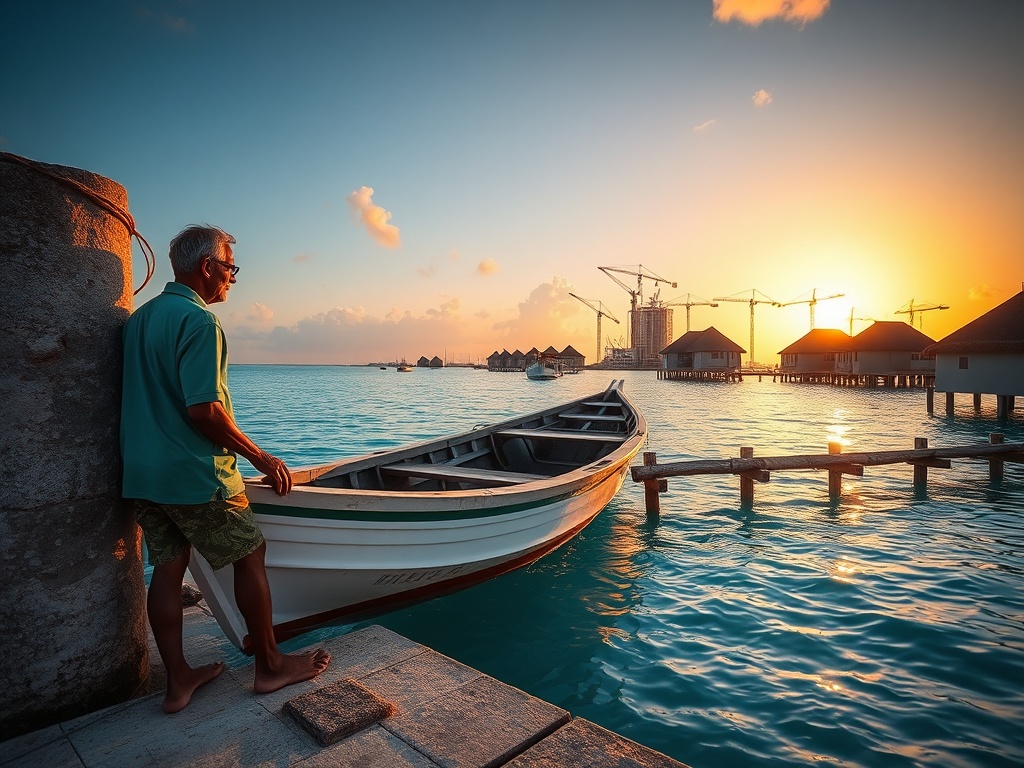
400,000 People, 100,000 Workers, One $5 Billion Question
The conversation unfolding across Maldivian social media reveals a nation at an economic crossroads. With a population of 400,000 supported by a workforce of approximately 100,000 generating a $5 billion economy, the fundamental question isn't whether we can do better—but how.
The tourism sector, responsible for the majority of our foreign exchange earnings, faces scrutiny from those who see it as both safety net and straitjacket. Critics argue that while tourism provides stability, it may also inhibit the bold economic diversification needed for long-term prosperity. Yet the consensus suggests not destruction but evolution—elevating tourism policies to create more visitor-friendly experiences while carefully building new economic pillars.
This tension between preservation and transformation mirrors broader economic anxieties. The discussion around land and housing exemplifies how economic concerns transcend mere property rights. When Male' residents receive land in Hulhumale' only to rent it out while living abroad, it highlights how financial imperatives often override community needs. The observation that "wealth should be made, not distributed for free" captures the frustration with subsidy-driven approaches that may create dependency rather than sustainable prosperity.
Our high cost of living, despite relative wealth compared to neighboring countries, creates a peculiar paradox: we've achieved what many developing nations strive for—minimal homelessness, no slums—yet daily financial pressures prevent citizens from enjoying these achievements. This disconnect between macroeconomic success and individual financial strain demands policy solutions that address both growth and distribution.
The emerging consensus suggests a balanced approach: leveraging tourism's strengths while systematically building alternative sectors. This requires careful calibration of investment ratios across economic domains, recognizing that abrupt shifts could jeopardize the stability that enables experimentation. The challenge isn't choosing between tourism and diversification, but managing the transition in a way that maintains economic security while opening new opportunities.
As artificial intelligence and global economic transformations reshape labor markets worldwide, Maldives must position itself not as a passive observer but as an active participant in the new economic landscape. This means investing in education, infrastructure, and policies that enable our workforce to thrive in emerging sectors while preserving what already works.
The path forward requires acknowledging tourism's vital role while refusing to be limited by it. Our economic future depends on this delicate balance—honoring the industry that built modern Maldives while courageously building what comes next.
— Source fragments: Economic diversification vs tourism preservation debate; Workforce and economic scale analysis; Housing and wealth distribution concerns; Cost of living paradox; Investment ratio considerations