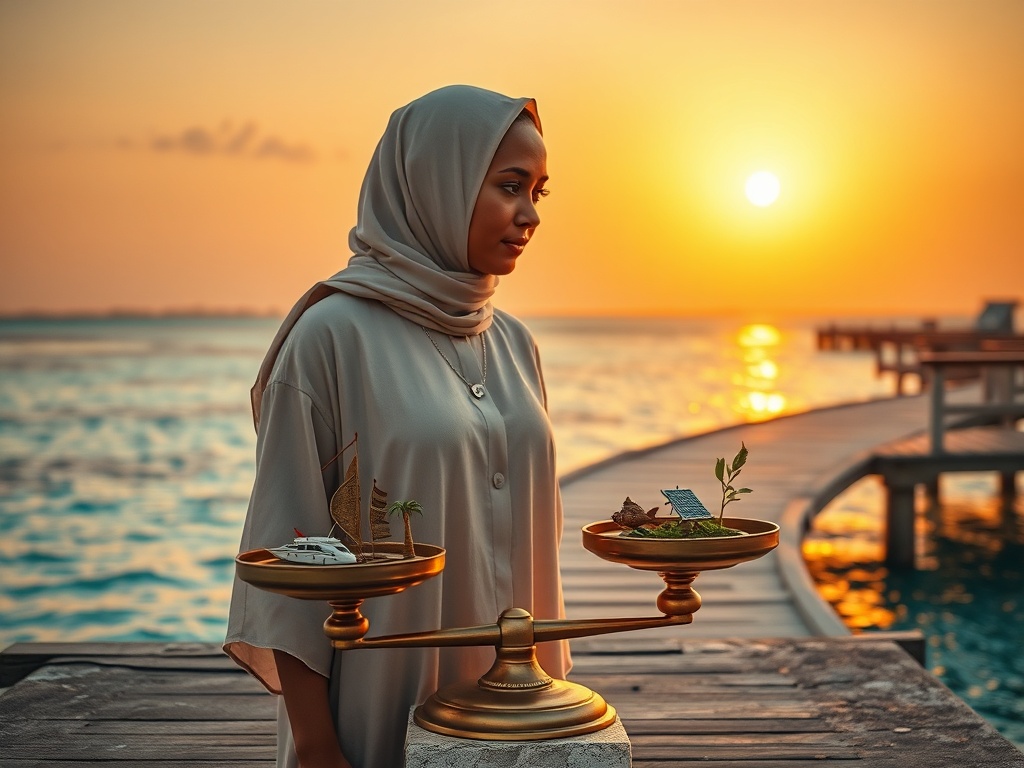
400,000 People, 100,000 Workers, One $5 Billion Question
The conversation unfolding across Maldivian social spaces reveals a nation at an economic crossroads. With a population of 400,000 supported by a workforce of approximately 100,000 people generating a $5 billion economy, the fundamental question isn't whether we should diversify—but how we do so without jeopardizing our economic foundation.
The tourism sector has long been Maldives' economic safety net, contributing significantly to foreign exchange earnings and employment. Yet the persistent concern about putting "all our eggs in one basket" has fueled calls for economic diversification. The critical insight emerging from public discourse is that this isn't an either-or proposition. The real challenge lies in finding the exact ratios of investment across sectors while ensuring tourism continues to thrive.
This economic conversation quickly intersects with pressing social issues. The housing crisis exemplifies how economic policies have tangible human consequences. When Male' residents receive land in Hulhumale' but choose to rent it out while living abroad, it creates a visible inequality that fuels public discontent. The underlying issue isn't land distribution itself, but the financial dynamics it enables—where wealth generation through rental income abroad contrasts sharply with locals struggling with high living costs.
Meanwhile, the workforce dilemma presents another layer of complexity. With 100,000 workers supporting the entire population in a $5 billion economy, questions about fair compensation and wealth distribution become urgent. The sentiment that "wealth should be made, not distributed for free" reflects a growing impatience with handout-based solutions and a desire for sustainable economic participation.
Tourism policy itself faces scrutiny. The recognition that "we really need to focus more on elevating our tourism policies" suggests an awareness that merely maintaining the status quo isn't enough. The industry must evolve to remain competitive while the country explores other economic avenues.
The path forward requires nuanced policymaking that acknowledges tourism's central role while strategically investing in diversification. It demands addressing the housing and cost-of-living crises that prevent Maldivians from fully benefiting from economic growth. Most importantly, it calls for economic strategies that create genuine wealth opportunities rather than relying on redistribution alone.
As one observer noted, the government's challenge is finding those "exact ratios"—the precise balance between nurturing our established industries and courageously exploring new ones. In a nation where economic stability and social welfare are deeply intertwined, getting this balance right isn't just economic policy—it's nation-building.
— Source fragments: Can we diversify Maldives economy by destroying Maldives tourism; tourism is the safety net while we take risks to diversify; I like to believe govt will know that exact ratios to spend on each sector; 100k work force which feeds the rest with 5billion USD economy; The issue revolves around money...ultimately this is about money. Not land; wealth should be made. not distributed for free; we really need to focus more on elevating our tourism policies