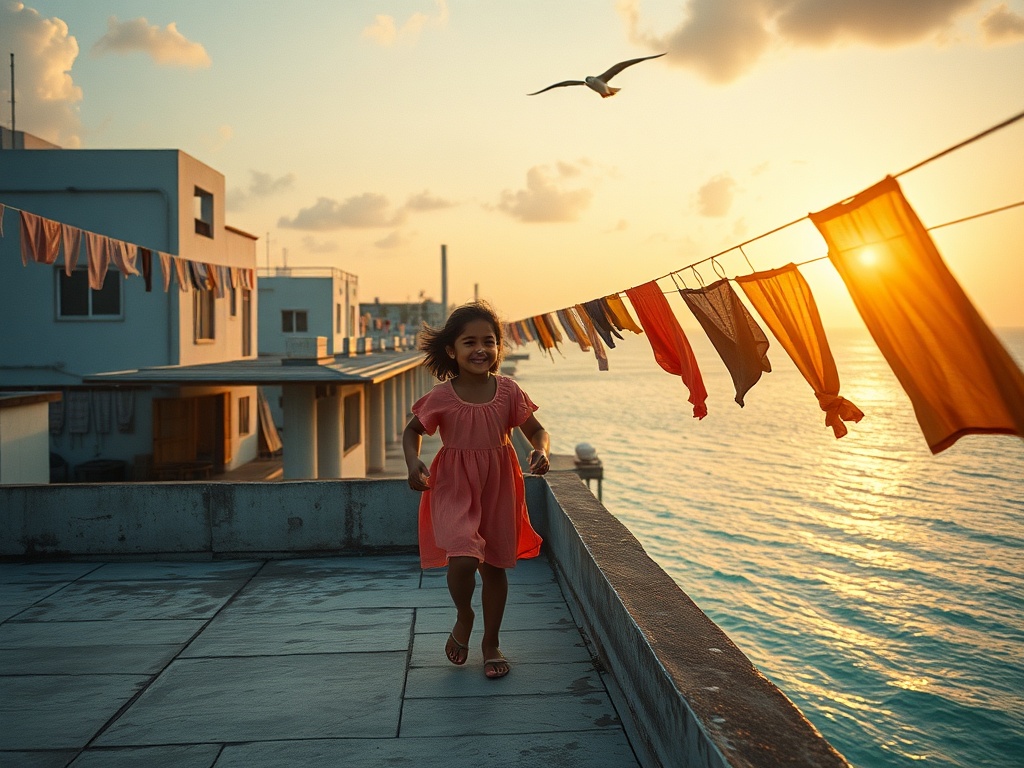
A Father Watches His Daughter Chase Pigeons Between Drying Laundry
The evening call to prayer echoed across the tightly packed buildings of Malé, but Ahmed barely heard it. He stood on the rooftop of his apartment building, watching his seven-year-old daughter Laila chase pigeons between drying laundry. Her laughter, bright and unburdened, felt like a small rebellion against the weight pressing down from all sides.
Below them, the city hummed with the tension of too many lives squeezed into too little space. Ahmed remembered his own childhood on a different island—the wide beaches, the endless horizon. Here, the horizon was a wall of concrete, and the only beach was a memory.
'Baba, when can we have a garden?' Laila had asked yesterday, her small hands gesturing toward the potted basil plant struggling on their balcony.
He thought of the Binveriya Scheme, of friends who'd secured land through connections he didn't have. He remembered Mariya, a woman from his office who owned properties across three atolls yet claimed to understand the common struggle. 'We're all in this together,' she'd said once, while checking her investment portfolio on a phone that cost more than Ahmed's monthly salary.
The system had its own logic, one that respected wealth more than character. Ahmed had seen it in the way his proposals at work were dismissed until repeated by someone with the right family name. He'd felt it in the defensive explanations of those who benefited from the very schemes they claimed to oppose.
His phone buzzed with another message from the parents' group—complaints about the school system, about housing, about the way everything felt rigged against ordinary people. 'What else can we do?' someone had written. The question hung in the salt-tinged air.
Laila came to lean against him, her small body warm against his side. 'Look, Baba,' she said, pointing at a seabird soaring high above the crowded rooftops. 'It's free.'
Ahmed felt the familiar tightening in his chest—the fear that his daughter would inherit not just his love for these islands, but the limitations built into their very foundation. The injustice wasn't just in policies and schemes; it was in the way it made people turn against each other, calling beautiful things ugly because they couldn't bear to see their own reflection.
As the last light faded, painting the minarets gold, Ahmed made a silent promise. He would find a way to give Laila more than just survival. He would give her the truth about this place they called home—the beautiful and the broken, the privileged and the struggling. And maybe, just maybe, her generation would learn to build something new from the uneven ground they'd inherited.
— Source fragments: We must do anything & everything to cease this grave injustice. Otherwise our children & their children will face similar fate as we do; The average Malé and RT meehaa are living in tough conditions; Injustice of the system; this is an unfair clause; All Maldivians should have access to the same levels of wealth; A poor man will never be taken seriously enough, in the Maldives, our people respect wealth and money more than character; Scheme breaches multiple fundamental rights, is discriminatory across a huge swathe of the population, perpetuates historical inequalities