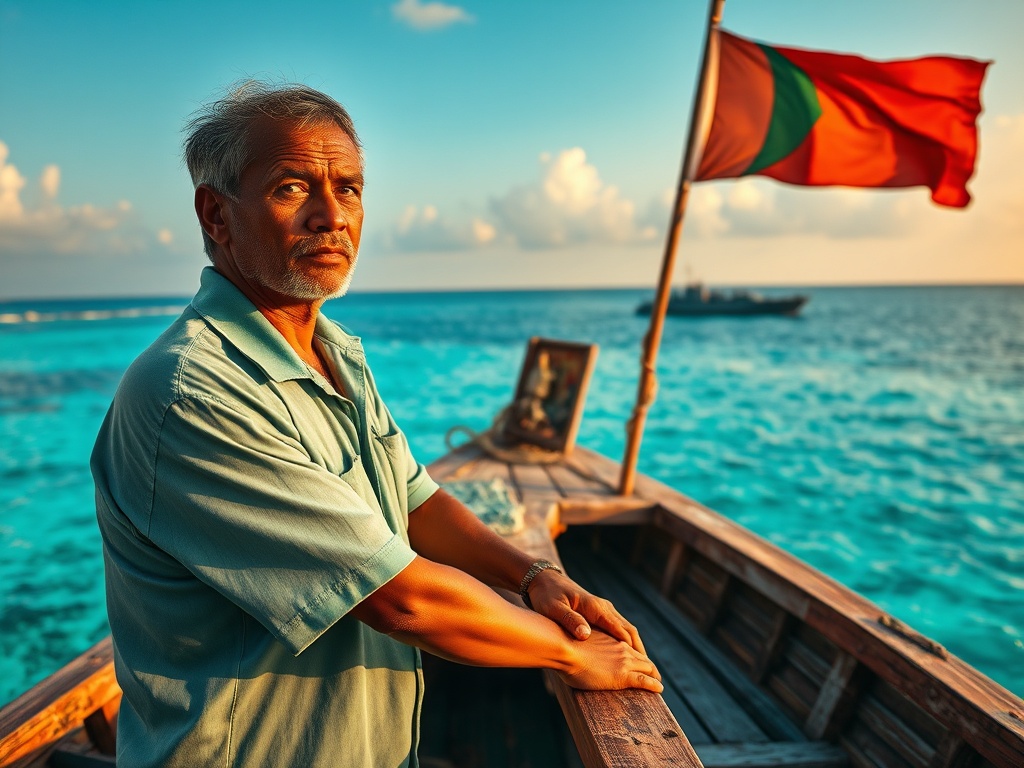
A Fisherman's Horizon and the Warships Beyond It
The conversation unfolding across Maldivian social spaces reveals a nation grappling with the fundamental question of sovereignty in a world where might often makes right. The core tension centers on how a small island nation navigates relationships with regional powers while preserving its autonomy.
The maritime boundary dispute serves as a potent symbol of this struggle. When international recognition of territorial waters becomes negotiable, the very foundation of national sovereignty feels precarious. This isn't merely about nautical miles—it's about whose voice matters in determining a nation's rightful domain.
Maldivians are watching global events with heightened awareness. The pattern seems familiar: powerful nations imposing their will on smaller countries, whether through military threats, economic pressure, or strategic dominance. The examples of Nigeria and Venezuela facing external pressure after asserting resource control resonate deeply here, where economic independence remains an ongoing challenge.
The presence of foreign military forces on Maldivian soil has become a flashpoint in this sovereignty debate. Critics argue that such presence, however framed as mutual cooperation, inherently compromises true independence. The perception isn't necessarily about hostility toward any particular nation, but rather a fundamental discomfort with the power imbalance that foreign military presence represents.
This has sparked discussions about strategic posturing and diplomatic leverage. Some voices advocate for demonstrating capability and resolve—not necessarily confrontation, but clear signals that Maldives cannot be taken for granted. The Singapore-Malaysia dynamic is cited as a relevant parallel, where smaller nations maintain sovereignty through strategic positioning and calculated relationships.
Underlying these strategic calculations is a deeper emotional reality: the fear of becoming collateral damage in larger geopolitical games. The devastation witnessed in Gaza serves as a sobering reminder of what can happen when powerful nations act with impunity. This isn't abstract geopolitics—it's about the very real possibility of Maldivian lives and land becoming bargaining chips.
The conversation reflects a maturing political consciousness that sees beyond simple alliances to examine the complex web of dependencies and vulnerabilities. There's growing recognition that sovereignty isn't just a legal status but an ongoing negotiation—one that requires constant vigilance, strategic thinking, and above all, unity in defining what independence truly means for the Maldives.
As these discussions unfold, they reveal a nation determined to write its own story rather than have it written by others. The challenge lies in balancing practical realities with principled independence, in finding the space where Maldives can stand as an equal in a world that often treats small nations as afterthoughts.
— Source fragments: Maritime boundaries recognition, foreign military presence concerns, strategic posturing discussions, observations about global power dynamics affecting smaller nations, sovereignty anxieties