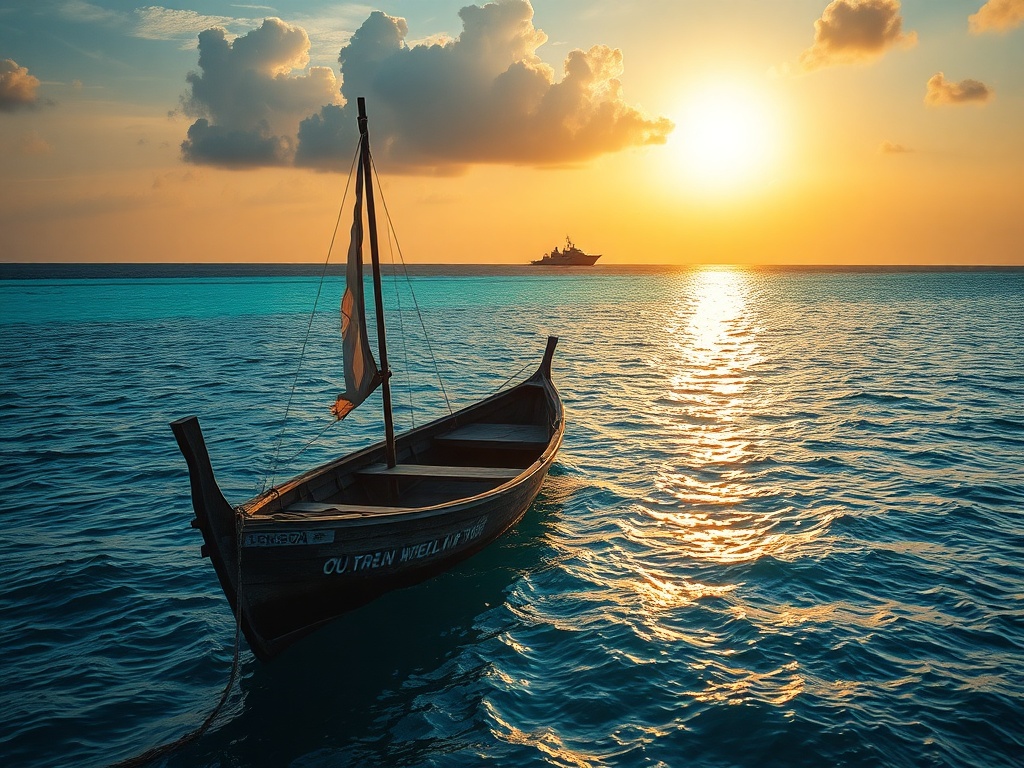
A Fishing Boat Watching Distant Warships on Our Horizon
The conversation unfolding across Maldivian social media and coffee shops reveals a nation grappling with its place in a shifting global order. The fundamental question echoes through these discussions: what does true sovereignty mean when your territorial waters extend 200 miles but are recognized by others as only 12? This discrepancy strikes at the heart of national identity for an island nation whose existence is defined by the ocean that surrounds it.
The debate has intensified around foreign military presence, particularly the Indian troops stationed in the Maldives. Critics argue this undermines genuine sovereignty, creating what some describe as an "occupied" feeling despite formal independence. The discussion has shifted toward examining how small nations can assert themselves without provoking conflict. Some voices advocate for strategic posturing—demonstrating military capability through drone flyovers and missile tests near disputed areas—as necessary signaling to larger neighbors.
Parallel conversations draw connections to global power dynamics, where the United States threatens Nigeria and Venezuela over resource nationalization and policy independence. The pattern appears familiar: when smaller nations assert control over their resources or align with alternative powers, they face pressure from established global players. This resonates deeply in the Maldives, where economic sovereignty remains fragile amid heavy import reliance and foreign currency shortages.
The Chagos archipelago precedent looms large in these discussions—a reminder that decolonization narratives can mask strategic interests, leaving smaller voices unheard in international forums. This historical context fuels contemporary anxiety about whether Maldivian interests might be similarly sidelined in broader geopolitical calculations.
Yet beneath the strategic debates lies a deeper cultural concern: the erosion of national confidence. Some observers note a troubling pattern where internal governance challenges—from corruption to inefficient public sectors—undermine the moral authority needed to assert sovereignty externally. The conversation has evolved to recognize that true independence requires both external assertiveness and internal reform.
As these discussions continue, they reflect a nation maturing in its geopolitical awareness, moving beyond simple binary positions to more nuanced understandings of how small states navigate between competing powers while preserving their identity and interests.
— Source fragments: cannot. they don't recognize our 200 miles. they only recognize 12 mile from shore; This is what our people need to understand. Although we think we are sovereign, India doesn't see us like that; We need to do something for them to realize we are not happy with their presence; The UN called it decolonization. Britain called it defense strategy. Maldives was never called at all; USA is threatening Nigeria and Venezuela. 2 Independent countries