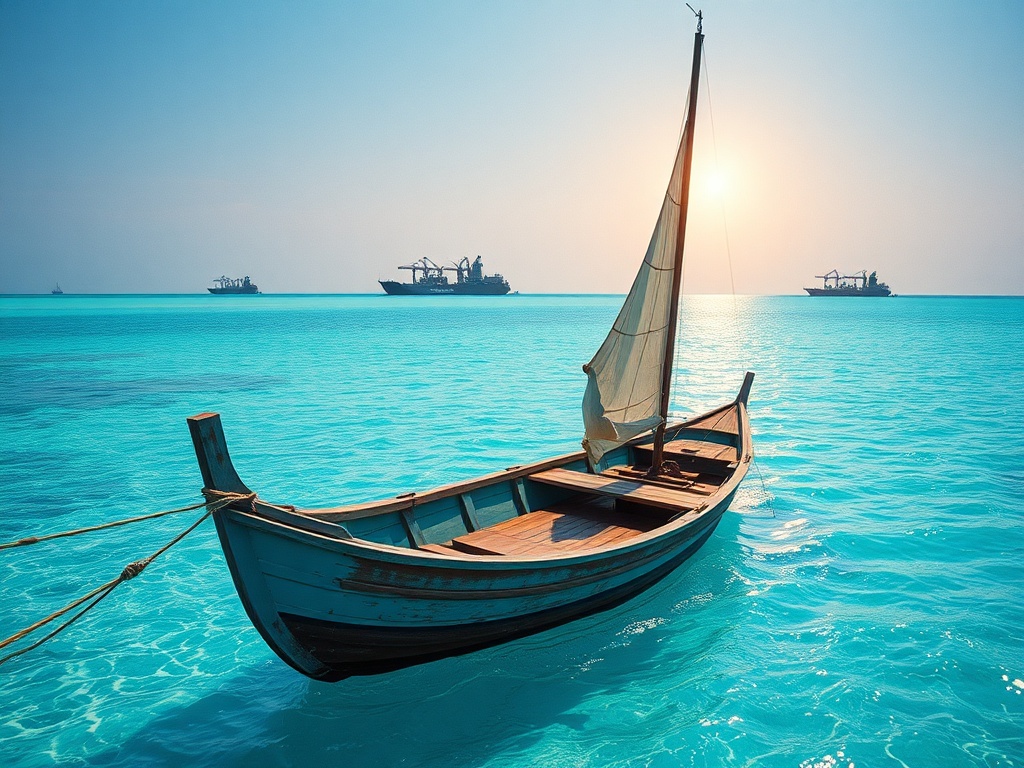
A Maldivian Dhoni Sails Past the World's Container Ships
In the grand theater of international relations, small states have always faced a fundamental paradox: how to maintain sovereignty while navigating the competing interests of global powers. Recent global conversations reveal this tension playing out across multiple fronts, from strategic alliances to technological competition.
The discussion around Singapore's military spending highlights a recurring theme—the strategic calculus of small states operating in vital geopolitical locations. Like Singapore guarding the Malacca Strait, the Maldives occupies a strategically significant position in the Indian Ocean. This geography brings both opportunity and vulnerability, forcing careful navigation between competing powers seeking influence in critical maritime routes.
Diplomacy becomes the primary tool for survival, evolving from 'pure' to 'applied' forms that mix principle with pragmatic necessity. The reference to 'applied diplomacy' captures the essential reality for small states: theoretical ideals must be adapted to practical realities. This mirrors the Maldives' own delicate balancing act between regional powers, where maintaining relationships requires constant calibration.
The conversation about Nigeria and Venezuela illustrates how resource wealth and size create different leverage points in international affairs. For smaller nations without such natural advantages, the challenge intensifies. They must rely on strategic positioning, international law, and alliance-building to amplify their voice on the global stage.
Technological shifts add another layer of complexity. The emergence of AI and advanced manufacturing as new frontiers of geopolitical competition suggests that power is no longer measured solely by traditional military might. Small states must now consider how technological sovereignty fits into their strategic planning.
Perhaps most revealing is the contrast drawn between immigrant nations and indigenous communities. The Maldives' identity as a small island community with deep-rooted traditions creates a different foundation for statehood than countries built on successive waves of immigration. This cultural distinctiveness informs how Maldivians perceive sovereignty and engagement with the wider world.
As the Universal Periodic Review process examines countries including the Maldives, these global conversations about power, diplomacy, and sovereignty become immediately relevant. The question isn't whether small states will engage with global powers, but how they can do so while preserving their unique identity and interests in an increasingly interconnected world.
— Source fragments: Singapore spends a lot on their military because it's a Western client state that's strategically located in a strait; Yes diplomacy. Maybe that time we used pure diplomacy. This time we may have to use applied diplomacy; Fair, but Nigeria and Venezuela are countries far bigger than Maldives and with enough resources; All China has to do to finish the US as a global power, at this stage, is to come up with a new and advanced AI platform; America was built on immigration. It literally defines their civic identity. The Maldives is a small island community that built its own statehood and traditions