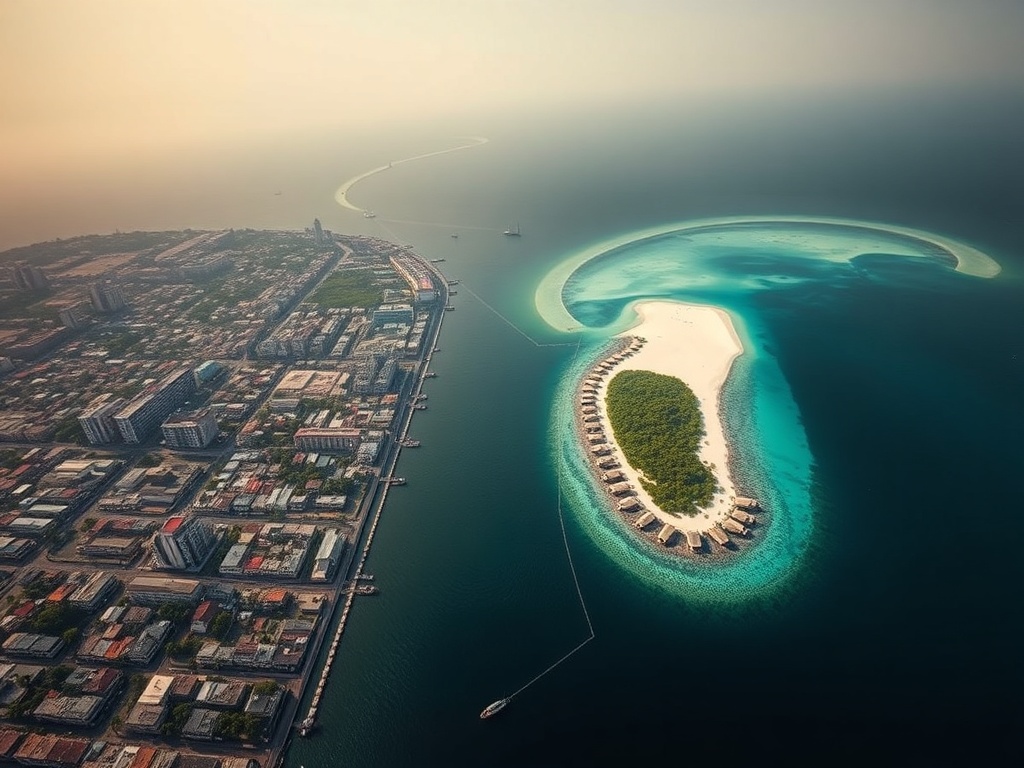
A Malé Birthright: Free Land Worth Millions
The story of modern Maldives is often told from the center—a narrative of Malé’s ascendancy. Yet, this story omits a crucial counter-narrative: one of deliberate extraction and systemic suffocation. For generations, the economic dynamism of the Maldives pulsed not from its crowded capital but from the southern atolls of Addu and Huvadhu. These regions were self-sufficient, populous, and culturally distinct hubs of maritime trade, their commercial lifelines stretching to Colombo and Galle long before Malé established its dominance.
World War II presented Malé’s ruling elite with a pivotal opportunity. The conflict disrupted traditional trade routes and allowed the central government to consolidate control, systematically redirecting the south’s economic flows northward. This was not an organic shift but a calculated political maneuver. The post-war era cemented this process, designing a political economy where Malé operates as a parasitic core, its growth predicated on the continuous extraction of resources, talent, and revenue from the periphery. The result is a cancerous urbanization—Malé, swollen and congested—while the islands that once powered the archipelago struggle for breath.
This structural violence manifests in daily life through a pervasive culture of geographic discrimination. A citizen’s value is routinely assessed not by merit but by the island on their identity card. It reduces complex human identities to simplistic labels, fostering an ‘us versus them’ mentality that politicians have long exploited. The most glaring evidence of this institutionalized bias is in housing policy. A citizen born in Malé is rewarded with free land worth millions, a birthright subsidy. Meanwhile, a resident from another atoll, having paid taxes and rent in the capital for 15 years, is offered a leasehold flat at a cost of millions. This is state-sanctioned apartheid based on birthplace.
Such normalized injustice explains historical ruptures like the formation of the short-lived Suvadive republic. It was not an act of treason but a desperate act of self-preservation against an extractive and dismissive center. The deep-seated resentment this created simmers in today’s political discourse, in anonymous online battles, and in the quiet decisions of families to conceal their origins.
The path forward demands a fundamental re-imagining of the Maldivian state. Thriving again requires decentralizing power, resources, and opportunity. It means dismantling the policy architecture that treats every island outside Malé as a colony to be managed and mined. True equality, as guaranteed by the Constitution, must move from parchment to practice. It requires Malé’s elites to recognize that the nation’s future cannot be hostage to one island’s insatiable appetite. The soul of the Maldives lies not in its congested core, but in the ability of all its islands to breathe, build, and prosper on their own terms.
— Source fragments: Economic jealousy of Malé towards Southern merchants; WWII as a turning point for centralization; Southern prosperity and self-sufficiency; Need for decentralization; Malé as a 'cancerous core' built on extraction; Identity-based discrimination via island labeling; Constitutional guarantee of equality vs. reality of second-class citizenship; Explicit birth-based discrimination in housing/land policy (Malé ID vs. RT); Historical justification for Suvadive formation as resistance to Malé elites; Normalization of discrimination and xenophobia; Notion of 'reshuffling' population owed to Addu due to its revenue contribution.