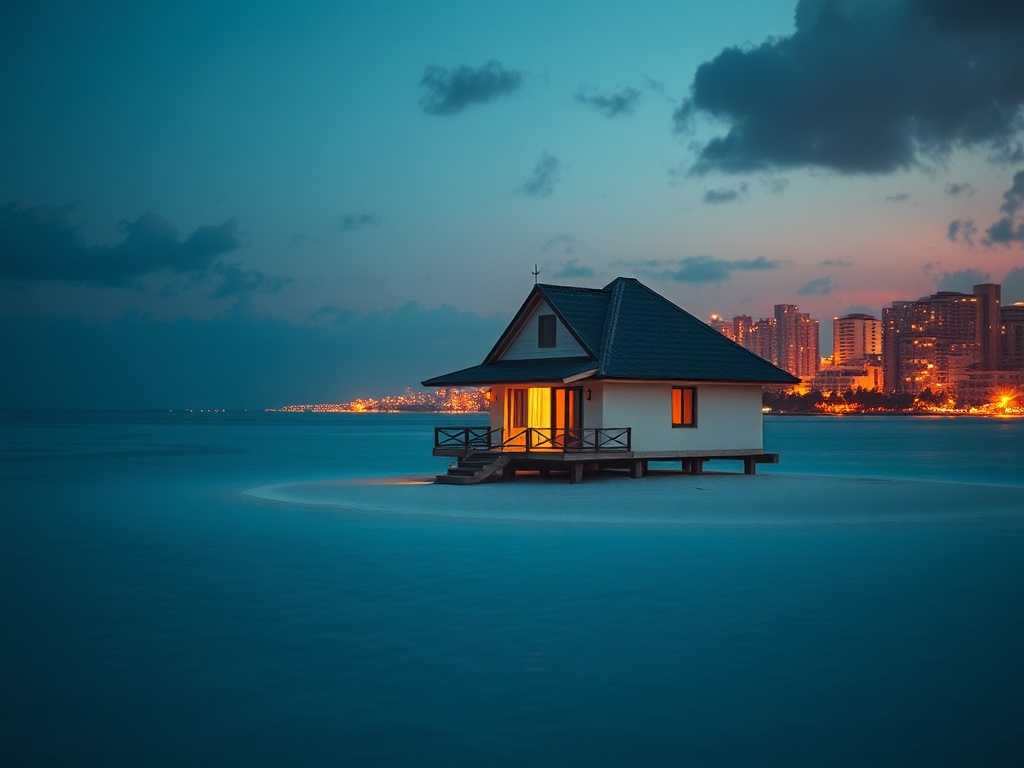
A Registered Space in Malé Versus an Island Home Alone
In the crowded heart of the Maldives, a quiet revolution in thinking is taking root. The traditional narrative of island development—where every citizen deserves spacious homes in their ancestral islands—is being challenged by a pragmatic reality: a small registered space in Malé with full access to services may be more valuable than a palace on a resource-starved outer island.
The debate cuts to the core of national planning. With Malé physically unable to expand further, the logical progression suggests developing other regions and encouraging migration. Yet this overlooks a fundamental truth about what constitutes quality of life. The argument emerging isn't about luxury versus poverty, but about access versus isolation.
Consider the mathematics of modern living: a three-by-three meter registered space in the capital provides what a sprawling island home cannot—immediate access to healthcare, education, employment opportunities, and social infrastructure. These are the premium services built collectively through national investment, and their concentration in Malé creates an undeniable gravitational pull.
Meanwhile, outer island residents face a different calculation. Even those with substantial homes confront the reality of limited medical facilities, educational constraints, and economic opportunities. The Taj Mahal comparison isn't hyperbole—it represents the fundamental mismatch between physical space and functional living. A beautiful home becomes merely a beautiful prison when basic services remain hours away by sea or air.
This isn't merely about individual choice but about national resource allocation. The concentration of services in Malé, while problematic, reflects the economic reality of serving a dispersed population. Developing parallel infrastructure across 187 inhabited islands represents a staggering financial challenge that may never provide equivalent service quality.
The emerging consensus suggests a recalibration of development priorities. Rather than pretending all locations offer equal opportunity, honest assessment acknowledges the trade-offs: urban density brings resource access, while rural spaciousness often means service deprivation. The solution may lie not in resisting this reality but in managing it better—ensuring that those who choose outer island life receive adequate support, while urban residents accept density as the price of proximity.
In the end, the debate reveals a nation grappling with its geographical destiny. The future may require accepting that for many Maldivians, a registered concrete box in the capital represents not deprivation but opportunity—a difficult truth that could reshape national development policy for generations.
— Source fragments: Male have no more land anyway, the only way forward is development of other regions and moving there; Every Male' person will have a place to call home, even if it's a 3 x 3 box. But they also have access to all the premium services; It doesn't matter if you have Taj Mahal back in your island when there are no resources