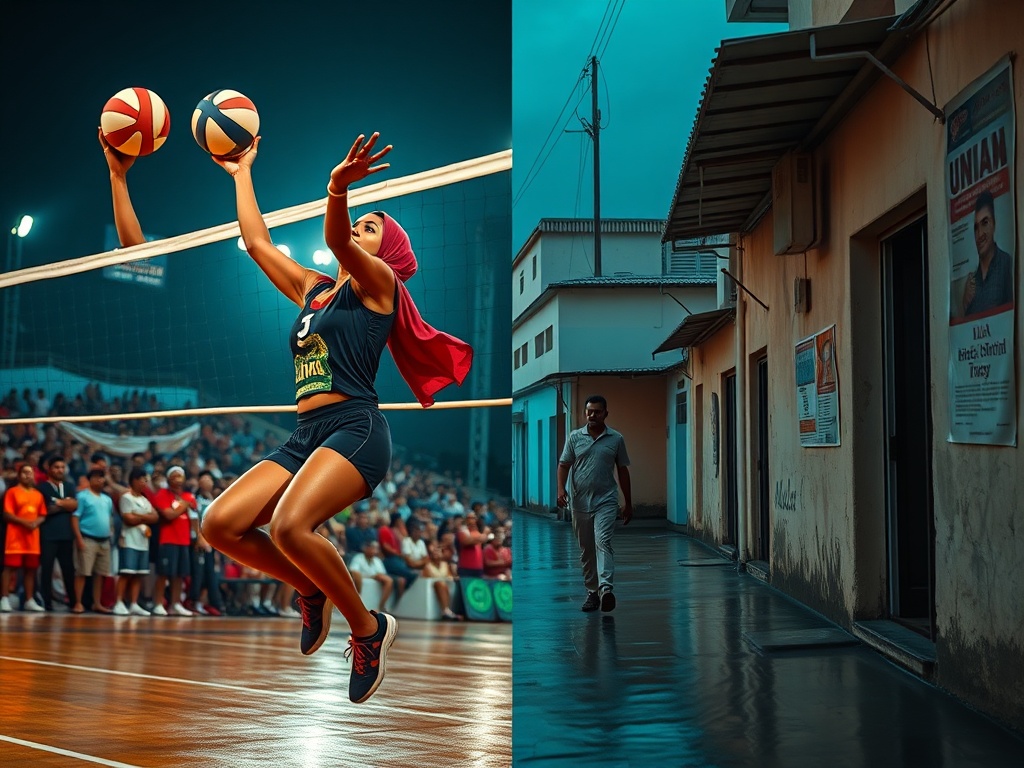
A Subsidized Flat, Leased from Singapore, Sits Empty in Malé
In the early hours of a Malé morning, the scent of salt and diesel hangs heavy over the congested streets. A young woman scrolls through her phone, her screen split between two worlds. On one side, a jubilant feed celebrates the historic victory of the Maldives women's volleyball team at the 2025 CAVA Cup. On the other, a cascade of messages details the day's grim calculus: the price of rice, the queue for the clinic, the rent due on a flat subleased from an absentee leaseholder in Singapore. This is the contemporary Maldivian condition—a society living in a state of profound duality. The nation produces world-class athletes, whose determination mirrors a deeper, unyielding national spirit. Yet, that same spirit is daily tested by systems engineered to fail it. The victory was a fleeting, powerful reminder of what is possible when collective effort is channeled toward a clear goal. It stood in stark contrast to the opaque goals of governance. Corruption is the architecture of daily life. It manifests in the housing blocks that rise skyward, not as homes for the needy, but as political currency. Subsidized flats, meant to alleviate the suffocating congestion of the capital, become assets in a shadow economy, leased by those living abroad to those desperate enough to pay a premium. The government's ledger shows a tenant; the reality is an empty unit and a middleman's profit. This is the institutionalized betrayal of a social contract. Meanwhile, the economic engine sputters. Tourism revenue flows in but is quickly siphoned off—parked in foreign accounts by resort owners, or drained through expatriate remittances. The Maldivian Rufiyaa is perpetually thirsty for the US dollar, a thirst that drives up the cost of every imported staple. The national conversation oscillates between the celebratory—a tasty fruit plucked from a childhood tree near Aminiya School—and the desperate—a plea for someone to simply listen, to engage in the collaborative problem-solving that feels absent from the halls of power. There is a palpable yearning for competence, for the clean efficiency symbolized by a privately-funded stadium development abroad. The observation that some projects can be built without a government subsidy resonates here as a longing for a system where things simply work. Instead, the public sector bloats with political appointees, while the judiciary's independence erodes. The nation's youth navigate this landscape. Some find solace in global digital communities. Others face the more immediate demons of unemployment and disillusionment. The path forward is obscured by the walls of nepotism, debt, and political consolidation. To be Maldivian today is to hold these contradictions in balance: immense pride in identity and potential, coupled with a deep, fatiguing frustration at the machinery that hampers it. The volleyball team's triumph was a brilliant flash of what we are. The enduring challenge is to build a society that reflects that victory in the dignified quality of everyday life.
— Source fragments: Maldives CAVA Cup victory; childhood memory of eating fruit near Aminiya School; Dhivehi phrase 'ކޮށް ކޮށް kuriya nudhevuneema'; commentary on corruption, housing, economy, and governance from context.