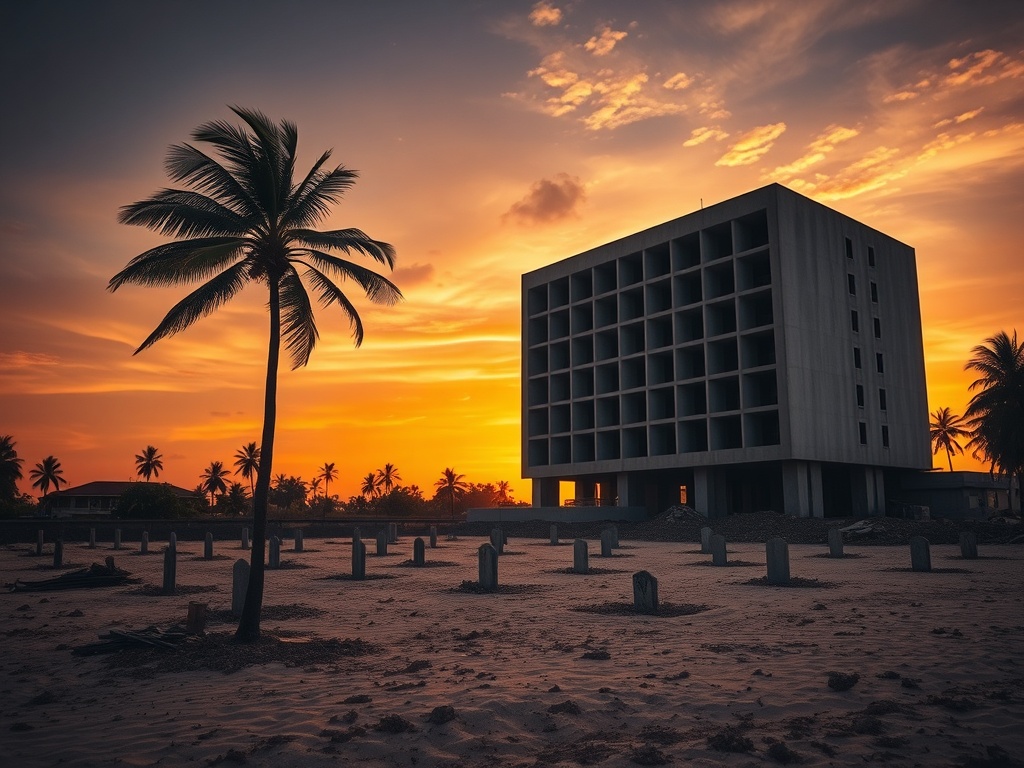
A Tree Watching Graves Disappear Under Concrete
The tree stood as a silent witness, its roots tangled deep in soil that held generations of memory. Before it rose a rectangular intruder—not just concrete and steel, but a symbol of something more profound. The debate over development versus preservation has become a central tension in the Maldivian consciousness, where every construction project carries the weight of history.
Across the islands, similar conflicts play out daily. The conversion of sacred burial grounds into public parks represents more than urban planning—it represents a severing of ancestral ties. Graves that once marked the final resting places of relatives now lie beneath playgrounds and pathways, their sanctity replaced by utility. The emotional response to these transformations speaks to a deeper cultural anxiety about what we preserve and what we sacrifice in the name of progress.
The controversy extends beyond physical spaces into the realm of identity. The academic discourse surrounding Maldivian origins often feels disconnected from lived experience, with indigenous perspectives frequently marginalized in favor of external narratives. This creates a double displacement—both physical and cultural—where development projects can feel like another form of erasure.
Yet the conversation is rarely simple. The need for public spaces, housing, and infrastructure in increasingly crowded islands creates legitimate pressures that cannot be ignored. The challenge lies in finding balance—acknowledging the practical necessities of modernization while respecting the spiritual and historical connections that give communities their character.
What emerges from these conflicts is a broader question about Maldivian identity in an era of rapid change. How do we honor our ancestors while building for our descendants? The tension between concrete and tradition, between development and preservation, reflects a society grappling with its own transformation. The tree and the building, the grave and the park—these are not just physical opposites but symbolic poles in a national conversation about who we are and what we value.
The emotional intensity surrounding these issues suggests they touch something fundamental in the Maldivian psyche. It's not merely about land use but about continuity, memory, and the invisible threads that connect a people to their past. As the islands continue to evolve, these conversations will likely grow more urgent, demanding solutions that acknowledge both the practical needs of the present and the sacred obligations to those who came before.
— Source fragments: Her roots run deep... ancestral grounds... rectangular belligerent... erase our history and geography for concrete... desecration of graves... respect the dead... indigenous studies... lose our identity