Addu Fishimathi reclamation 90% complete, no plan yet for reclaimed land: Ministry
The reclamation of the 'Mulekede Fishimathi' area in Addu Hithadhoo is 90% complete, but the Ministry of Infrastructure said today that no development plan has yet been prepared for the reclaimed land.
The reclamation has been opposed by environmental protection organisations because the area contains sensitive natural habitats. According to the article, the Fishimathi area is an important nursery where species such as small fish, crabs and dingaa thrive, and is considered a buffer zone for the safety of the Addu Nature Park. Environmental groups have said the reclamation will cause major damage to the mangrove and wetland system and will have an unavoidable impact on the Addu Nature Park.
The organisations sent a letter to President Mohamed Muizzu asking that the project be stopped, and also submitted a plan on how the area could be developed instead of reclaimed. They also asked the People's Majlis to stop the reclamation.
The government decided to reclaim the area after some residents of Hithadhoo submitted a petition requesting that the link road be widened to make travel easier from the Mulekede area to the northern part of the island, and that problems such as the bad smell from the area be resolved.
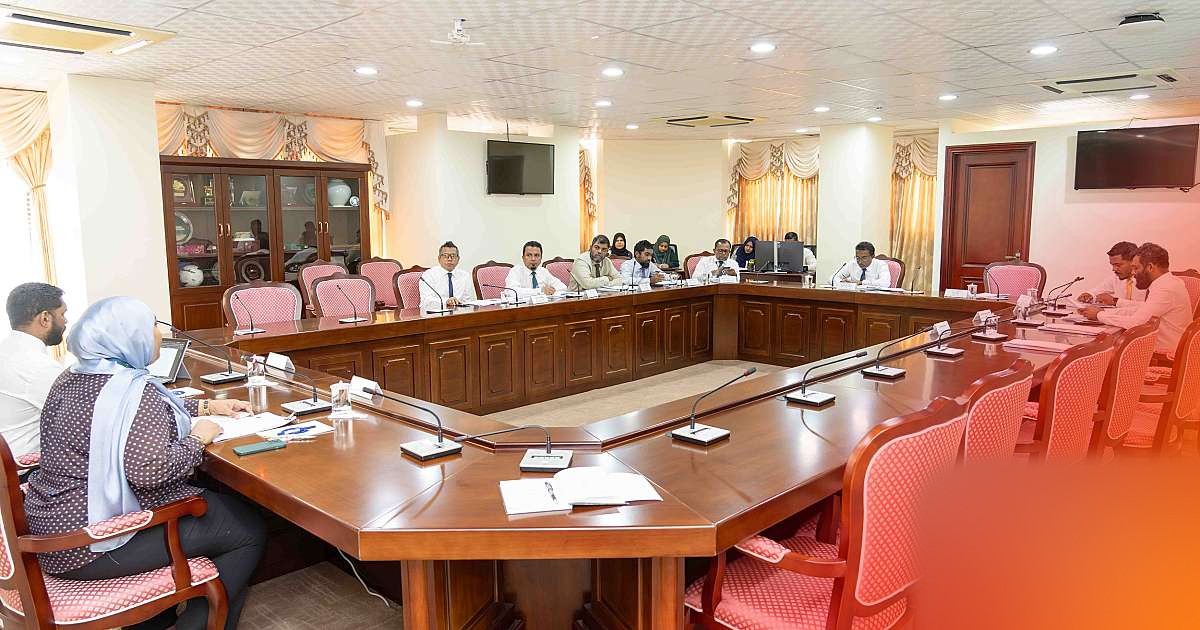
The Environment and Climate Change Committee, which is studying the matter, clarified information today with relevant parties from the Ministry of Infrastructure present.
Principal Structural Engineer Asraraa, who participated on behalf of the Ministry of Infrastructure, said the reclamation is being carried out in two phases, that 90% of the first phase has been completed, and that work on the second phase will begin before the 30th of this month. After that, additional works will begin, including shoreline protection under the EIA and establishing a buffer zone for the mangrove.
"Then there is still no development plan regarding the reclaimed area that has been prepared. That is the current update," Asraraa said.
The 'Environment Project' organisation, in its letter to the President, said the only way to resolve problems such as the bad smell is to develop the area without reclaiming it, and proposed in the EIA report attached to the letter that a bridge be built so the Fishimathi area can be crossed without damage to the environment. The organisation said that even if the area is reclaimed, the land shortage problem faced by Hithadhoo and the bad smell problem will not be resolved, and that the project makes it very likely that waste will be disposed of illegally and the area will become dirty.
At today's meeting, members asked whether any solution has been brought for the difficulties faced by residents due to saltwater intrusion, which is among the purposes of reclaiming the area, and whether any study has been conducted on the extent to which the desired results can be achieved when reclaiming an area that includes such important natural species. They also asked about the Ministry's thinking on carrying out the work without removing trees that do not absolutely need to be removed, given that large trees in the mangrove will be significantly affected when the second phase works are carried out. Members noted that there is no scientific study showing that such large trees would have the opportunity to grow if removed and relocated elsewhere.
Some members also expressed concern that the road being reclaimed through the area is where buses on the link road will drop off passengers, and that when the reclamation is completed the road will connect to a narrower road than the one it previously connected to.
"What I am saying is that in the future too, when such things are done, the relevant technical persons should conduct studies and give advice to those of us who are formulating policies in such matters. It is your responsibility to give advice to those who are formulating policies when bringing changes by reclaiming and building on such sensitive areas where such living things exist," said Abdullah Sodiq, the member for Hithadhoo North constituency.
Asraraa also agreed at today's meeting that even if the area is reclaimed, the waste problem will become worse and the bad smell problems will not be fully resolved. He said the biggest complaint when the reclamation was decided was the bad smell from the area, and that the biggest impact is on the parties living there. He said that although the matter will not be fully resolved by the reclamation, some solutions will be received by residents due to the buffer zone being built.
"Whether a very big complaint of the parties living in that area is known, that is, matters such as the bad smell from the area and waste dumping. I do not know in any way that reclaiming land will resolve this problem. Even if land is reclaimed, if waste is dumped in the area and those matters are not looked after, the problem will remain exactly the same," Asraraa said.
"Now we will have built a small buffer zone. That will be between the area where people live and the show line. I believe that at least that safety will be there. At least the problem is receiving some solution to some extent."
Asraraa said he believes that due to the buffer zone the species of the area will improve further, the problems faced due to waste becoming worse will receive some solution to some extent, and the way the area will look in the future will also become beautiful.
He also noted that the situation of saltwater intrusion will be looked at after the entire work is completed, that work will be done to look at the condition of the mangrove and the information will be shared later as it is not yet available, and that a consultant could be appointed to study the damage the mangrove may suffer. Regarding concerns about removing the large kadhu trees currently in the area, he said that if those trees do not absolutely need to be removed, he will look into whether there is a way to carry out the work without removing them.