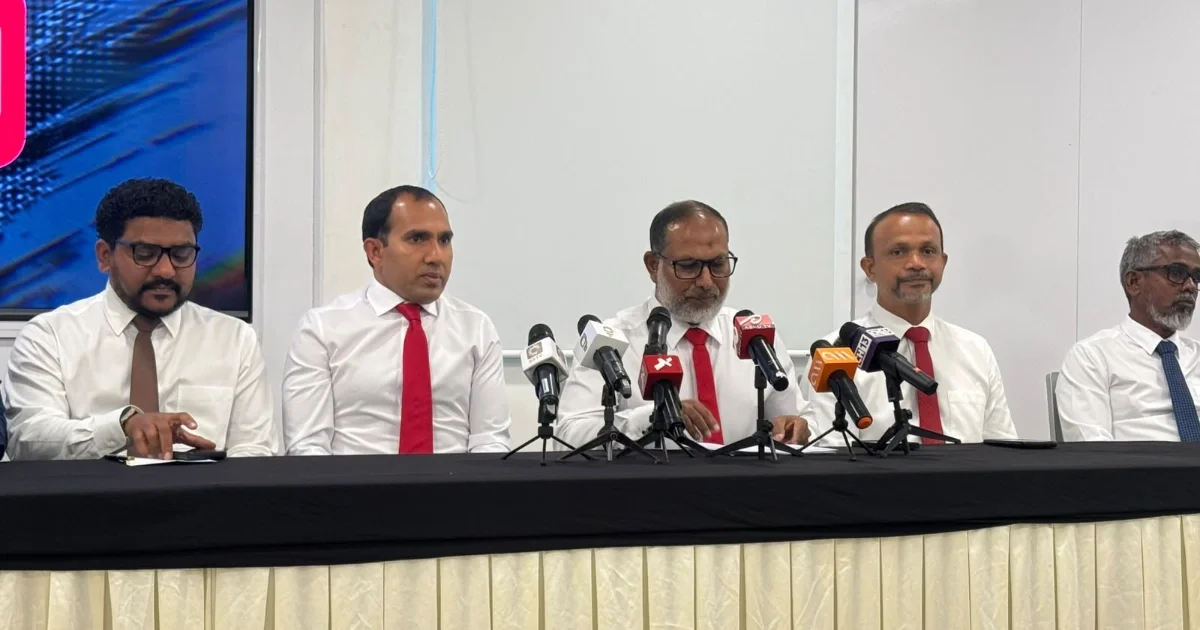
Adhaalath Party Backs Calls to Halt Ras Malé Over Religious Unity Concerns
The Adhaalath Party has welcomed calls to halt projects that would create separate areas in the Maldives where foreigners can reside for long periods, a demand also backed by the movement formed to oppose the sale of Ras Malé.
In a post on X, Ali Hussain, former member for the Kendhoo constituency and a leading figure in the 'Dhivehinna Dhivehinna' movement, welcomed the Adhaalath Party for speaking out on behalf of religion and the nation.
'To fully support the call made to speak out in defense of religion and the nation even amid fear, and to not proceed with the Ras Malé project in a way that harms the Maldives' safety and religious unity,' Ali Hussain's post read.
The commercial terms for the sale of the 500-hectare Eagal Hills of Ras Malé, being built by reclaiming Fushidhiggarufalhu with state funds, were signed on September 21. The government is currently making final preparations to sign the permanent agreement for the project.
The Adhaalath Party has expressed concern that under the Ras Malé project, separate areas would be created where foreigners can reside for long periods, and that this could endanger the Maldives' religious unity and safety. The party requested the government not to proceed with the project in a way that allows foreign settlement, and instead to develop facilities such as holiday homes.
One of the concerns of many Maldivians is that the Maldives is opening the way for foreigners to settle. While many religious scholars have also been raising their voices against this, in a statement issued by the Adhaalath Party last night, it did not name the Ras Malé project directly but called on the government not to proceed with it in the way it is currently being carried out.
'If projects are carried out in a way that creates separate areas where foreign parties live for long periods, the Adhaalath Party believes that this would compromise the Maldives' religious unity, public interest, Maldivian culture, and the Maldives' safety and security. Therefore, we request the government not to proceed with any project in this manner,' the party's short statement said.
The statement said changes need to be brought to the policies used in carrying out international real estate projects in the Maldives. Instead of building places for foreign parties to live permanently or for long periods, such projects should be aimed at developing facilities such as holiday homes used by foreign parties for vacations, the party believes. The statement also said that arranging projects on such a principle would protect against damages that could be caused to the Maldives' social fabric.
As preparations are underway to hold a large gathering on Friday to raise voices against the sale of Ras Malé, it has not yet been disclosed whether the Adhaalath Party will participate. However, it has been revealed that former President Abdulla Yameen Abdul Gayoom and some individuals included in the leadership of the opposition MDP will participate in that gathering.
At a time when voices against the sale of Ras Malé are growing louder, the government last Monday submitted four bills to the Parliament to establish the legal framework needed to proceed with the Ras Malé project.
In the real estate bill submitted to facilitate the Ras Malé project, while it is stipulated that the longest period land can be leased to foreign parties under the Constitution is 99 years, that protection is bypassed through a 'surrender and re-grant' model so that leases can be extended indefinitely. Therefore, foreigners will get the opportunity to settle in that city.
Article 89 of that bill states that the leasehold of apartments and properties in the special zone can be sold to foreigners for 99 years. And when a foreigner buys a place from the master developer, what they get is not the remaining period of the previous lease. Instead, when the previous lease is surrendered to the government, the authority must issue a new 99-year lease directly to the purchasing party. According to Article 78 (a) of the bill, even if the master developer's term ends, the lease issued in that manner will continue.
Under this model, foreigners who buy are given full authority to resell the property to other parties and to mortgage it to banks. Therefore, this is seen as an arrangement brought to abolish the protections of the Constitution and create a way for land to be owned by foreigners permanently or without expiry.