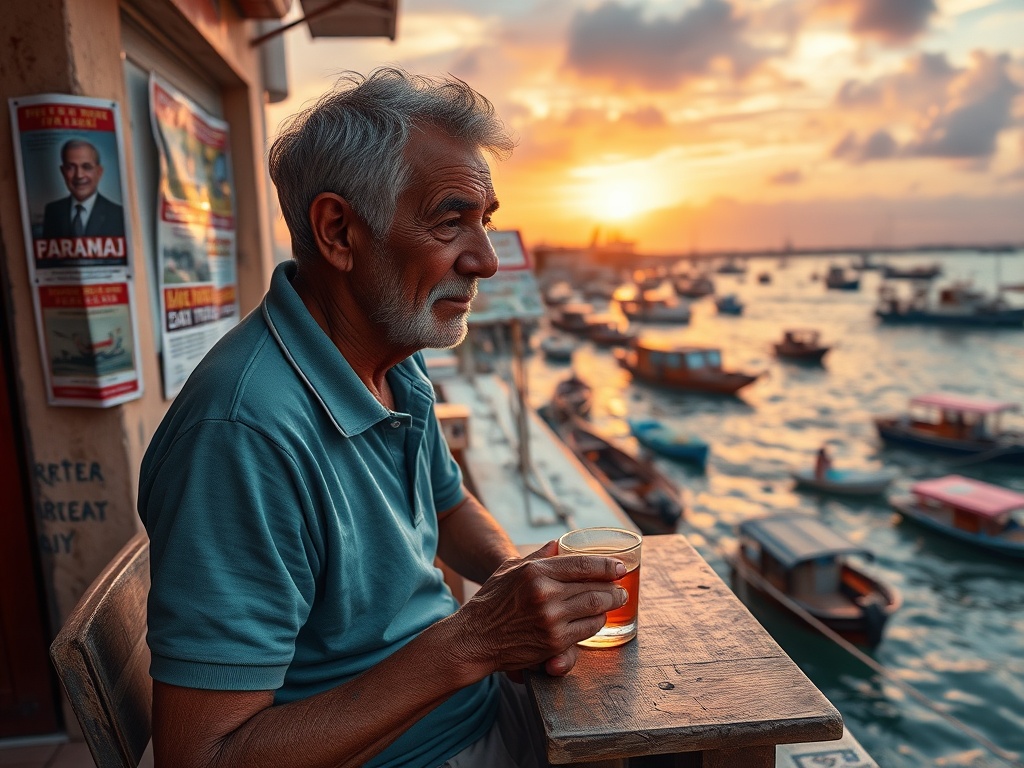
Afternoon Prayer, Political Posters, and the View from the Teashop
The afternoon call to prayer echoed across the crowded buildings of Malé, the sound competing with the distant hum of speedboats crossing the harbor. From his usual spot at the teashop overlooking the sea, Ahmed watched the political posters flutter in the ocean breeze—some new, some faded, all promising something different.
He remembered the conversation from last night, the passionate voices arguing about leadership. 'I am old school,' one man had declared, stirring his sweet milk tea. 'I love the concept of philosopher king.' The words had lingered with Ahmed through the night, like the scent of salt and diesel that perpetually hung over the city.
This morning, he watched as another political rally gathered momentum near the fish market. The candidate's voice boomed through speakers, promising change, promising strength. But Ahmed thought of the philosopher king ideal—the ruler who governs with wisdom rather than power, who steers not by force but by understanding.
He remembered his grandfather, a humble fisherman who could read the ocean's moods better than any weather forecast. 'A good captain doesn't fight the waves,' the old man would say, his hands rough from years of handling ropes and nets. 'He understands them, works with them.'
Now, looking at the political landscape, Ahmed saw too many captains trying to command the sea itself. The posters promised everything—lower prices, better housing, solutions to the drug problem that haunted the youth. But the boats still struggled in rough weather, and the houses in Malé grew more crowded by the day.
A group of young men nearby discussed the latest political developments, their voices a mix of hope and cynicism. 'Many things have to be right for a candidate to become president,' one said, echoing Ahmed's own thoughts. It wasn't just about elections or party affiliations; it was about something deeper, something more fundamental to how a society functions.
Ahmed thought about the concept of following the law—not as a restriction, but as the currents that guide all ships safely to harbor. When everyone follows the same rules, from the smallest fishing boat to the largest cargo vessel, the sea becomes predictable, navigable.
The sun dipped lower, painting the white buildings in golden light. The political rally was dispersing, the crowd scattering like leaves in the wind. Ahmed finished his tea, the ceramic cup warm in his hands. He thought about what would replace the nation state, as one young intellectual had mused. Perhaps something smaller, more intimate—like the island communities that had existed long before modern politics, where everyone knew their neighbors and leaders were chosen for their wisdom, not their wealth.
As he stood to leave, the evening breeze carried the scent of the sea—clean, constant, unchanged by the political winds that swept through the islands. The philosopher king might be an ancient ideal, but the need for wise leadership felt more urgent than ever in these crowded, complicated times.
— Source fragments: "I love the concept of philosopher king. Not weakened vassal ruler who can't steer the boat in rough weather", "Disagree. reducing power of the ruler is not the solution. solution is for everyone to follow the law", "Actually many many things have to right for a candidate to become a president", "I think we're arriving to the answer of this question: 'nation states replaced empires. what will replace nation states?'"