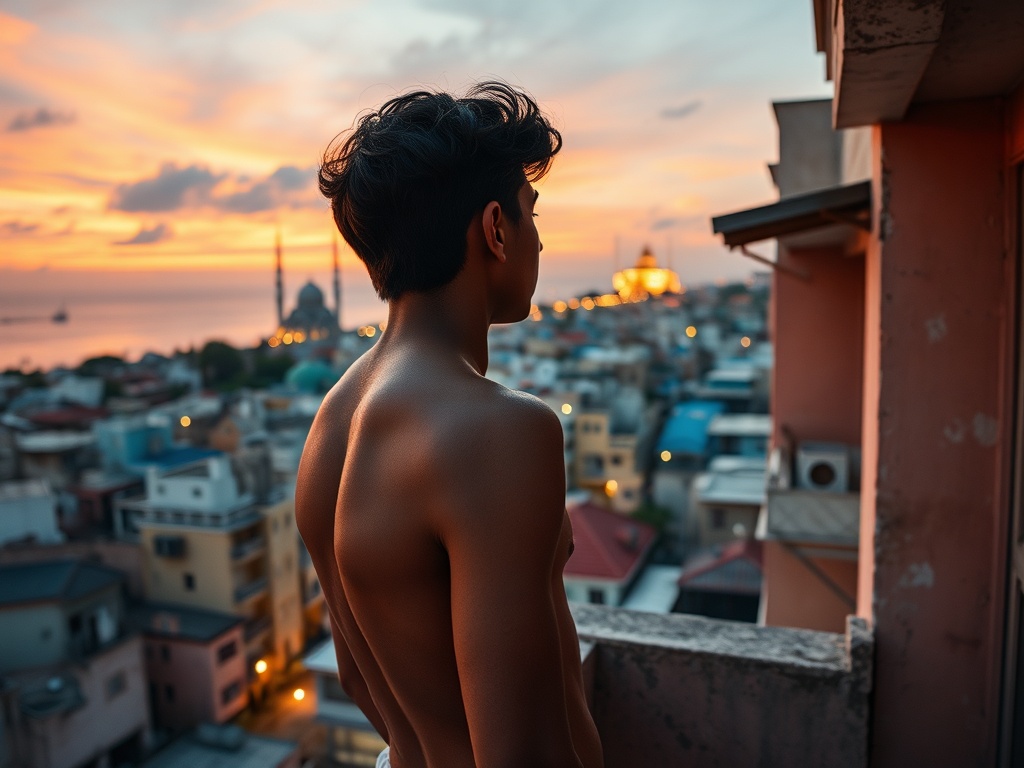
Ahmed on the Balcony as Malé Answers the Call to Prayer
The call to prayer echoed across the tin roofs of Malé, a sound as familiar as the salt in the air. Ahmed stood on his narrow balcony, watching the evening light paint the Indian Ocean in shades of gold and violet. Below, the city moved with the rhythm of devotion, but in his chest, a different rhythm played—one of quiet uncertainty.
He remembered his grandmother's hands, worn from years of mending fishing nets, always moving in prayer. "Wala Hawla Wala Quwwata Illa Billah," she would whisper during storms, her faith as solid as the coral stone walls of their ancestral home. That certainty felt like another country to him now, one he could visit but no longer inhabit.
Social media had opened windows to other worlds, other ways of thinking. He'd watched friends become atheists almost as a fashion, then champion causes they barely understood. He'd seen the same fervor that once defended faith now directed at political movements, the same absolute certainty in different packaging.
At the university, during astronomy class, his professor had explained the Big Bang theory. Ahmed had felt something shift inside him—not a rejection of faith, but an expansion of wonder. Could the Quran's creation story and scientific theory be different languages describing the same miracle? The question felt dangerous, like walking on reef edges at low tide.
He thought of his cousin, recently arrested for religious activities the state deemed extreme. The family whispered about poison and purity, about Allah's will. Ahmed wondered about the space between devotion and dogma, between faith and freedom.
Later, walking through the crowded streets, he noticed a woman adjusting her hijab, her eyes holding a story he would never know. He thought about the laws that defined their nation—100% Muslim, no citizenship for others. He wondered about the believers who risked everything for their faith, and the doubters who risked everything for their questions.
The sea breeze carried the scent of salt and diesel. Fishing boats rocked in the harbor, their lights beginning to twinkle like distant stars. Ahmed realized that faith, like the ocean, was both boundary and horizon—something that could confine or carry you, depending on how you learned to navigate it.
He didn't have answers, only the deepening understanding that in a nation defined by certainty, the most courageous act might be to embrace uncertainty—to hold both faith and questions in the same heart, like holding seawater and moonlight in cupped hands.
— Source fragments: Religious devotion, social media influence on beliefs, tension between faith and scientific understanding, Maldivian religious identity, personal spiritual questioning