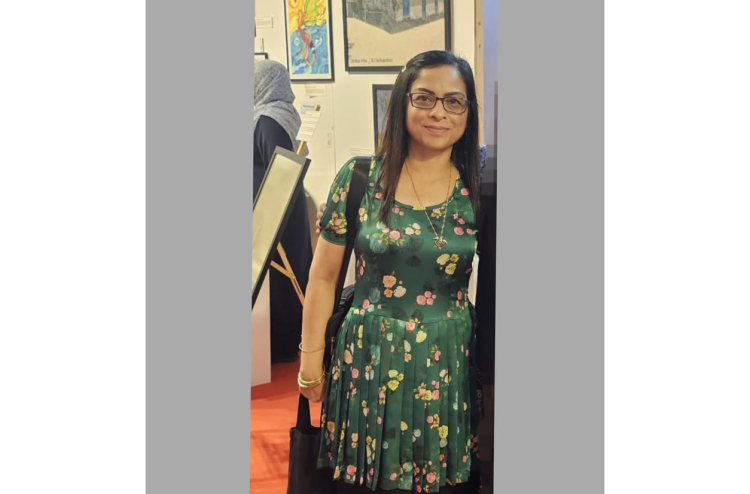
Aminath Muna Keeps Maldivian Culture Alive, One Dress at a Time
Aminath Muna is rarely seen in anything other than Maldivian cultural dress, a sight that is uncommon in the Maldives. Whether at official functions or simply walking down the street, she greets the world in traditional Maldivian attire, drawing the eyes of many because of her distinctive style. In a country where cultural dress is usually reserved for special occasions, Muna's everyday commitment has become a notable exception amid complaints that Maldivian cultural practices are being eroded.
According to Muna, she began wearing cultural dress after an invitation from the Dhivehi Language Academy to travel to India's capital in 2019. On the trip to New Delhi in October that year with a team active in Dhivehi language and poetry, the then President of the Dhivehi Language Academy, Ashraf Ali, requested that she wear cultural dress as she was representing the Maldives. At the time, Muna, who used to wear jeans and a top, did not own a dress that fell into the cultural category. She prepared for the trip by obtaining about four dresses, including long dresses, short dresses and libaas.
"While preparing for that trip, it just came to mind that I should switch to this dress. The women of both sides of the family always wore Maldivian cultural dress. In doing all matters of their lives, they wore long dress," Muna said.
When Muna's mother left her native island of GA. Maamendhoo and moved to Malé, she commonly wore a kasabu libaas. But at that time, as women in Malé commonly wore long dress, her mother also switched to that dress. "My mother passed away when I was very small. Then the other women also wore long dress. They spent the whole day in that dress; in doing all matters, the dress they wore was that. So Muna also came to be, in their memory and in their honour, to switch to it. That is how this courage came to mind," Muna explained.
After the trip, she returned to Malé and began collecting different types of cultural dresses. During Covid and the lockdown, she began sewing kandiki and short dresses. But as many days passed without sewing, it took two or three days to cut the short dress and kandiki, which she later handed over to people to complete. Muna said she has long dress, libaas and short dress in her possession, but as most are kandiki and short dress, she is commonly seen in that attire. As it is kept very jarried, she wears kasabu libaas for special functions.
"To other people this is a costume put on for a function. But to me this is the dress I put on every day. In this wardrobe there will not be jeans and a top," said Muna, who is also active in MDP political affairs.
Muna believes that because she is in cultural dress, it will not become a new scene for Maldivians, and she thought people would know she is Maldivian without further introduction. But that too was a wrong assumption. Even at airports, when a foreigner is assumed and the first conversation is held, it is in English. "When I answer in Dhivehi, they ask whether this one is a Maldivian. Then I say this one is a Maldivian — isn't this one here in Maldivian dress."
Muna said she is very surprised that even in Maldivian dress, because it is not known that she is Maldivian and because people look, she draws attention. But she was disappointed by the answer given to a question asked in connection with the matter. "When I asked someone nearby, they said that in the Maldivian community a Maldivian wearing Maldivian cultural dress will not be present; it is foreigners who are mostly present. That is why it is not known. Then one group said it is different from a foreigner," Muna said. "Even when I went to my grandfather's island after very many years, people asked what is this thing I am wearing. To them that matter became a shock. A cultural shock. It also does not come to mind that it could be otherwise. That group could be shocked at that group's culture."
As her family members live in England, she also travels to that country from time to time. Some people there, finding the dresses beautiful, ask questions about them. "To them it looks very beautiful, and especially the kasabu Maldivian libaas. Even when stopping at a train station with many people, or when meeting on the street, this English person will ask, this is such a beautiful dress. Then from that point began the stories of Maldives," Muna said.
Muna said that even though Maldivians commonly do not wear cultural dress, they have love for that culture. She believes everyone can, at their own level, do something so that this culture is not killed but kept in the world. At the very least, it is good to keep in one's possession a Maldivian dress of some kind, so that when a special occasion comes, there will be no difficulty in wearing a dress from there. Muna said that although at one time she wore dress according to fashion trends and grew up in that style, she now believes she can serve Maldivian culture in her own capacity. To her, the earliest style is still the most beautiful, rather than modernised cultural dresses.
"I believe that in my own capacity I am doing something to keep Maldives' culture alive. Very few — as many as can be counted on the fingers — people may be out there wearing short dress and kandiki having become hardened. But I did not begin wearing dress in this way because people asked nearby, or whether they find it beautiful or hardened," Muna said. "Now, apart from long dress at special functions, I am very happy that I wear different types of cultural dress. Even when commonly being like this, whether it is a man or a woman, when seen in cultural dress I am just very happy."
What Muna is showing us is that Maldivian culture is something that can be kept alive. However much some people look with awe and however much they are surprised, what is important to her is giving priority to culture.