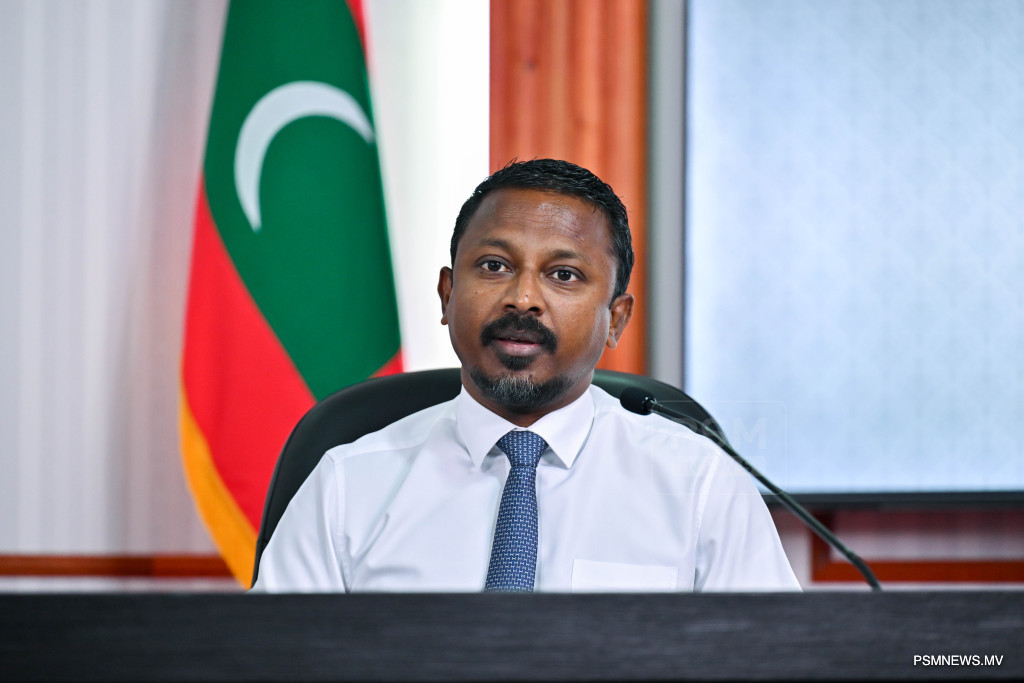
Attorney General Defends Eagle Hills Project Amid Allegations of Unlawful Land Sale
Attorney General Ahmed Usham has affirmed that the Maldivian government will strictly adhere to legal frameworks and the Constitution in the implementation of the Eagle Hills project in Rasmalé, dismissing claims that the development involves the illegal sale of land to a foreign entity.
Responding to allegations shared on social media, the Attorney General clarified the government's position regarding the USD 20 billion waterfront and marina development. On September 21, the government and Abu Dhabi-based developer Eagle Hills signed an agreement to lease 500 hectares of land in Rasmalé for a period of 99 years. This arrangement has drawn criticism from opposition figures who argue that such a long-term lease effectively constitutes an unlawful sale of national territory.
To provide context, Ahmed Usham detailed the evolution of Maldivian tourism laws. He noted that when the first tourism law was introduced in 1999, resorts could only be leased for 25 years. This limit was extended to 50 years in 2010, and subsequently to 99 years in 2015. He highlighted that under Article 8 of the current tourism law, the government is required to compensate investors for the depreciated value of their investments once a 99-year lease expires.
Regarding the specific legal standing of the Rasmalé project, the Attorney General explained that the development will be governed by a real estate law currently being drafted. He emphasized that the parties have currently only signed a Letter of Intent and a Commercial Terms Agreement, which serve as a foundation for future negotiations.
Usham further clarified that the project cannot proceed without the passage of relevant legislation by the Majlis (the Maldivian Parliament). He reassured the public that all subsequent agreements and implementation steps would be conducted in full compliance with the laws of the Maldives, ensuring that no constitutional violations occur during the realization of the massive infrastructure project.