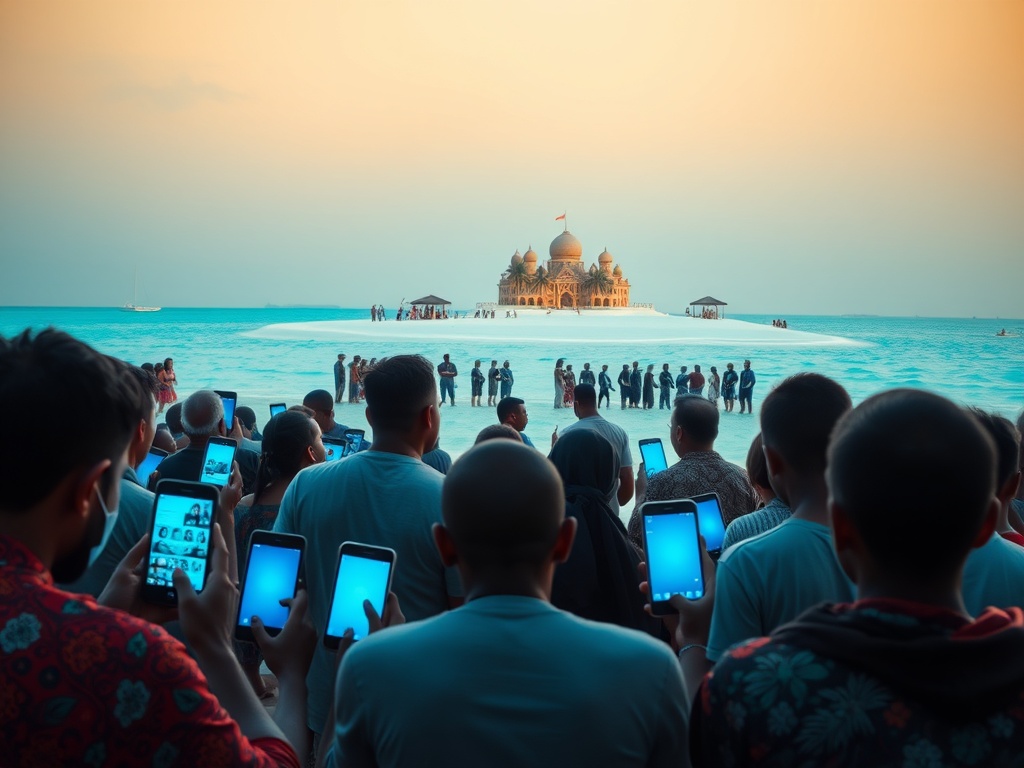
Between Digital Debates and Island Meetings, a Nation Divides
In the digital squares of Maldivian political discourse, a familiar tension emerges—the space between policy and personality, between online activism and offline realities. The conversation reflects a nation wrestling with its political identity amid deepening divisions.
The debate often circles back to representation: the mathematical reality of 76 lawmakers representing island communities versus 17 from Malé creates inherent tension in parliamentary dynamics. This geographical divide mirrors ideological ones, where constituents increasingly demand accountability from their representatives through direct communication, yet wonder whether such engagement translates to meaningful change.
What emerges is a political landscape where labels lose meaning. "Centrist? Socialist?" The questions hang in the digital air, met with both confusion and introspection. Some advocate for progressive economic policies—land redistribution, universal basic income, employment guarantees—while rejecting ideological categorization. This reflects a broader Maldivian tendency to prioritize practical solutions over political branding.
The ruling party understands something crucial: online vocalism doesn't necessarily correlate with offline critical mass. They've learned from international examples—the candidate who misread his base, the campaign that failed to translate digital enthusiasm into physical ballots. In Maldives, this awareness shapes political strategy, with parties carefully measuring the pulse beyond social media metrics.
Meanwhile, the conversation reveals an important distinction: many participants emphasize their willingness to condemn wrongdoing regardless of political affiliation, positioning themselves against what they perceive as partisan blindness. This suggests an emerging political maturity, though one constantly tested by the heat of debate.
The fundamental challenge remains: on certain issues, the country appears permanently divided. The recognition that some debates may never reach consensus pushes the conversation toward practical solutions rather than ideological victory. This pragmatic turn represents perhaps the most promising development in Maldivian political discourse—the acknowledgment that progress requires working across divides rather than conquering them.
As these digital conversations continue, they reveal a political culture in transition—one still grappling with its identity but increasingly aware that the solutions to Maldives' challenges require bridging the gap between online rhetoric and on-island reality, between political labels and practical governance.
— Source fragments: Good that you realized you have crossed the line between policy and persons; I am sure we have 76 lawmakers representing islanders to 17 Male' Law makers; They are counting on the off line critical mass. The online crowd is vocal online. it doesn't correlate with offline reality; i am CENTRIST?!!?!?!???????????????????????; I don't call myself a socialist but I have been tweeting about giving away land, giving ubi, giving job as a right; It's an issue where the country will always be divided on. We have to accept that fact. Find other solutions