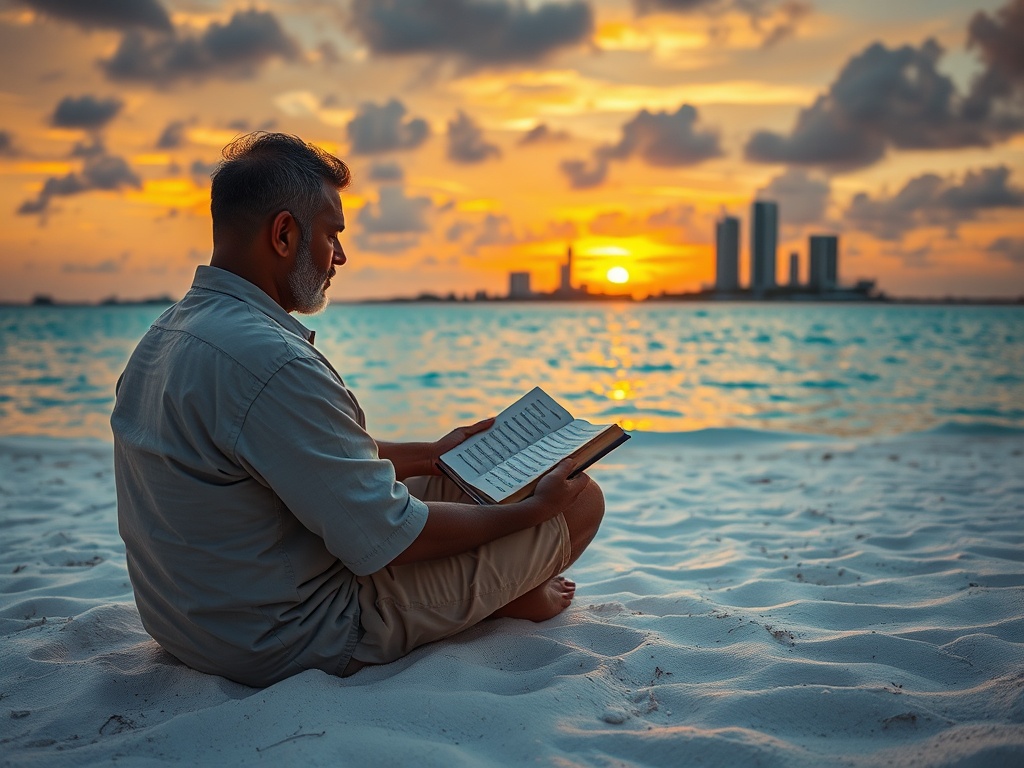
Between Malé's Mosques and Cafés, the Quran Meets Modern Science
In the quiet courtyards of Malé's mosques and the bustling cafés where Maldivian youth gather, a conversation unfolds that echoes through Muslim communities worldwide. It's a dialogue about faith, science, and the delicate balance between religious certainty and intellectual curiosity.
The debate often centers on whether scientific theories like the Big Bang must seek validation from the Quran, or whether the Quran stands as the absolute standard against which all theories must be measured. This tension between religious authority and scientific inquiry reflects deeper questions about how Muslim societies navigate modernity while preserving religious identity.
In the Maldivian context, where Islam forms the bedrock of national identity, these discussions carry particular weight. The Quran's description of creation—"Do not the Unbelievers see that the heavens and the earth were joined together before We clove them asunder?" (21:30)—has long been interpreted by some scholars as anticipating the Big Bang theory. Yet others caution against what they see as stretching religious understanding to validate scientific propositions that operate on entirely different premises.
The concern, as voiced in these conversations, is that scientific theories often claim neutrality about divine causation—saying "I don't know or care who did this"—while Islamic tradition emphasizes Allah as the primary cause of all creation. This fundamental difference in perspective creates what some see as an unbridgeable gap between scientific methodology and religious worldview.
Yet within this debate lies a spectrum of approaches. Some Maldivians advocate for viewing science and religion as separate domains of knowledge, each with its own methods and purposes. Others seek harmony, finding in scientific discoveries evidence that reinforces their faith rather than challenges it.
The discussion extends beyond cosmological theories to questions of human origins, where the Quran's account of Adam's creation from dust contrasts with evolutionary narratives. Here too, Maldivians navigate between literal interpretation and metaphorical understanding, between religious certainty and intellectual humility.
What emerges from these conversations is not a simple binary of conflict or compatibility, but a complex negotiation of identity in a globalized world. As Maldivian society contends with rapid modernization, economic pressures, and cultural change, these theological debates reflect larger questions about how to maintain religious authenticity while engaging with contemporary knowledge systems.
Ultimately, the conversation reveals a community grappling with timeless questions in new contexts, seeking a path that honors both faith and reason, tradition and progress, in a nation where Islam remains the foundation of individual and collective identity.
— Source fragments: Discussions about Quran not contradicting Big Bang Theory, debates about whether scientific theories need validation from Quran, concerns about stretching religious understanding to validate scientific theories, mentions of Quran as absolute standard