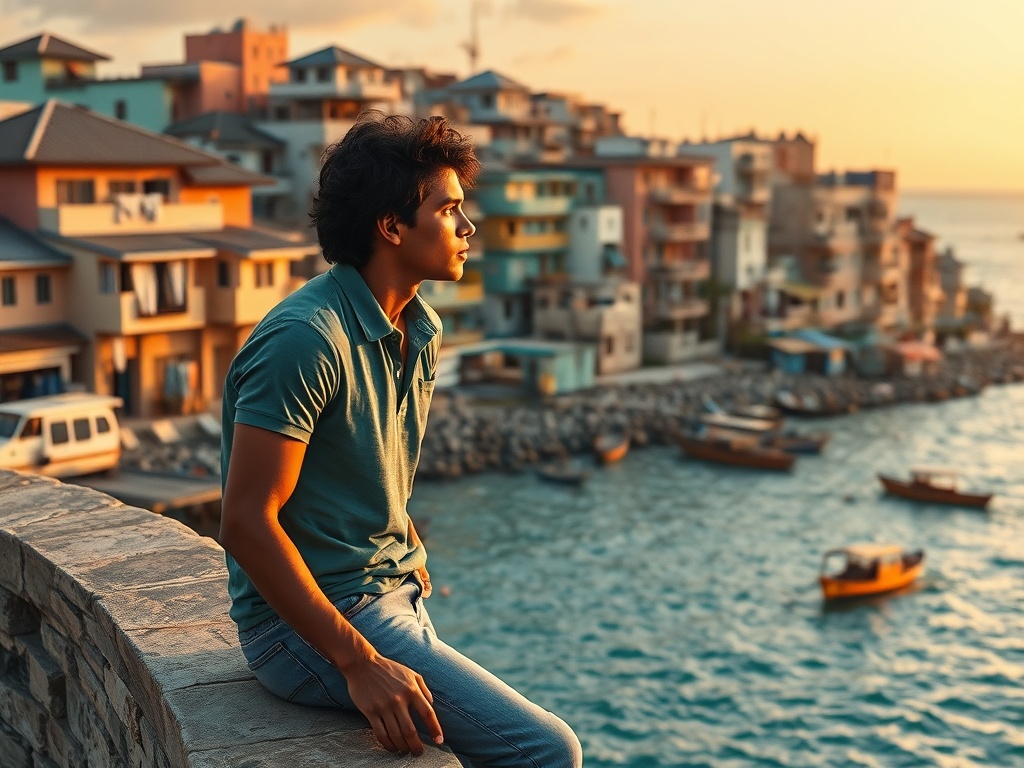
Between the Minaret and the Sea: A Young Maldivian's Dreams Adrift
The call to prayer echoed through the narrow streets of Malé, but Adam barely heard it. He was staring at his phone screen, at another job application rejection. 'We regret to inform you...' The words blurred as the afternoon heat pressed against his skin like a damp cloth.
From his family's cramped apartment, he could see the sea—that constant blue presence that both defined and confined their island existence. His father had been a fisherman, but the old man's boat now sat rotting at the harbor, a casualty of changing times and foreign competition. 'The sea gives, and the sea takes,' his father would say, but lately it seemed to only take.
Adam remembered his university days, the optimism that had felt like a physical force. He'd studied business administration, dreaming of opening a small café that served both traditional Maldivian tea and Italian espresso—a bridge between worlds. But the permits never came, the loans were denied, and the spaces he could afford kept going to foreign-owned businesses that paid their workers less.
His sister Mariyam came home from her government job, her face tight with exhaustion. 'Another minister's nephew started today,' she said, dropping her bag. 'Doesn't know how to use the photocopier, but he'll be my supervisor by next month.' She didn't need to say more; they both understood the unspoken rules of advancement.
That evening, Adam walked to the seawall where the city's youth gathered. He watched the expatriate workers hurrying to their accommodations, their lives parallel but separate. He saw his friend Hassan, who'd given up looking for work and now spent his days smoking in the park. 'What's the point?' Hassan had asked him last week. 'The good jobs go to relatives, the bad jobs go to foreigners, and we're left with nothing.'
But as the sun dipped below the horizon, painting the Indian Ocean in shades of orange and violet, Adam felt something shift. The sea that confined them also connected them to something larger. The same waters that brought challenges also brought tourists whose dollars kept the economy afloat, the same currents that limited their space also carried their ancestors to these islands centuries ago.
He thought of his grandfather, who had navigated by the stars without GPS, who had understood the sea's moods and mysteries. That same resilience flowed in Adam's veins. The system might be broken, the opportunities scarce, but he was still here, still breathing the salt-tinged air, still part of this intricate tapestry of island life.
He pulled out his phone again, but this time he wasn't looking at job listings. He opened his notes app and began writing—about the taste of morning tea in Malé, about the way the light hit the white mosque domes at sunset, about the quiet dignity of people who refused to be defeated. The words flowed easily, naturally, as if they'd been waiting beneath the surface all along.
Maybe his café would remain a dream for now. But stories, he realized, were another kind of bridge—between past and present, between struggle and hope, between one heart and another. And those, at least, no one could take from him.
— Source fragments: