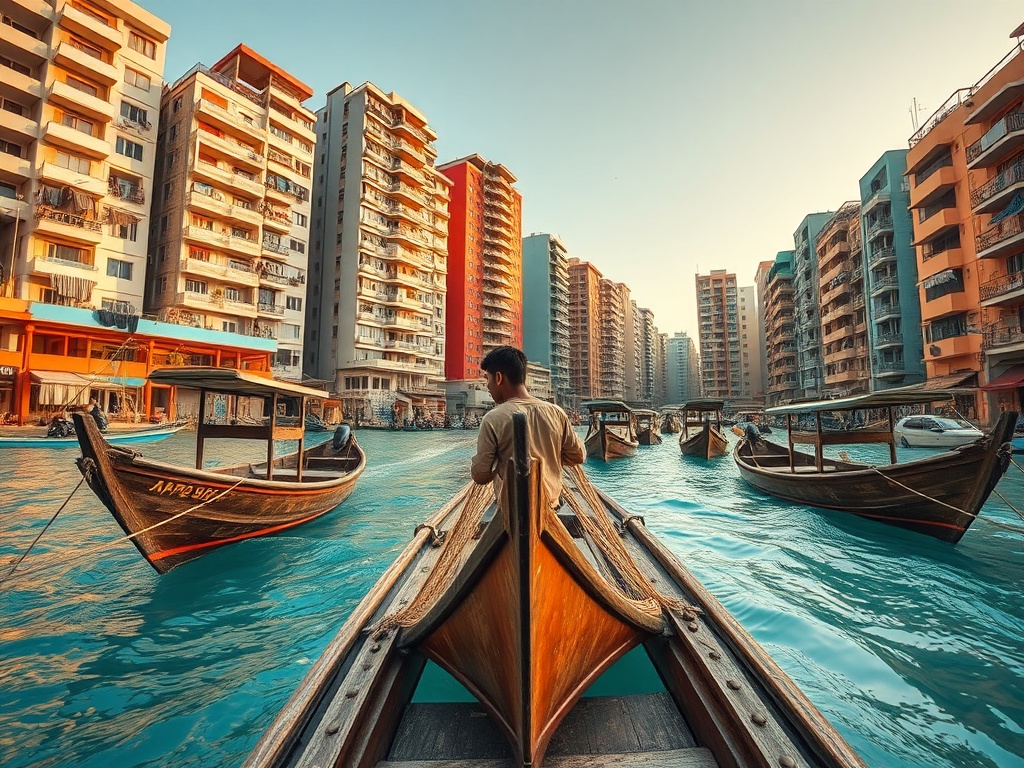
Between Tides: The Maldives' Unraveled Dreams
The sea has always been our first teacher—its rhythms dictating our days, its depths holding both mystery and sustenance. Yet today, different currents pull at our islands, currents of ambition and anxiety that leave us suspended between what we were and what we might become.
In the narrow streets of Malé, the pressure builds like monsoon clouds before the storm. Young men gather at the harbor wall, their eyes reflecting not the turquoise waters but the gray concrete of limited horizons. They speak in hushed tones of jobs that don't exist, of degrees that lead nowhere, of the slow erosion of possibility. The education we worked so hard to provide our children now feels like a bridge to nowhere, with the other side shrouded in mist.
Meanwhile, the rhythms of our economy beat to an unfamiliar drum. The resorts glitter on distant horizons, their lights visible from fishing dhonis, yet the wealth they generate seems to flow around us like water around stone. We watch the tourist dollars come ashore only to be swept back out to sea, while our shops struggle with import costs and our families calculate how many more tins of tuna they can afford each week.
Our political landscape has become a chessboard where ordinary people feel like pawns. The same faces rotate through positions of power, their family names familiar from childhood, while new housing projects—meant to be lifelines for the drowning—become political bargaining chips. The flats meant for young couples starting families are instead occupied by shadows, leased to those who treat our homeland as temporary accommodation.
Yet in this unraveling, something resilient persists. The fisherman still reads the waves with ancestral knowledge. The mother still teaches her daughter the old songs. The morning prayer still rises with the sun. These threads—fine but unbreakable—may yet be what we use to weave a new pattern, one where progress doesn't mean losing ourselves, where development serves the many rather than the few, where the Maldivian dream isn't something you have to leave to achieve.
— Source fragments: