Calls for Legal Reform on Withdrawing State Honours Amid Abdullah Shahid Case
The case involving former Foreign Minister Abdullah Shahid has raised urgent questions about whether Maldivian law provides a clear mechanism to withdraw national honours from individuals proven to have committed serious crimes, an issue that legal experts argue must be resolved through reform.
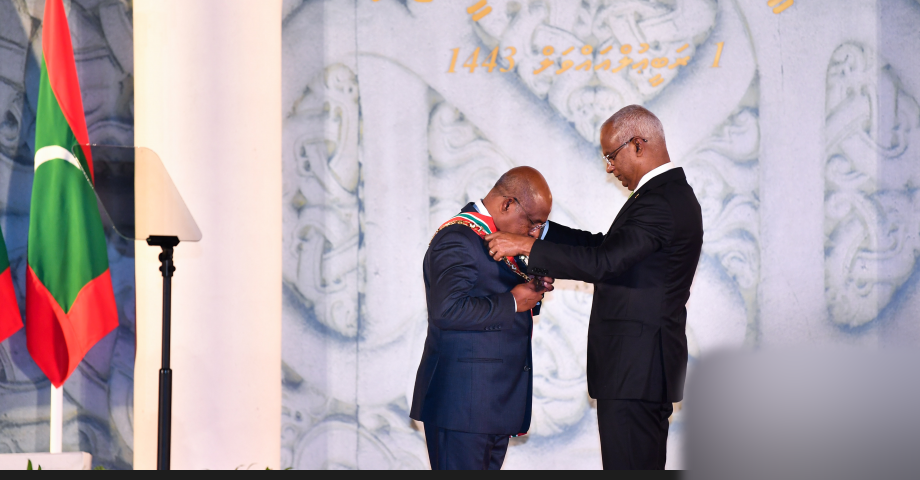
Shahid, who was conferred the honour of Nishan Izzuddeen (N.Iz.V.) by former President Ibrahim Mohamed Solih for his services to the foreign affairs sector and his election as President of the 76th Session of the United Nations General Assembly, was arrested in connection with a case in which he is suspected of sexually abusing a minor. He has been ordered to be held in custody for 30 days, and President Dr. Mohamed Muizzu has said the allegations are very serious and that the arrest was not made for political purposes. Because a minor is involved, investigating authorities and the court have not publicly disclosed the details of the case.
Under the law currently in force, the circumstances in which an honour must be withdrawn are narrowly defined. An honour is to be reclaimed if it is proven that a person who has been granted it has committed an offence for which a hadd is prescribed in Islamic Sharia, or has carried out an act against the state, or participated in such an act. The article does not clearly cover other major criminal offences for which a hadd is not prescribed, such as sexual abuse, rape, corruption, embezzlement or murder. If a major offence outside the stated areas is proven, there is no clear legal basis for withdrawing the honour.
State honours are not given merely for the adornment of an individual; they are a national honour conferred in the name of the Republic of Maldives. The association of persons who have committed major offences with such honours can lead to a loss of trust in the honours system itself.
Countries including the United Kingdom, France and Canada have established legal and administrative systems through which state honours can be withdrawn. In the UK, the Honours Forfeiture Committee examines cases of persons believed to have carried out actions that could cause the value of the honours system to decline. According to the UK Cabinet Office, an honour can be withdrawn for reasons including an offence being proven that entails a criminal offence resulting in a prison sentence of more than three months; a sexual offence being proven regardless of the length of the sentence; a breach of professional or regulatory rules; or another sufficiently significant act that causes the value of the honours system to decline. The committee examines results produced by courts and other official investigations and makes a recommendation through the Prime Minister to the King. A notable example is the 2006 CBE conferred on Australian artist Rolf Harris, which was forfeited after he was convicted in 2014 on 12 counts of sexual abuse of four girls and sentenced to five years and nine months in prison.
In France, according to the Grand Chancery of the Legion of Honour, foreign parties who have received the Legion of Honour and the National Order of Merit can have their insignia permanently taken away if they carry out an act that causes dignity to be lost.
The article calls for reforms to Maldivian law, including broadening the reasons for which an honour can be withdrawn to explicitly cover sexual offences, especially against children; rape and sexual abuse of persons other than children; murder and other serious violent offences; human trafficking and unlawful enrichment; corruption, bribery and embezzlement; fraud, major financial offences and misuse of office; treason and other major offences endangering national security; and a general clause covering acts contrary to the value and purpose of the honour.
It also proposes that honours conferred on foreign parties be covered by the same standards, so that no party is exempt from forfeiture procedures based on diplomatic status, political position or the circumstances in which the honour was conferred. It suggests the establishment of an independent State Honours Review Committee, chaired by a retired senior judge and including a constitutional and administrative law expert, a delegate of the Human Rights Commission of the Maldives (HRCM), a state administration expert and an independent delegate with experience in moral standards and virtue.
The committee would examine evidence and recommend whether an honour should be retained, suspended or withdrawn, with clear procedures for initiating reviews, the right to a fair hearing for the honour holder, and a role for the President in final decisions. The article also recommends maintaining a public register of honours and their withdrawal, publishing forfeiture decisions in the government gazette, and providing a path to restore an honour if the criminal judgment on which removal was based is later overturned.
The article concludes that there must be a clear legal system in the state for determining whether a person proven to have committed sexual abuse of a minor, violence and acts of cruelty, corruption, or any other major offence is fit to continue in a national honour, and that this must be settled through the law before another such case emerges. The prestige and dignity of a national honour must be protected throughout the entire period that the honour remains with the person.