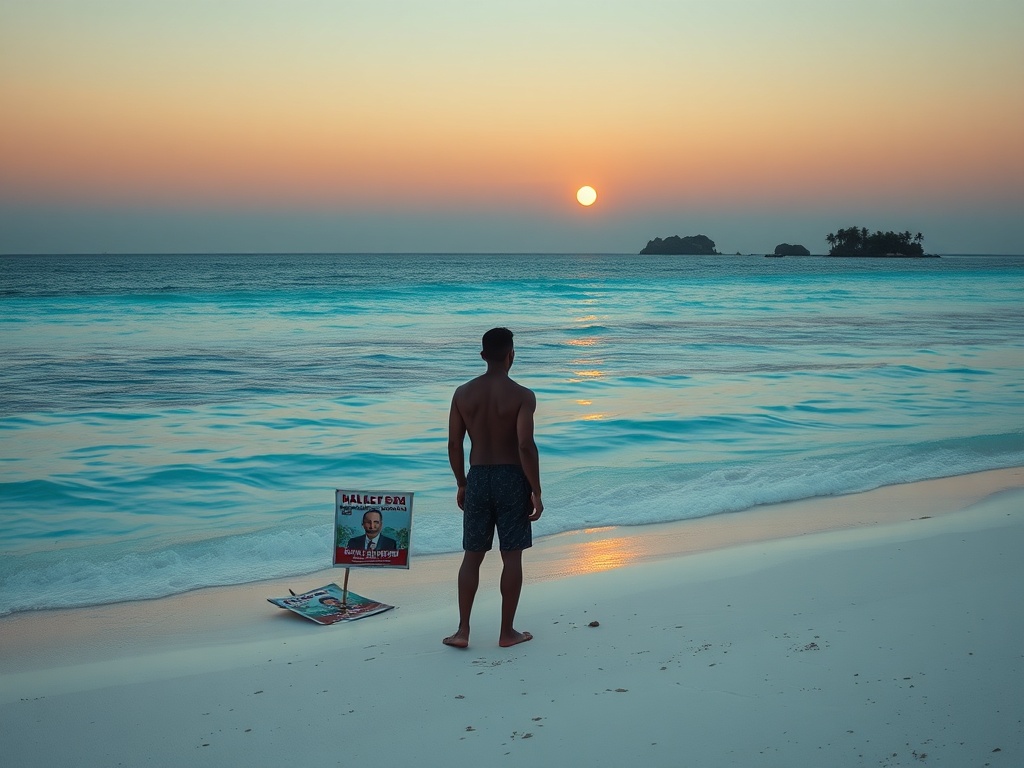
Campaign Posters Washed Ashore at Dusk
The tide comes in with the same rhythm it always has, washing over the white sand of our small islands, each wave a reminder of cycles that predate our politics. I watch from the edge of the water, thinking about how we speak of change—how we imagine different systems, different structures, different leaders—yet find ourselves caught in the same currents.
Someone mentioned how movements begin with passion against injustice, then gradually become about maintaining power. I've seen it happen—the slow transformation from idealism to the machinery of control. The same faces rotate through positions, the same promises echo during campaigns, the same disappointments settle in during governance. They speak of reforming commissions, limiting powers, creating checks—all sensible ideas that somehow never materialize in the way we hope.
Yet what strikes me isn't the political mechanics but the human cost. The young man who finished his education but finds no work that matches his dreams. The family that watches their savings evaporate against rising prices. The feeling that opportunities are reserved for those with connections, that merit matters less than proximity to power.
There's a particular loneliness to political disillusionment on an island. You can see the entire physical boundary of your nation from certain vantage points, yet the systems governing it feel distant, opaque. People speak in coded language—dog whistles, as someone noted—knowing that direct criticism carries risks. They block you when you challenge the establishment, regardless of which party colors they wear.
But the sea teaches patience. It has witnessed generations of our struggles, our aspirations, our failures. And in the spaces between political rhetoric, life continues—fishermen still cast their nets at dawn, mothers still prepare meals for their families, children still laugh as they chase each other through the narrow streets. These ordinary moments contain their own quiet resistance to despair.
Perhaps hope lies not in expecting different results from the same processes, but in valuing what persists despite the politics: our capacity to care for one another, to share what we have, to remember that these islands belong to all of us, not just to those who govern. The tide will recede again, leaving the sand clean, ready for new footprints.
— Source fragments: Major reason for excessive corruption is the unlimited power vested in the President; This is the reason why we need a two-tire system; Any Male' supremacist will block you when you go against the establishment; MDP is all abt corruption and laadheeny now. At the start it was more against injustice; If re-elected, he will repeat these same mistakes for sure; True. but shouldn't have used a dog whistle