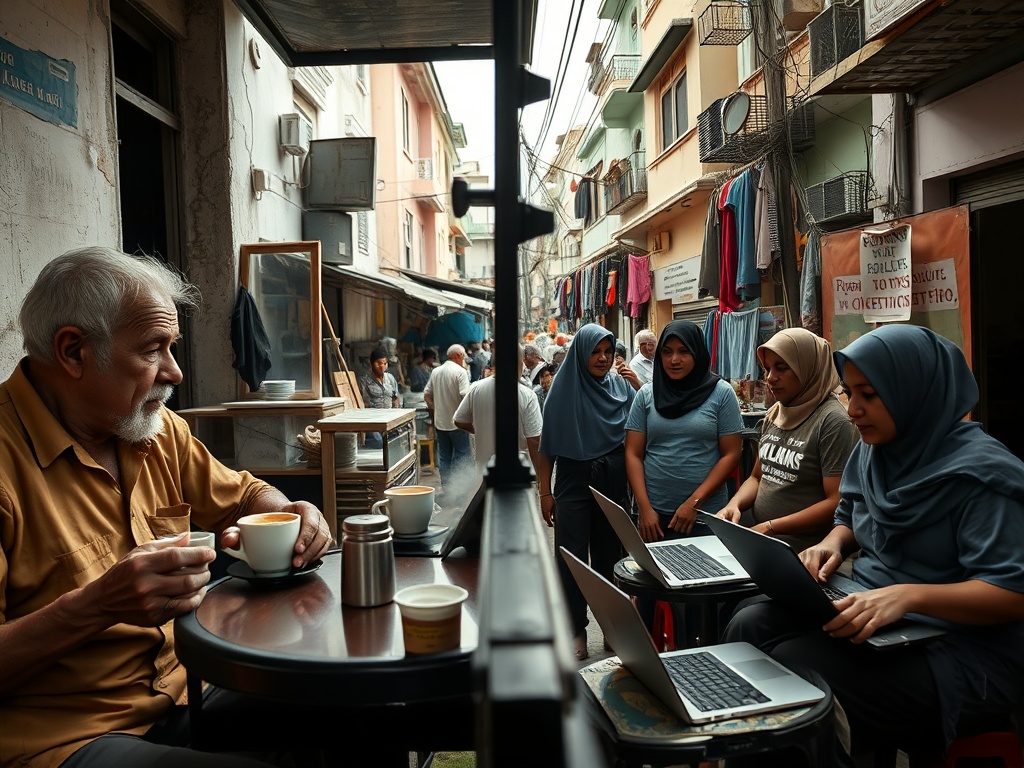
Coffee Shop Debates and Laptop Protests in Malé's Political Divide
In the crowded political landscape of the Maldives, the battle for the nation's soul plays out not just in parliament but in the collective memory of its people. The conversation reveals a country grappling with competing legacies—where one generation recalls the tangible progress of past leadership while another demands transformative change beyond traditional politics.
The narrative of national salvation through strong leadership persists among those who witnessed the archipelago's transition from scarcity to development. They remember a time when malnutrition was commonplace and basic staples were luxuries, crediting decisive leadership with pulling the nation from the brink. This perspective views three decades of governance not as stagnation but as necessary nation-building, framing current criticisms as historical ignorance rather than legitimate political discourse.
Meanwhile, a younger generation expresses exhaustion with what they perceive as political theater and empty promises. Their enthusiasm centers on figures who reject conventional political strategy and demonstrate unwavering commitment to core values. They champion politicians who operate with humor and humanism while confronting what they see as a corrupt status quo maintained by both centrists and right-wing elements.
The political method itself has become a point of contention. Where traditional politics emphasized stability and incremental progress, newer approaches value authenticity and volunteer-driven movements. The rejection of political compromise is celebrated as moral clarity rather than dismissed as impractical idealism.
This generational shift coincides with practical concerns that transcend political affiliations. Maldivians across age groups face a housing crisis in the congestated capital, where subsidized housing often fails to reach those most in need. Healthcare remains inadequate despite national insurance schemes, while economic pressures mount from import dependency and currency shortages.
The emerging political consciousness appears less concerned with party loyalty than with tangible outcomes and authentic representation. Support flows toward individuals who demonstrate consistency between their words and actions, regardless of traditional political calculations. This represents a significant evolution from the personality-driven politics that long dominated Maldivian democracy.
As the nation navigates foreign policy tensions and domestic economic challenges, these competing narratives reflect deeper questions about development, governance, and national identity. The political arena has become a battleground for memory itself—where one generation's salvation story confronts another's demand for transformation, and where political legitimacy is increasingly measured by action rather than rhetoric.
— Source fragments: Labor Party inclusion rhetoric, MAG era development claims, November 3rd significance, generational political differences, praise for unconventional political strategies, housing and economic concerns, support for authentic leadership over traditional politics