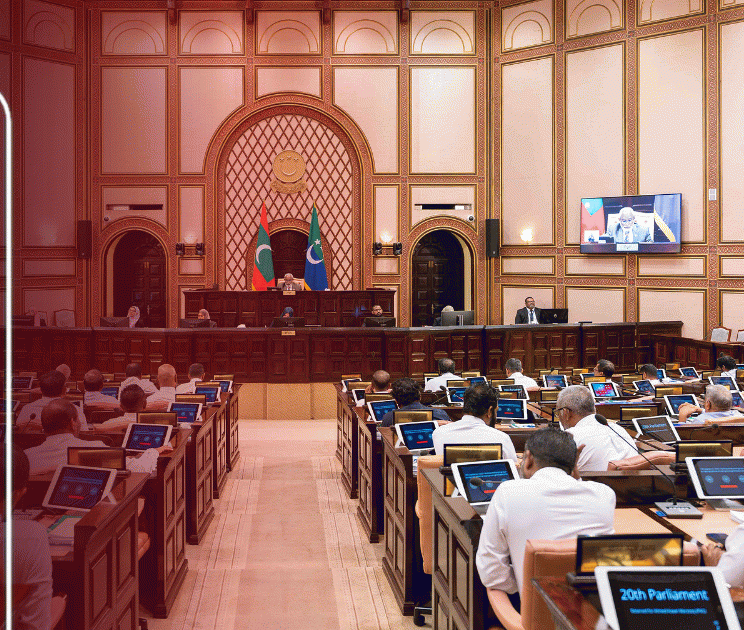
Column Questions Whether the People's Majlis Needs Members of Law-Making Calibre
A column published by Dheliumbu has questioned whether the People's Majlis, which the Constitution of the Maldives has elevated as the institution holding all powers of law-making, needs members who are exemplary in educational and moral terms and possess true law-making calibre.
The column states that what is seen in today's Majlis is, more than educational calibre, a place where the power of loud-voiced people and people with strong political influence prevails. It notes that although Article 73 of the Constitution sets qualifications for membership — being a Maldivian citizen, being a Sunni Muslim, having completed 18 years of age and being of sound mind — no educational qualification whatsoever has been specified. According to the Maldives Financial Review, the column says, decisions made by parties holding political positions and the frequent decisions connected to them have led the public to criticise most the lack of educational calibre and competence of those parties.
The column argues that if an academic debate or research work has to be carried out within the Majlis, members capable enough to reach its true purpose are proportionally very few. It cites Gallolhu Dhaairaa member Meekail Ahmed Naseem as saying that if there is a good intention to advance higher education, the first thing that must be done is to amend the law so that educational qualifications are required of Majlis members. He also noted that young people who achieve higher education with great sacrifices are forced to work behind political figures who have no educational calibre whatsoever.
In addition, former President Mohamed Nasheed has advised that a principle by which the educational calibre and work experience of parties contesting the Majlis can be weighed must be specified in the law. The column adds that some parties suspect that members who cannot even read with fluency documents well written in the Dhivehi language are sitting in the Majlis, a suspicion arising from the situation of those people when it comes to reading something written in Thaana in order to present bills submitted to the Majlis. The column states that it is a visible fact that they cannot be read with fluency, and that people who cannot read complete a five-year term in the Majlis without reading anything and then are decided upon. It acknowledges that the matter has not been confirmed by any official source, describing it as how it appeared from the visible scene, while maintaining that it is an indisputable fact that members of the state's main law-making institution must be an academically competent group.
Beyond the lack of academic competence, the column says the result of a lack of discipline and morals has been that Majlis time is spent on quarrelling, disrupting proceedings and inciting one group to spread false suspicions against another. Instead of resolving differences of opinion, damage has been caused to Majlis property, members have been physically assaulted and fights have even taken place among members. It recalls that in confrontations on January 28, 2024, at the session held to give approval to ministers, members supporting the government and opposition members attacked each other and some members had to be given treatment at a hospital. During the obstruction of voting, a fight took place between then Kendhikulhudhoo Dhaairaa member Ahmed Eesa and then Kanditheemu Dhaairaa member Abdullah Shaheem Abdulhakeem, and matters in which members were given death threats also surfaced.
The column attributes such unrest to confusion over the responsibilities of members, with members of the ruling party believing they have been elected solely to defend the government, while an elected opposition member's only work becomes obstructing the government and not allowing projects the government plans to proceed. In this rivalry between the two sides, it says, all the harm is suffered by ordinary people. It notes that RaajjeMV has written that a code of conduct must be specified and enforced to stop obstruction of Majlis work and the taking of illegitimate benefit from position, and that according to what the Commonwealth Parliamentary Association (CPA) notes, even if Majlis work proceeds in a manner seen as two-sided, the Maldives Majlis receives a "failed" report from integrity standards.
The column also refers to scenes of damage caused openly to Majlis property before the eyes of Maldivians, including destroying microphones, damaging computer screens and damaging chairs shown on television to all Maldivian citizens, as well as a scene of the Maldivian national flag being thrown to the ground. It questions how those involved remain in the Majlis wearing white shirts and party-coloured ties while saying they are strongly advocating for the rights of the people, and asks whether a law passed by beating and killing, and annulled before a month has passed since it was passed, is the kind of thing done by people of sound mind.
Turning to personal enrichment, the column says that when going to the first session after being elected, the white shirt to be worn and the shoes to be put on are also obtained with the help of some person who was trying to campaign for him. It asks how a person who enters the Majlis in such a poor state becomes, after completing a five-year term or being removed by the people, among the proportionally largest wealthy people of the Maldives, with two or three shops, two or three restaurants and launches that make trips registered in the name of a company he has formed, or by forming a construction company that becomes the best level of building construction and knocking down buildings in the Maldives. It asks whether the people cannot become aware and raise questions about how these people became wealthy.
On conflicts of interest, the column says the law has been written very clearly that one must stay away from a matter involving personal interest at the time of voting, yet their salaries are determined by the vote they themselves cast, and they also take committee allowances by forming committees under various names, asking whether this is not a matter involving personal interest.
The column concludes that the full power to change this situation of the Majlis lies in the hands of the Maldivian people, who must wake up today and, instead of voting for political influence and temporary benefit, make the People's Majlis truly a "People's Majlis". The power to make laws that shape the country's future must then be entrusted to educated people who have discipline and morals and who are academically competent, it says, otherwise the people will always have to remain in this situation.