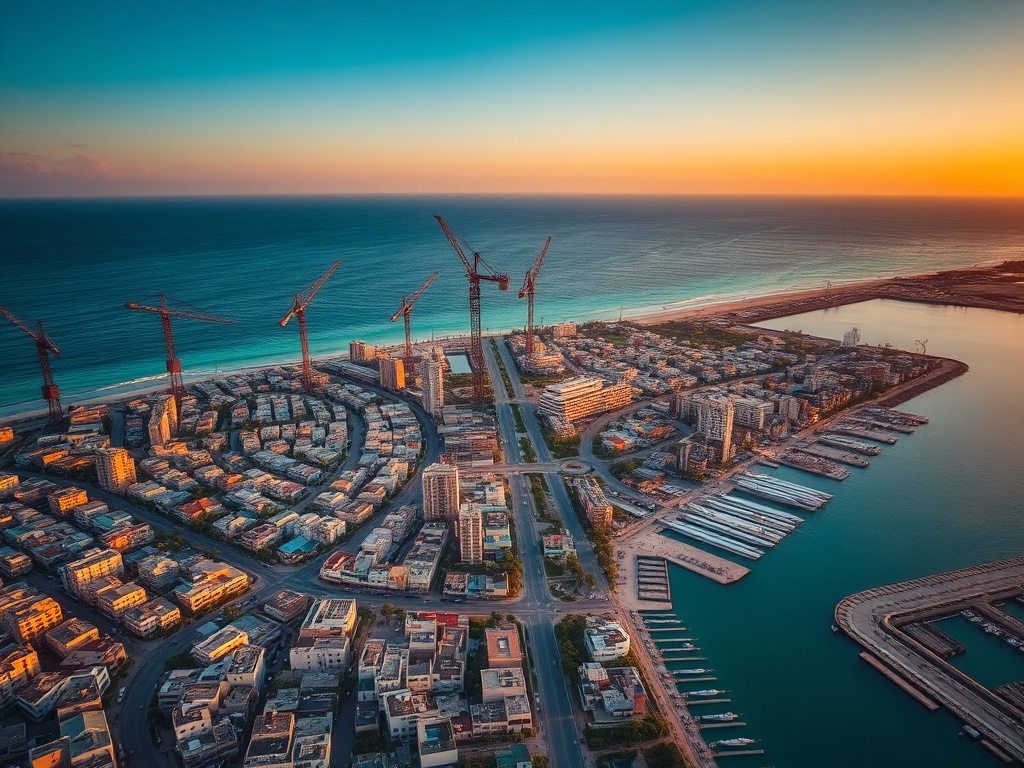
Construction Cranes Over Malé, Road Closures Below
The scaffolding of development continues to rise across the Maldives, visible in the ongoing work at the MMA building, road closures on Boduthakurufaanu Magu, and the steady expansion of police stations nationwide. These projects represent both ambition and inconvenience—the growing pains of a nation building for its future.
The conversation around infrastructure often centers on responsibility and communication. When airports expand or terminals shift, who informs the passenger? The debate reveals a fundamental tension in development management. Some argue that airlines, not airport operators, bear the primary responsibility for guiding travelers—a perspective drawn from international examples like Singapore's Changi Airport, where terminal information is clearly communicated through airline channels.
Meanwhile, in the atolls, redevelopment takes different forms. The allocation of MVR 1.5 billion for land reclamation in Addu City represents one of the largest infrastructure investments in the southern atolls, promising 190 hectares of new land alongside harbor development funded through Indian lines of credit. Yet questions persist about the practical implementation of such projects. As one observer noted regarding Maradhoo Feydhoo, the presence of a seawall doesn't necessarily indicate reclaimed land—highlighting the gap between perception and reality in development narratives.
The infrastructure expansion extends beyond transportation and land reclamation. Education facilities like the Gnaviyani Atoll Education Centre's new five-storey building and waste management centers contracted to WAMCO represent critical social infrastructure. These projects address long-standing gaps in public services, though their success will depend on sustainable management and community engagement.
Urban centers face their own challenges. In Hulhumalé, the towing of over 1,200 vehicles in two months reveals the strain of rapid urbanization on limited space. The enforcement action suggests both the growing vehicle density in the reclaimed island and the authorities' attempt to maintain order amid expansion.
The development conversation increasingly centers on coordination—ensuring that infrastructure growth serves practical needs rather than political announcements. As the country builds upward and outward, the test will be whether these structures integrate smoothly into daily life or remain as monuments to ambition disconnected from utility. The true measure of success lies not in the scale of investment but in the seamlessness of implementation.
— Source fragments: Why are they doing that on MMA building?? | Some airports in India for example have different terminals for domestic and international flights. So informing the passenger in such cases also falls on the airline. Not airport operator. | That is again also the airline issue. If you are travelling from T1, T2 or T3 in Singapore. You are informed of it by the airline. | Maradhoo Feydhoo has a big ass bandharu but as far as I am aware, there is no reclaimed land there. | The Maldives Police Service has announced road closures near the northern section of Boduthakurufaanu Magu to allow for ongoing redevelopment work. | In 2019, the government announced that USD 200 million from an Indian LOC would be used fr road n harbour development in Addu City. In June 2023, the government allocated MVR 1.5 billion for a land reclamation project (190 hectares) in Addu City | The practical work on the Gnaviyani Atoll Education Centre’s new five-storey building was also launched as part of the visit. Additionally, the groundbreaking ceremony for the development of a Waste Management Centre, contracted to Waste Management Corporation (WAMCO) was also | The Maldives Police Service has reported that a total of 1,222 vehicles were towed from the streets of Hulhumale over the past two months. | The Maldives Police Service has signed agreements with contractors to begin construction of new police stations across the nation.