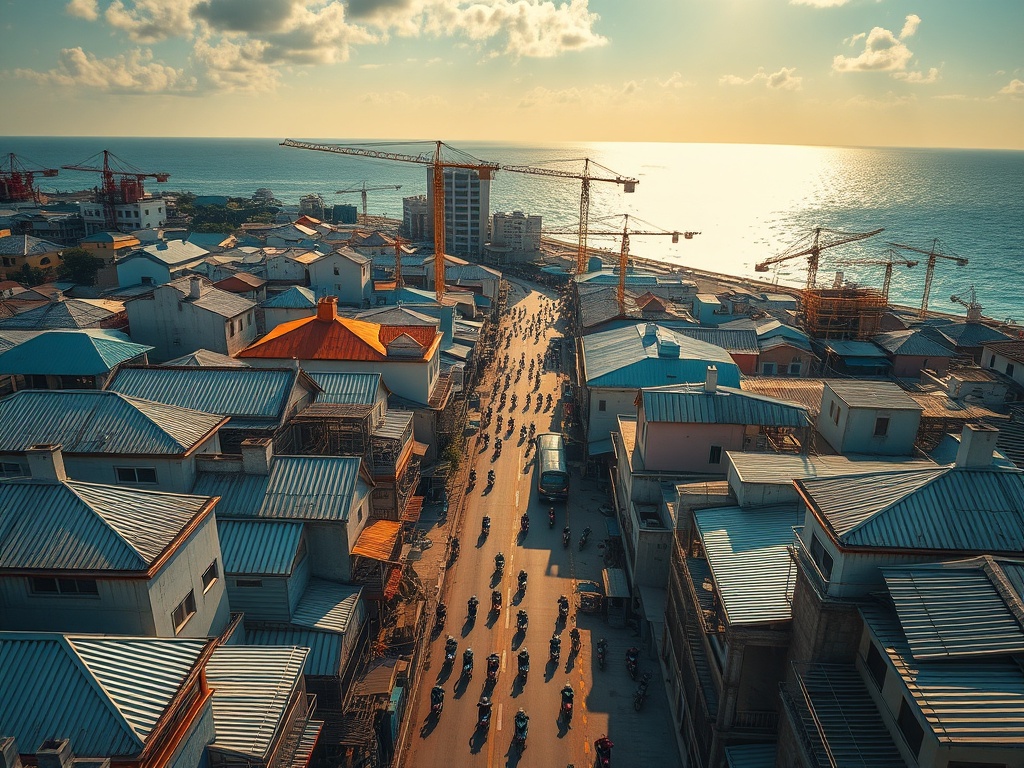
Cranes Over Malé, Empty Promises on the Atolls
Across the scattered atolls of the Maldives, a familiar frustration echoes through public discourse: the sense that development remains uneven, infrastructure inadequate, and opportunities concentrated in too few places. The call for building population hotspots with proper resources reflects a deeper yearning—not just for roads and buildings, but for dignity through development.
For years, the narrative has centered on grand projects and political announcements. Yet on the ground, the experience often tells a different story. Air conditioning systems strain against poorly insulated buildings, wasting precious energy and money. Basic construction flaws—like wooden doors with visible gaps at the bottom—speak to a culture of cutting corners rather than building to last.
The capital Malé, described by some as increasingly unlivable, bears the weight of this development imbalance. When roadblocks and congestion disrupt a city generating significant daily economic activity, the question arises: who bears the cost of these disruptions? The rhetoric of patriotism clashes with the reality of economic hardship for those trying to sustain businesses and livelihoods.
Meanwhile, the machinery of governance often appears disconnected from these daily struggles. The comparison to international examples—like Dublin's decade-long redevelopment debates or Belfast's council challenges—highlights a universal tension between political posturing and practical city management. When local authorities become synonymous with inefficiency and inflated costs, public trust erodes.
The technological limitations in implementing effective content filtering systems mirror broader capacity constraints. The acknowledgment that "we don't have the resources" for certain solutions reflects a sobering reality check about the gap between ambition and capability.
At the heart of these frustrations lies a fundamental question about national priorities. Are we investing in sustainable development that serves the people, or in visible projects that serve political timelines? The answer may determine whether the Maldives builds infrastructure that genuinely supports flourishing communities or merely constructs the appearance of progress.
— Source fragments: Developing islands neglected, need population hotspots with infrastructure; Insulation leaks making cooling inefficient; Male described as overcrowded; Questions about long-term infrastructure spending; Frustration with project delays and cost overruns; Criticism of local government competence; Economic impact of infrastructure disruptions