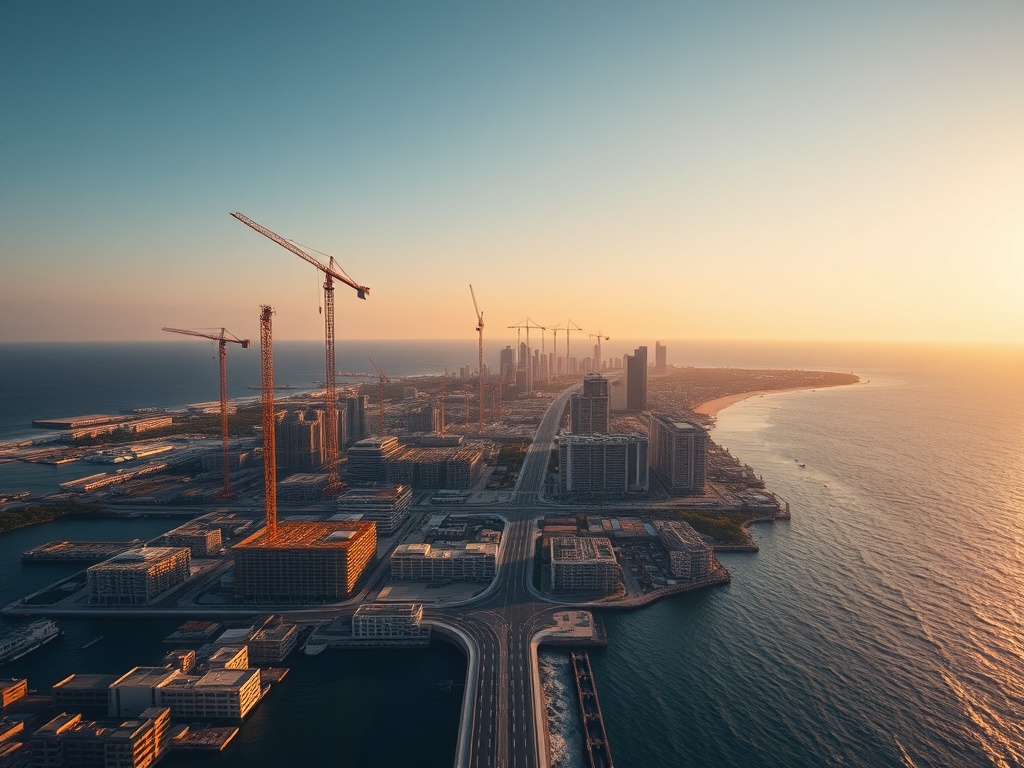
Cranes Over Malé, Questions on the Ground
The scaffolding rising across Malé's skyline and the dredgers working in Addu's waters tell a story of a nation in transformation. Yet beneath the visible progress lies a complex web of institutional responsibilities, public expectations, and the challenge of ensuring that development serves the people it's meant to benefit.
Recent discussions about airport operations highlight a fundamental question of accountability. When passengers face confusion about terminal assignments or flight information, who bears responsibility—the airline or the airport operator? This seemingly technical question reflects broader concerns about institutional clarity in an era of rapid modernization. As one observer noted, major international hubs like Singapore's Changi Airport delegate terminal notifications to airlines, suggesting that clear division of responsibilities is crucial for operational efficiency.
The scale of current infrastructure projects is staggering. In Addu City alone, a $200 million Indian Line of Credit for road and harbor development complements a MVR 1.5 billion land reclamation project covering 190 hectares. These massive investments promise economic revitalization, but they also raise questions about planning coherence and community benefit. The tension between development priorities was evident when harbor spaces originally intended for foreign vessels and cruise tourism were reconsidered under housing schemes, highlighting the constant balancing act between immediate public needs and long-term economic strategy.
Meanwhile, in the capital region, practical challenges mount. The towing of over 1,200 vehicles from Hulhumalé streets in just two months reveals the growing pains of urban management. Road closures around Boduthakurufaanu Magu for redevelopment work disrupt daily life even as they promise future improvements. These disruptions underscore the importance of coordinated planning and clear communication between authorities and citizens.
The infrastructure conversation extends beyond transportation. New police stations, education centers, and waste management facilities represent the essential backbone of community development. The recent launch of Gnaviyani Atoll's five-story education center and waste management facility demonstrates how infrastructure investments must serve multiple public needs simultaneously.
Yet the ultimate test of these developments lies not in their scale or cost, but in their ability to serve the public effectively. As one commentator pointed out, having infrastructure is one thing; ensuring it benefits land owners and communities through fair charging mechanisms and accessible services is another. The challenge facing the Maldives is not just building, but building wisely—creating systems where responsibility is clear, benefits are widely shared, and public resources translate into genuine public good.
— Source fragments: Why are they doing that on MMA building??; Some airports in India for example have different terminals for domestic and international flights. So informing the passenger in such cases also falls on the airline. Not airport operator.; The Maldives Police Service has announced road closures near the northern section of Boduthakurufaanu Magu to allow for ongoing redevelopment work.; In 2019, the government announced that USD 200 million from an Indian LOC would be used fr road n harbour development in Addu City. In June 2023, the government allocated MVR 1.5 billion for a land reclamation project (190 hectares) in Addu City; Phase 3 wasn't even a thing before Binveriya Scheme because the harbour space was crucial to attract foreign vessels and cruise tourism.; The Maldives Police Service has reported that a total of 1,222 vehicles were towed from the streets of Hulhumale over the past two months.; I no. The point is we have infrastructure. We can make sure the land owner can be charged; The Maldives Police Service has signed agreements with contractors to begin construction of new police stations across the nation.