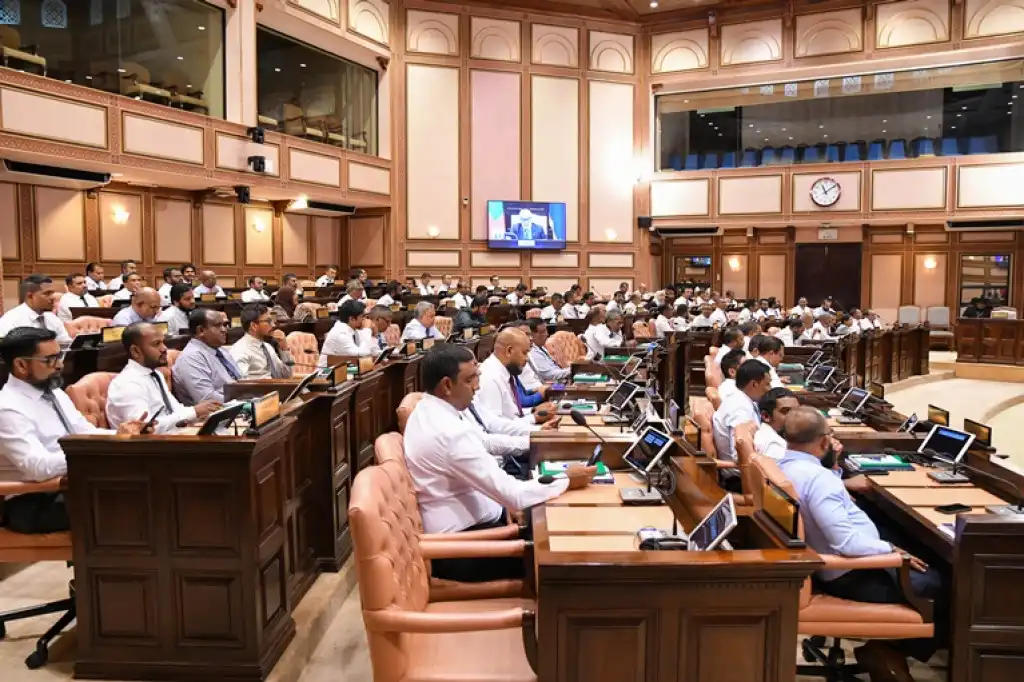
Death Penalty Bill Passed by People's Majlis, Sent to Judiciary Committee
The People's Majlis has passed a bill establishing a robust legal framework for the imposition and execution of the death penalty, with execution to be carried out by hanging. The bill, submitted on behalf of the government by the member for Guraidhoo constituency, Hannan Mohamed Rasheed, was passed on Wednesday with the agreement of 56 members and has been sent to the Judiciary Committee for study.
The stated purpose of the bill is to introduce a robust legal framework setting out the principles and procedures relating to the imposition of the death penalty on a person in the Maldives and the execution of the sentence, in compliance with constitutional and international principles and the rights of the public and of the offender.
Accordingly, the bill sets out the principles courts must follow in imposing the death penalty, the obligations the state must fulfil in carrying out a death sentence, the rights of a person sentenced to death, and the circumstances and reasons that prohibit the execution of the sentence, along with other principles and procedures relating to the imposition of the death penalty and the execution of the sentence.
Under the bill, matters relating to the execution of the death penalty shall be overseen by a committee comprising seven members, including a Commissioner of Police of the Correctional Service and a senior officer of the police service, a prosecutor, a member of the People's Majlis, a doctor, and a party appointed by the Supreme Court, in addition to a party authorised to give religious remarks and religious advice.
The bill also details the rights afforded to the offender. According to the bill, all matters of practically carrying out the death penalty shall be planned and run by the Maldives Correctional Service. It states that the sentence shall be carried out by placing a noose around the offender's neck and applying force, then arranging the manner in which he hangs from that noose.
In addition, the parties who must be present and who have the right to be present when the death penalty is carried out, the handing over of the body of the deceased to the family, and the matters prohibited in carrying out this penalty have also been detailed and included in the bill.