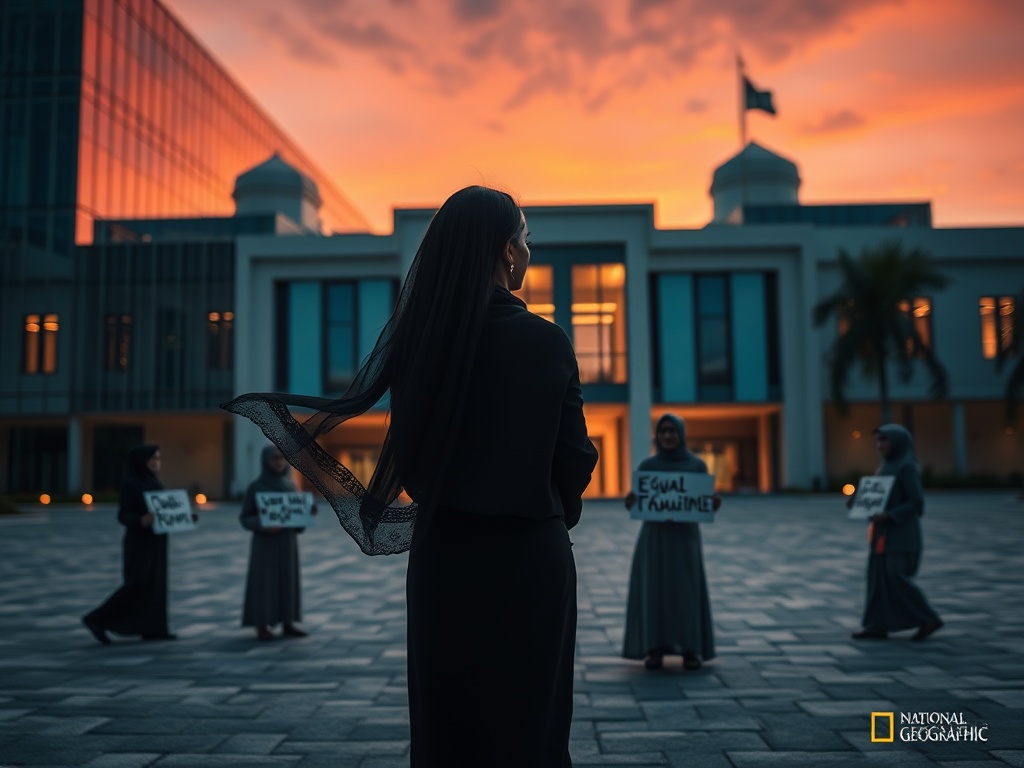
Democracy's Empty Seat: Where Are the Women in the People's Majlis?
In the Maldives, the promise of democracy echoes through political speeches and constitutional documents, yet a fundamental contradiction persists: a system that celebrates democratic ideals while systematically excluding half its population from meaningful participation. With women holding just 3% of parliamentary seats, the architecture of power remains overwhelmingly male-dominated, raising urgent questions about what kind of democracy can truly exist under such conditions.
The statistics tell a sobering story, but the lived experiences reveal something deeper—a pattern of exclusion that extends beyond parliamentary chambers into the very fabric of social and political life. When institutions designed to represent the people fail to reflect their composition, democracy becomes an abstraction rather than a lived reality. The gap between constitutional guarantees and practical implementation grows wider with each election cycle that fails to produce meaningful change.
This exclusion manifests in multiple dimensions. Beyond parliamentary representation, women face barriers in accessing education, healthcare, and housing—fundamental rights that should be universal but remain unequally distributed. The irony is particularly sharp in a nation that proudly identifies as 100% Muslim, where principles of justice and equality are central to religious teachings, yet their practical application in governance falls short.
Recent public discourse has highlighted disturbing patterns of violence against women, with cases of assault and abuse circulating through social media and private conversations. The normalization of such violence, coupled with celebratory public attitudes toward male political figures, creates an environment where women's safety and dignity become secondary concerns. The frustration is palpable in online spaces where citizens express exhaustion with what they describe as an "endless loop" of abuse cases met with inadequate institutional response.
Meanwhile, the conversation around class struggle and political accountability has taken on new urgency. Critics argue that fighting an abstract ruling class without naming specific individuals and systems enables the perpetuation of corruption and nepotism. The identification of political enemies has become a necessary step toward genuine accountability, particularly as high-profile corruption cases continue to surface without resulting in systemic reform.
The housing crisis in Malé exemplifies how basic rights become politicized, with subsidized housing often benefiting those who least need it while ordinary citizens struggle with overcrowding and exorbitant costs. Similar patterns emerge in healthcare, where systemic inefficiencies and shortages force many to seek treatment abroad, creating a two-tier system that privileges wealth over need.
What emerges from these interconnected crises is a clear picture: democracy cannot be measured solely by the regularity of elections or the existence of political parties. True democracy requires equal representation, protection from violence, access to basic services, and accountability for those in power. Until these conditions are met for all citizens—regardless of gender, class, or political connection—the Maldivian democratic project remains incomplete. The revolution that began with multi-party politics must now continue with a deeper commitment to equality, justice, and genuine representation for every voice in the nation.
— Source fragments: Equality is Non-Negotiable Democracy in the Maldives cannot exist while women remain excluded; With only 3% of parliamentary seats held by women; True democracy demands equal representation; Education, access to healthcare and housing is a universal right; We shouldn't tolerate gang rape at any cost; Endless loop of abuse/assault cases; The irony of celebrating men; how do you disrespect women like this; There is no class struggle if we are fighting an abstract ruling class