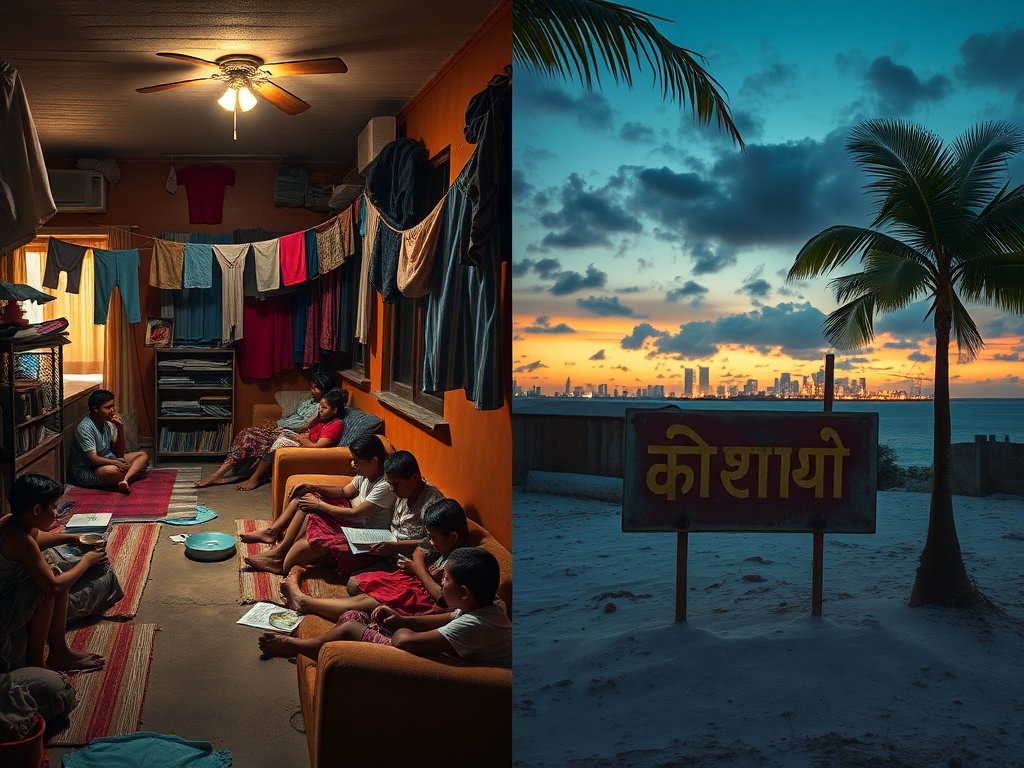
Families in One Malé Apartment, a 'For Sale' Sign in Hulhumalé
In the cramped living rooms of Malé, where multiple families share single apartments and children grow up without space to call their own, a fundamental question echoes through the concrete walls: who deserves a home in the capital? The housing crisis gripping the Maldives has become more than an economic issue—it is a fracture line running through the nation's social contract.
The recent distribution of land in Hulhumalé Phase 2 was meant to address this crisis, but instead revealed deeper inequities. The sight of these publicly allocated plots appearing on private sale platforms exposes how well-intentioned programs are co-opted by existing power structures. This isn't merely about housing policy failure—it's about the perpetuation of an elitism that treats opportunity as inheritance rather than right.
For native Malé residents, the crisis carries particular bitterness. Generations have watched their ancestral home become increasingly unaffordable while waiting lists for social housing stretch to over 30,000 applications. The argument that outer island residents can 'return home' rings hollow to those born and raised in the capital's crowded conditions, for whom these four walls represent their only option.
The rental market exacerbates the divide. With two-bedroom apartments commanding 16,000 Rufiyaa and three-bedrooms reaching 23,000, families face impossible choices between shelter and other necessities. The government's contradictory approach—regulating taxi fares while claiming inability to intervene in housing costs—reveals a political selectivity in addressing market failures.
Meanwhile, the very infrastructure meant to provide relief has become part of the problem. Social housing units obtained through government programs are sometimes sublet at market rates, creating perverse incentives where public support becomes private profit. The requirement to upgrade properties to 'amilla' standards presents another barrier, locking out those without substantial capital.
This isn't merely a policy challenge—it's a test of national priorities. The housing crisis forces a confrontation between competing visions of development: one that concentrates opportunity in the capital, and another that envisions a more distributed prosperity across the archipelago. Either path requires confronting the uncomfortable reality that current approaches are failing too many Maldivians who simply want what generations before them took for granted—a place to call home.
— Source fragments: Hulhumalé Phase 2 land sales on ibay; Malé natives deprived of housing rights; 30k+ waiting for social housing; rental prices (16k for 2-bed, 23k for 3-bed); government policy contradictions; intergenerational crowding in Malé households