Fisheries Minister calls building people key to developing mariculture sector
Minister of Fisheries, Agriculture and Marine Resources Ahmed Shiyam has said that people need to be built within the mariculture sector in order to develop it.
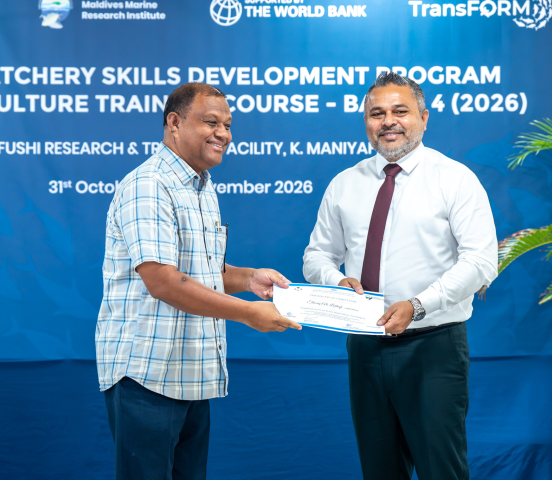
The Minister made the remarks at the ceremony concluding the 4th Basic Mariculture Training Course of 2026, held under the Marine Hatchery Skills Development Programme run by the Ministry of Fisheries, Agriculture and Marine Resources.
The Basic Mariculture Training course is conducted under initiatives in the government's 14-week roadmap to establish the hatcheries needed to improve fish products and to teach aquaculture skills to youth. The Marine Hatchery Skills Development Programme aims to build people in the mariculture sector to pave the way for a sustainable marine aquaculture industry in the Maldives.
Eleven participants from nine atolls took part in the course, held at the Research and Training Facility in K. Maniyafushi from October 31 to November 12. Four courses are arranged under the programme this year.
Certificates were handed over at a ceremony in Maniyafushi, attended by Minister Shiyam.
Speaking at the ceremony, Minister Shiyam highlighted the importance the government gives to mariculture and stressed the importance of training people in the sector.
"Among the work we need to do to develop mariculture as a separate industry, I see building people in this sector as the most important thing. The parties who will be active in the practical work of this sector, and to advance this sector, the work being done to train people in this sector and to build people will be included in this," he said.
The course covered aquaculture systems, live food preparation, farming of sea cucumber, milkfish and Maldivian grouper, tilapia and seaweed, identifying and protecting against diseases affecting farmed species, and working in mariculture with minimal harm to the environment. Participants also received practical experience in farming sea cucumber, milkfish and grouper. A session was held to raise awareness of marketing opportunities for mariculture products, and as an industry exposure activity, participants visited a seaweed farm run by private parties in B. Fehendhoo.
Main components taught in the Basic Mariculture course include aquaculture systems, live food preparation, fish biology, sea cucumber farming, milkfish farming, Maldivian grouper farming, tilapia farming, seaweed farming, identifying diseases affecting farmed species and protecting against diseases, and protecting the environment when doing aquaculture.
Through such programmes, along with the development of the Maldives' mariculture, additional opportunities for income and employment will be created in islands and nearby areas, and economic work carried out in the Maldives can be further broadened and diversified.