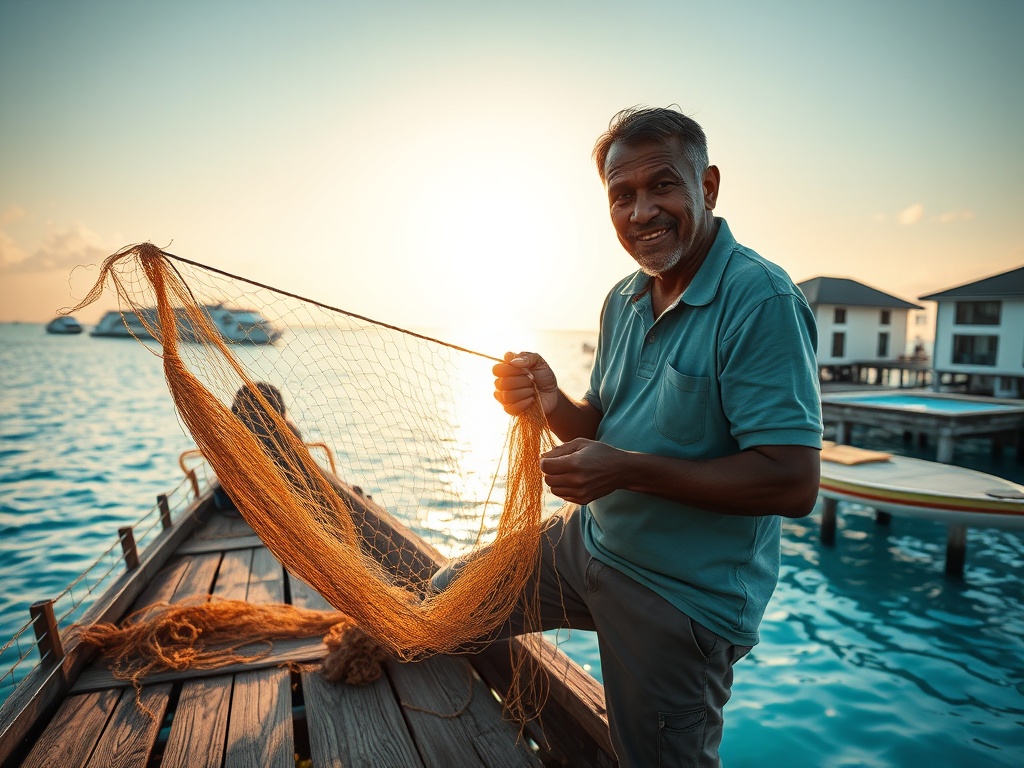
Fisherman Mending Nets as the Resort Glows Behind Him
The conversation about Maldives' economic future has reached a critical juncture. Across social media and coffee shops, Maldivians are asking fundamental questions about our development path. At the heart lies tourism—the industry that transformed our archipelago from a collection of fishing communities into a global luxury destination.
Tourism generates approximately $5 billion annually for our economy of 400,000 people, supporting nearly 100,000 workers who in turn sustain families across the islands. Yet many question whether this economic engine distributes its benefits fairly. As one observer notes, "Can't there be a way that this 100k is paid well with a $5 billion economy?" This question strikes at the core of our development challenge.
The diversification debate often pits tourism against other sectors, but the reality is more nuanced. Tourism serves as our economic safety net—the reliable income source that could theoretically fund our transition to a more varied economy. The concern isn't about destroying tourism, but about ensuring it continues to provide stability while we explore new opportunities.
Meanwhile, parallel conversations reveal interconnected challenges. The housing crisis in Malé and Hulhumale' reflects deeper economic pressures. When residents rent out government-subsidized properties while living abroad, it highlights how economic opportunities—or the lack thereof—shape behavior. The underlying issue isn't land ownership itself, but the financial calculus that drives these decisions.
Our high cost of living creates a peculiar paradox: we've achieved remarkable development milestones with no visible slums and minimal homelessness, yet many Maldivians feel unable to enjoy these achievements. As one comment observes, "We are fortunate but we can't enjoy it coz cost of living is also high."
The path forward requires balancing multiple priorities. Elevating tourism policies to become more visitor-friendly while ensuring greater local benefit. Developing new economic sectors without jeopardizing our primary revenue source. Addressing housing and cost-of-living pressures while maintaining social stability.
Ultimately, the conversation points toward a development model where wealth creation, not just distribution, takes center stage. As one voice puts it, "wealth should be made, not distributed for free." This philosophy could guide our approach to economic diversification—building upon our tourism foundation rather than dismantling it, while creating new pathways for prosperity that benefit all Maldivians.
— Source fragments: tourism diversification debate, economic safety net concept, workforce compensation questions, housing and economic behavior observations, wealth creation philosophy