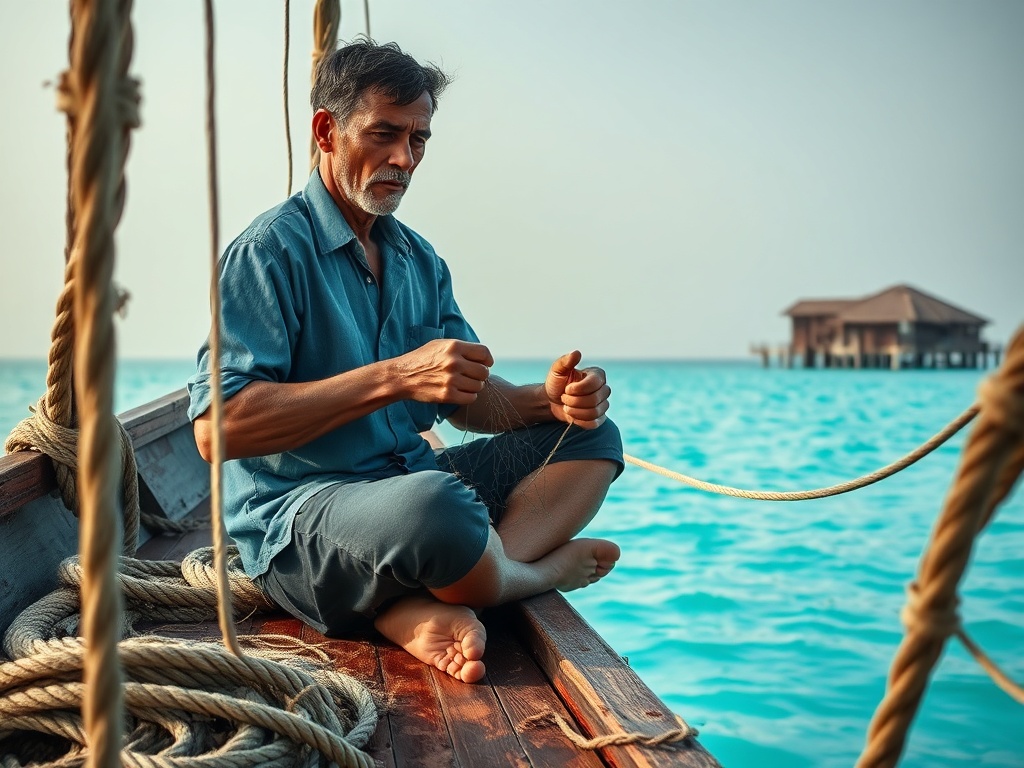
Fisherman Mending Nets as the Resort Skyline Grows
The debate over tourism development in the Maldives has moved beyond economic benefits to confront a more fundamental question: what are we willing to sacrifice for progress? Across the archipelago, communities are grappling with the tension between modernization and preservation, between bureaucratic efficiency and cultural identity.
At the heart of this tension lies the unique social fabric of Maldivian society, where people remain deeply connected to their home islands. Each community functions as an extended family—small, tight-knit, and bound by shared history and values. This intricate social structure, developed over centuries of island living, represents more than just tradition; it's the bedrock of Maldivian identity.
The current tourism model has created visible fractures in this foundation. The concept of local tourism, critics argue, has fundamentally altered island life in ways that threaten cultural preservation. The example of Gulhi stands as a cautionary tale—a community where the mixing of tourists and locals on public beaches has led to cultural clashes and the erosion of social norms. When visitors unfamiliar with local customs arrive without proper guidance, the delicate balance of island life becomes disrupted.
A more sustainable approach would distinguish between resort-based tourism and community-focused preservation. The existing system where tourists primarily experience the Maldives through resort stays, with carefully managed excursions to local islands under guide supervision, offers a model worth refining rather than abandoning. This separation allows economic benefits to flow while protecting the cultural integrity of local communities.
The challenge lies in finding equilibrium. As development pressures increase, the temptation to prioritize bureaucratic efficiency and economic metrics over social cohesion grows stronger. Yet the very essence of what makes the Maldives unique—its island-specific identities, its close-knit communities, its cultural traditions—depends on resisting this temptation.
What emerges from this debate is not opposition to tourism itself, but rather a call for more thoughtful development. The preservation of cultural identity need not mean economic stagnation, nor must economic growth require cultural erosion. The path forward demands recognizing that the value of community cohesion cannot be measured in economic indicators alone, but in the preservation of what makes each Maldivian island uniquely itself.
— Source fragments: Bureaucratic efficiency cannot take precedence over cultural identity; people are deeply tied to what island they are from; each community being small and tight knit; local tourism must be for locals only; tourists go resorts, come to islands on excursions; the guide ensures they follow the rules; current concept has destroyed the islands; look at Gulhi for example