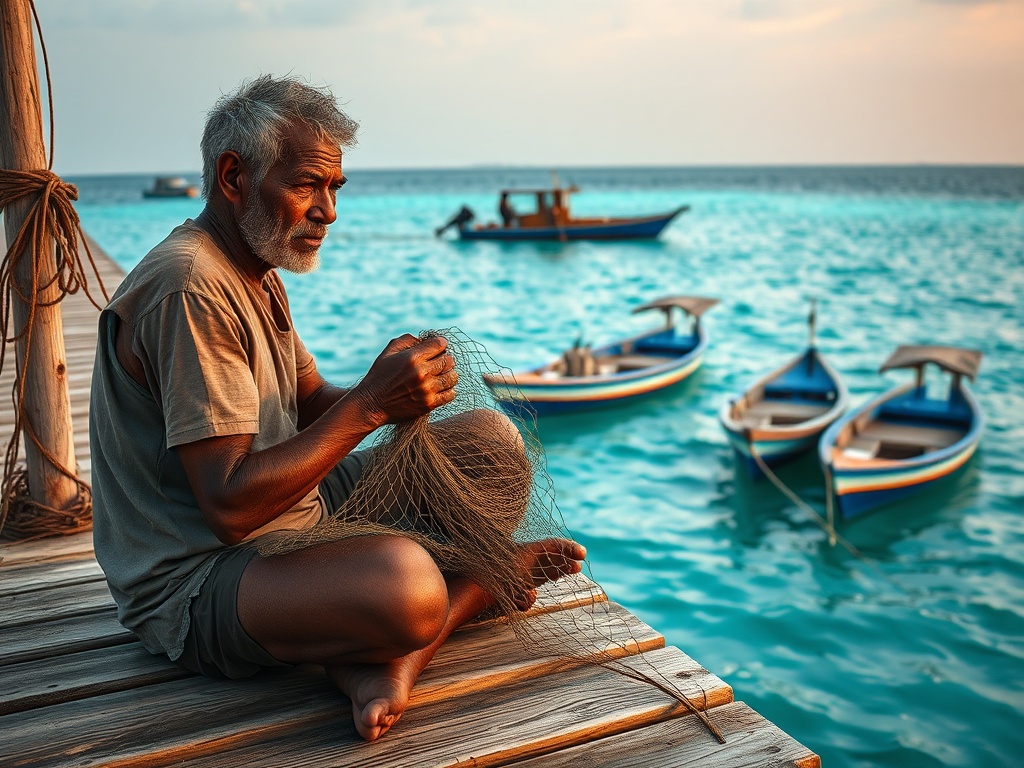
Fisherman Untangling Nets While the Radio Talks of Gaza
The morning sun painted the lagoon in shades of gold, but Ismail felt no warmth as he untangled his net. The radio crackled with news of wars in places he'd never seen—Gaza, Sudan, Venezuela. Names that felt like distant storms gathering beyond the horizon. He remembered his grandfather's stories of British ships during the Chagos affair, how Maldives was never called to the table, never asked about the waters that were their lifeblood.
His son Ahmed sat on the dhoni's edge, scrolling through his phone. "They're talking about India again, Baba. Some say we need drones, missiles—posturing, they call it."
Ismail looked at the endless blue stretching to the horizon. "We are like the small fish who must swim carefully among the whales," he said, his voice barely above the lap of waves against the hull. "When big nations argue over territory, it is the small islands that remember what it means to be occupied by inches."
He thought of the 200-mile exclusive economic zone that other nations only recognized as 12 miles from shore. The ocean that had always been their provider was becoming someone else's property. The same waters where he'd learned to read the currents from his father now felt like contested ground.
"Remember when a ceasefire was something everyone agreed on?" Ahmed asked, his voice heavy with the cynicism of his generation.
Ismail pulled in the net, the silver catch glittering in the morning light. Each fish represented survival, but also sovereignty. The right to feed your family from your own waters. The right to exist without looking over your shoulder at larger neighbors.
As they turned toward home, the atoll rising from the sea like emeralds scattered on blue silk, Ismail thought of Nigeria and Venezuela—independent nations threatened by powers that saw them as pieces on a strategic board. He felt the fragile beauty of his own islands, the lucky accident of geography that had spared them such direct confrontation.
But the anxiety remained, a current beneath the calm surface. The knowledge that in a world where nations could be invaded and sovereignty became negotiable, no island was truly safe. The ocean that connected them also made them vulnerable, and the same waters that gave life could just as easily carry threats to their shores.
That evening, as the sun bled into the western horizon, Ismail watched the fishing boats return to the harbor. Each light represented a family, a community, a way of life. And he understood that sovereignty wasn't about posturing or missiles—it was about the right to watch your children grow up free, to fish in waters that were yours, to exist without apology in the small space the ocean had granted you.
— Source fragments: Maldives was never called at all. #Chagos #MaldivesClaim #UN; This is what our people need to understand. Although we think we are sovereign; We are so lucky we are not yet threatened by a big country; Demanding a ceasefire has become too much to ask?