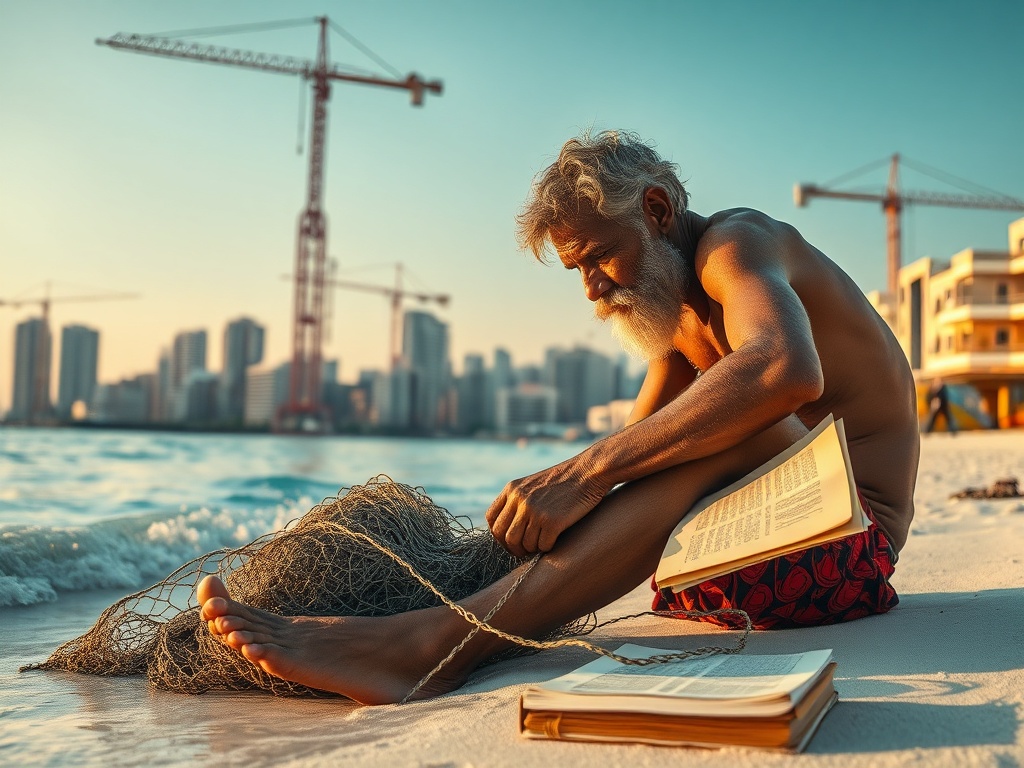
Fishermen Mend Nets as Cranes Reshape the Skyline
The sea has its own accounting—tides that give and take with ancient precision, currents that redistribute warmth without favor. But on these islands, our ledgers tell a different story. There's a growing sense that public resources flow like monsoon currents—predictable in their direction, yet leaving some shores enriched while others erode.
When construction cranes silhouette the Malé skyline, they cast long shadows across neighborhoods where families wonder about the mathematics of distribution. How does a government find millions for newspapers that rarely turn pages in public discourse, while the construction industry builds the physical future? The question hangs in the salt-heavy air: where does value originate, and where does it ultimately settle?
The concern isn't merely about budgets or balance sheets—it's about the invisible architecture being built beneath our feet. Free land distributions and subsidized housing should be foundations for stability, yet they risk becoming markers in a different kind of construction—one of social stratification. When systematic processes require personal favors to navigate, when public functions become private negotiations, we're building something more permanent than concrete.
There's a particular Maldivian wisdom in understanding that true value isn't printed or distributed—it's cultivated. A currency's strength reflects collective confidence, not just fiscal policy. The desire for the Rufiyaa to stand firm against global currents speaks to deeper yearnings for sovereignty in all its forms.
Fishermen understand that you cannot harvest what you haven't nurtured. The sea gives, but only what it has sustained. Our national resources operate on similar principles—when distribution becomes disconnected from contribution, when favor eclipses fairness, we're not just spending money. We're spending trust. And unlike currency, trust once depleted cannot be printed anew.
The real construction happening across our islands isn't just in the resorts rising from lagoons or the apartments climbing skyward. It's in the invisible framework of who we're becoming—a society balanced between what we give publicly and what we keep privately, between immediate wants and generational needs.
— Source fragments: Public Accounts Committee scrutiny; construction industry vs newspapers; fiscal health and currency strength; free land distribution creating social imbalance; systematic processes requiring favors