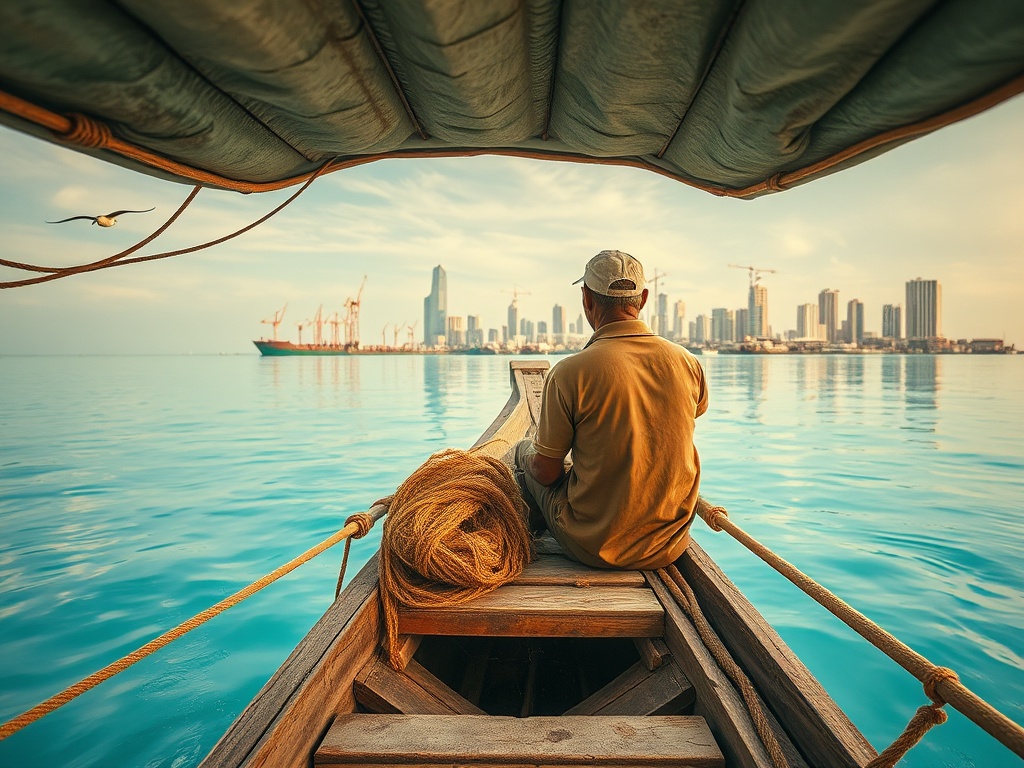
Fishermen Mending Nets as Cranes Rise Over Malé
The sea has its own economy—tides that give and take with predictable rhythm, currents that follow patterns older than memory. On land, we watch a different kind of exchange, one where value seems to shift with the political winds.
There's a particular unease that settles in the throat when promises are made without visible means. How does a government fund generosity? The question hangs in the humid air between buildings in Malé, where construction cranes pivot like question marks against the sky. The concrete rises, but what foundation supports it? When subsidies flow to certain industries while others struggle, people begin to calculate the real cost of these transactions.
The construction industry builds more than buildings—it builds narratives of progress. Yet beneath the gleaming surfaces, there's concern about what's being constructed in the ledger books. The same hands that carefully regulate taxi meters claim helplessness when it comes to housing costs, creating a dissonance that echoes through crowded neighborhoods.
Meanwhile, the national currency floats in uncertain waters. The solution seems straightforward in theory—use foreign reserves to stabilize the exchange rate—yet the execution remains elusive. It's as if we're watching someone describe how to repair a boat while standing on the shore, never actually getting their hands wet.
Free land distributions create their own currents in society, reshaping the shoreline of opportunity for generations. The concern isn't about helping families secure shelter, but about whether the selection process creates permanent divisions—whether our children will inherit not just property, but predetermined positions in the social hierarchy.
In the gaps between policy and practice, between allocation and accountability, trust becomes the most valuable currency—and the one in shortest supply. The real construction needed isn't of buildings or industries, but of systems that can bear the weight of public expectation without crumbling beneath it.
— Source fragments: Concerns about budget scrutiny, questioning sources of government funding, observations about selective industry support, currency stability discussions, reflections on long-term social impacts of resource distribution