From 1932 to 1943: How the Maldivian Constitution Fixed the Throne to the Huravee Dynasty
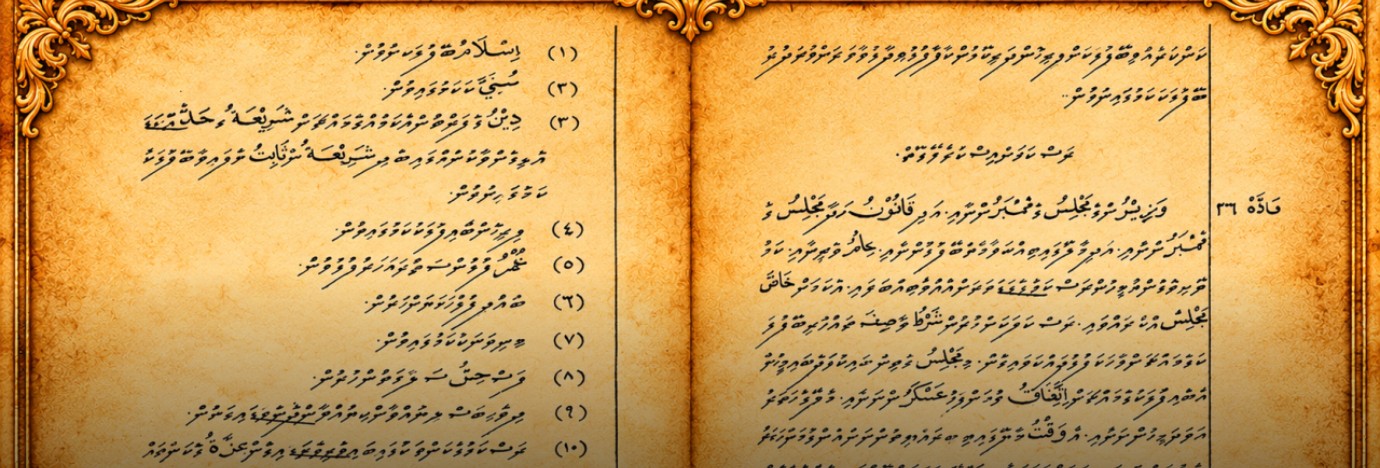
The first Constitution of the Maldives, adopted in 1932, and the Constitutions in force until 1943 stipulated that the king placed on the throne of the Maldives must be of the Huravee royal dynasty by lineage — a descendant of the male line of Al-Sultan Al-Ghazi Hassan Izzuddin (Don Bandaarain), and ultimately a descendant of the last king or one not far removed in lineage from a monarch who had ascended the throne.
The Constitution also set out how a king would be placed on the throne: through the members of the Council of Ministers, the members of the legislative assembly, the noble persons residing in Malé, the scholars and capable persons assembling at the royal palace and carrying out the special matters decided by that special assembly.
Al-Sultan Al-Ghazi Hassan Izzuddin (Don Bandaarain) reigned from 1759 to 1767. Ten kings from the male line of Don Bandaarain ascended the throne of the Maldives between 1774 and 1943:
1- Al-Sultan Muhammad Muizzuddin (1774 - 1779)
2- Al-Sultan Hassan Nooraddin, the First (1979 - 1799)
3- Al-Sultan Muhammad Mueenuddin, the First (1799 - 1835)
4- Al-Sultan Muhammad Imaduddin, the Fourth, "Muskulhi Bandaarain" (1835 - 1882)
5- Al-Sultan Ibrahim Nooruddin (1882 - 1886 and 1888 - 1892)
6- Al-Sultan Muhammad Mueenuddin, the Second (1886 - 1888)
7- Al-Sultan Muhammad Imaduddin, the Fifth, "Aaganduvaru Manippulhu" (1892 - 1893)
8- Al-Sultan Muhammad Shamsuddin, the Third (1893 and 1903 - 1934)
9- Al-Sultan Muhammad Imaduddin, the Sixth, "Hajji Imaduddin" (1893 - 1903)
10- Al-Sultan Hassan Nooraddin, the Second (1935 - 1943).
After the royal dynasty was determined and stated in the Constitution, only one prince ascended the throne of the Maldives: Al-Sultan Hassan Nooraddin, the Second (1935 - 1943). After 1943, the Constitution stated that the king must be a person of noble birth and lineage who has the support, esteem and respect of the people. The election of a king therefore became a matter for the assembly (the Parliament).
The article was written by Muhammad Shaathir, who has spent 35 years working at the national level in the fields of information and writing. Before he was 20, he wrote national historical writings in newspapers and magazines, provided information on radio and TV, and became known as the youngest historian of the 1990s. He has served more than 20 years in journalism in the state media, holding positions including reporter, sub-editor, editor, senior editor and executive editor, and wrote about 15 years' worth of historical research articles for "Haveeru". He has worked for 25 years on national committees established by the state concerning Maldivian history and culture, served seven years as Director General of National Archives, and served as Deputy Minister in five ministries (Transport and Communication, Finance and Treasury, Arts Culture and Heritage, Communication Science and Technology, Environment Science and Technology) for 12 years. He has received the National Award for Youth (history and culture), the National Award (awareness-raising concerning history) and the "Alimas Galan" of Maldivian journalism.