Government defends dollar reforms as foreign currency income tops $1 billion for first time
The Maldives government has defended its sweeping foreign currency reforms as the country's dollar earnings surpassed one billion dollars in a calendar year for the first time in history, according to statistics cited from the Maldives Inland Revenue Authority (MIRA).
According to the figures, dollar income received by the state rose from 949.74 million dollars in 2023 to 1.06 billion dollars in 2024, and reached 1.49 billion rufiyaa in 2025 — an increase of 38.5 percent compared with the previous year.
The article describes the dollar shortage as a long-running problem of roughly 15 years, linked to fluctuations in the dollar's value, which reached the point where banks had to limit the dollars sold to citizens. It says traders buying dollars at high prices on the black market to import goods has driven up the prices of goods, with the heaviest burden falling on the public.
It recalls that the previous government set a limit of a maximum of 750 dollars per month that could be withdrawn from students' bank cards, described at the time as a temporary measure, and says no solution was found before that term ended.
During the 2023 presidential election campaign, it says, the PNC's presidential candidate and current President, Dr. Mohamed Muizzu, shared detailed policies for a robust solution. At a rally held on 27 August 2023 in GDh. Thinadhoo, the President highlighted that although there are many foreign investments in the Maldives, there is no system through which the dollars earned from them can be retained in the country's financial system. His pledges included creating laws requiring investors' dollars to circulate in the Maldives' financial system for a specific period and completely abolishing the dollar limit for children studying abroad.
The article states that when Dr. Mohamed Muizzu took over the leadership, the Maldives' economy was in a fragile state, attributing this mainly to the previous government printing money in an unprincipled manner without any limit — including in 2020 and 2021 in connection with the Covid situation, and continuing in 2022 and 2023 when the economy began to recover. This, it says, increased the rufiyaa in the market and pushed up demand for the dollar excessively.
To build dollar reserves, the government brought a major change to foreign currency regulations: the broad regulation in force since 1987 was abolished and the central bank, the Maldives Monetary Authority (MMA), began implementing a modern, robust new regulation. Under the change that came into effect on 1 January 2025, foreign currency income earned from the Maldives' tourism industry was made legally required to be deposited into the Maldivian banking system; except for exempted transactions, all transactions in the Maldives were made mandatory in Maldivian rufiyaa; and businesses earning more than 15 million dollars a year must register with the MMA.
Businesses were categorised as follows: Category A (resorts and hotels) must deposit 500 US dollars per tourist per head, or 20 percent of total income, into the bank; Category B (guesthouses and tourist vessels) must deposit 25 US dollars per tourist per head, or 20 percent of total income. Outside tourism, businesses that earned no less than 15 million US dollars in foreign currency income during the past calendar year must deposit 20 percent of the foreign currency income received per month into the bank. The full authority to enforce the rules is given to the MMA.
To make foreign currency acquisition easier through the banking system, the MMA increased the amount of US dollars issued to banks per week by 51 percent for a period of one month.
On the black market, the article says the People's Majlis Finance Committee has added strict measures to the law. Under the proposed amendments, selling foreign currency contrary to the official rates set by the MMA, or attempting to sell, is a major offence, punishable by a fine of between MVR 25,000 and MVR 1 million depending on severity. Advertising and promoting foreign currency prices contrary to the official rate on digital platforms and through other means is also prohibited, with a fine of between MVR 25,000 and MVR 500,000, rising from MVR 100,000 up to MVR 5 million if a legal entity or company is involved. The threshold at which income earned outside tourism must be deposited into bank accounts was amended from 15 million dollars to parties earning no less than 25 million US dollars during the past calendar year, to be deposited into banks licensed by the MMA, and it has been decided to take strict measures against parties operating money transfer businesses without a licence.
According to MMA statistics, with the changes to the foreign currency regulation, the amount of dollars entering banks has increased by 21 percent, compared with only 10 percent over the past four years. Under the new law, 364 million dollars had been deposited into banks by the end of June this year, and the government aims to increase the amount of dollars sold to small and medium enterprises by 50 percent.
While 90 percent of foreign currency income received is brought to the MMA, 60 percent of it is used to build the country's reserves and for state expenditure. This year alone, 174 million dollars has been spent to service the country's debt — an increase of 51 percent compared with last year. The state also spends a large portion of dollar income on importing essential goods such as oil and fuel cards. The MMA says not all dollars brought to the authority are used solely for debt servicing and government expenditure; 30 percent of income received is always made available to the public through the banking system as market intervention.
Priority has been given to foreign currency assistance for small and medium enterprises. Previously banks provided TT support of only 5 percent, but dollars needed to make TTs are now provided up to 30 percent, with the MMA aiming to raise this to 50 percent.
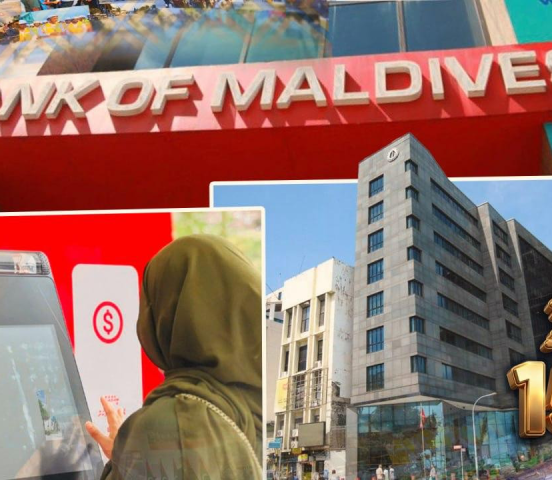
Bank of Maldives issues an average of 2.7 million dollars per day, including card transactions and TT transfers. During this year, 570 million dollars has been sold at the official rate and 270 million dollars issued as loans, while through 86 dollar ATMs established in various regions of the Maldives the public is withdrawing an average of 1.2 million dollars per day.
Dollars issued for essential needs have increased many times over: 1.9 million dollars was issued for the higher education sector in 2021, compared with 3.6 million dollars per month now; 3 million dollars per month is now issued for medical treatment; and the total amount issued to parties travelling abroad has been raised from 1.5 million to 10 million dollars.
President Dr. Mohamed Muizzu has repeatedly assured that the government will not do anything that would hinder economic progress. "We are doing this work to advance the economy. Therefore, we will not do anything that hinders economic progress. Then, even the measures being taken in foreign currency matters, their results will certainly be good. For political purposes, some parties will present various kinds of narratives. Regardless, its results will be very good overall," the President said.
Work is also underway to amend the foreign currency law so that parties earning foreign currency, including resorts and guesthouses, must deposit 40 percent of the income they receive into banks every month.
The government says it has serviced and settled 1.3 billion US dollars of previous debts, and in the past eight months alone the state has spent 10 billion rufiyaa on debt servicing — described as a record amount, more than the total spent on debt servicing over the past nine years.
Economic Minister Mohamed Saeed said this government has issued 80 percent more dollars at the official rate than the previous government. In the last three years of the previous government, a total of 1.75 billion dollars was issued at the official rate; this government has so far issued 1.9 billion dollars, an increase of approximately 97 percent calculated per month. According to the statistics, 483.53 million US dollars was issued at the official rate in 2024, 733.82 million in 2025, and 718.53 million so far in 2026.
The article also cites 313 new foreign investments secured during President Dr. Mohamed Muizzu's leadership, presented as evidence of growing foreign investor confidence in the Maldives. It concludes that while the dollar issue cannot be resolved overnight, the government is working with courage to reach its root, and the results prove the Maldivian economy has set its course toward stability and prosperity.