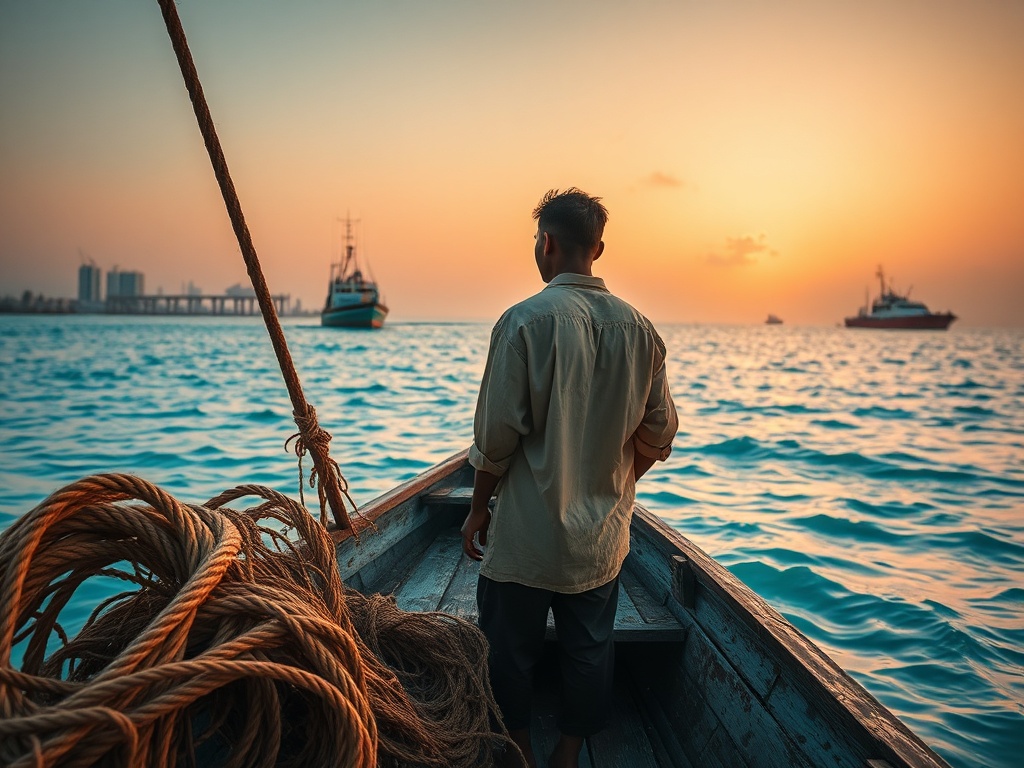
Grey Ships, Stolen Seas: A Maldivian Fisherman’s Vanishing World
The horizon bled orange as Hassan guided his dhoni through the gentle swells, the morning prayer still fresh on his lips. Then he saw them—three grey vessels, foreign and massive, their industrial silhouettes stark against the rising sun. They moved with the confidence of those who don't recognize boundaries drawn on maps, who don't understand that the sea has its own laws, older than any nation.
Hassan remembered his grandfather's hands, weathered and sure, teaching him how to read the currents, how to respect the lanu mas that had sustained their family for generations. Now these foreign ships were doing the same fishing at industrial scale, their methods brutal and wasteful. He'd seen the evidence himself—sharks with fins sliced off, discarded bodies sinking into the deep. The fishermen knew this happened, but knowing and seeing were different oceans.
Back in Malé, the air felt different—thick with arguments he couldn't escape. His cousin Ahmed spoke of free land allocations while their neighbor Rashid complained about those who would inherit multi-storey houses still getting government benefits. Hassan stayed silent, feeling the strings of affiliation tightening around everyone, even those who claimed to be free.
At the harbor cafe, old men debated politics with the intensity of monsoon winds. They spoke of foreign military bases and weapons purchases, of parties scared of losing votes, of a constitution that needed clearer housing policies. Hassan listened to the anger ebb and flow like the tide, noticing how everyone saw only half of Raajje, only their side of the humanity.
That evening, as he mended his nets on the beach, Hassan thought about the precarious balance of their islands. The demand for housing far exceeded supply, creating invisible currents that pulled people apart. Some saw land as generational wealth, others as basic dignity. All parties seemed boneless, visionless in the face of these waves.
The next morning, he returned to sea before dawn. The foreign vessels were gone, but their ghostly presence lingered in the disturbed water. Hassan cast his net anyway, feeling the familiar pull of tradition against the changing tides. He understood now that some nets were visible—the ones he mended with his hands—while others were invisible, woven from politics and promises, catching everyone in their mesh.
As the sun warmed his face, Hassan realized that surviving these currents required more than just knowing how to read the water. It required remembering who they were—island people who understood that what you take from the sea, you must respect, and what you build on land, you must share.
— Source fragments: I saw foreign vessels with my eyes. yes they were doing the same lanu masverikan at industrial scale. they don't recognize our 200 mile shore. its actually common. fishermen know this. and they are more brutal actually. they just cut the fins and throw away the shark; I am free of government and its affiliations; Most of the people I know who got land are already well-off. Relatively speaking ofcos. These are people who will inherit property when their parents pass. We're talking multi-storey houses with just two or three siblings; you guys have no clue at our precarious situation; Why mdp see only a half side of the humanity; All parties are scared of losing votes! Apart from the supremacist attitude! Boneless, visionless cowards!; When demand far exceeds supply, setting a price ceiling below the market rate is rarely effective