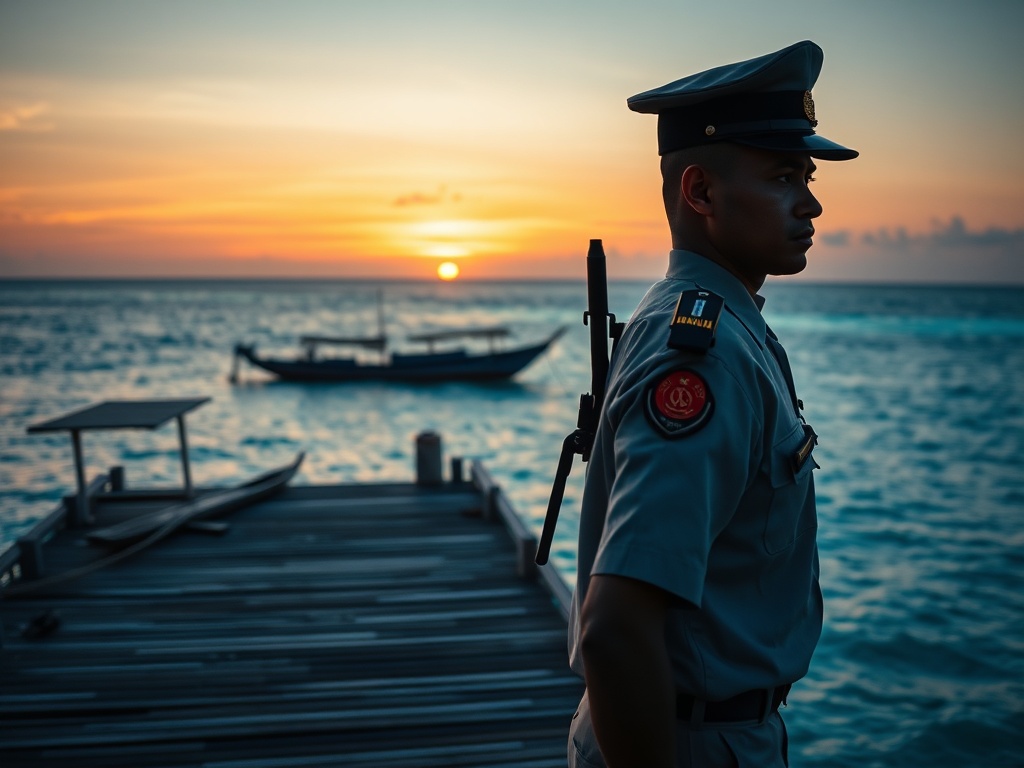
How 400,000 Islanders Protect an Ocean Nation
In the vast expanse of the Indian Ocean, where tiny coral atolls dot the blue horizon, a fundamental question of sovereignty echoes across Maldivian society: How does a nation of scattered islands secure its independence in an increasingly complex geopolitical landscape?
The debate centers not on whether to build a war machine, but on how defense investment serves as diplomatic leverage. Proponents point to Singapore—another small nation that transformed its military into a formidable force despite American protection options. Their "paranoid" security stance, as some describe it, stems from understanding that sovereignty isn't given but negotiated from positions of strength.
This perspective challenges the notion that military spending automatically signals aggression. Rather, it represents what security analysts might call "defensive deterrence"—the ability to make foreign powers think twice before overstepping. The memory of foreign military presence, however brief, lingers in the national consciousness, fueling arguments for self-reliance.
Critics counter with Iceland's example—zero military budget, yet remarkable safety—suggesting that security derives from international cooperation and strategic positioning rather than arms accumulation. They question whether missile systems serve practical purposes for an archipelago where surveillance drones might offer more relevant protection.
The conversation reveals deeper anxieties about national agency. When one side argues that "countries don't go to war out of the blue," they're articulating a worldview where military capability strengthens diplomatic hands during negotiations over fishing rights, tourism investments, or regional partnerships.
The government's current rehabilitation of MNDF and police facilities suggests this perspective has found policy traction. Yet the discussion remains nuanced—advocates emphasize trained, responsible arms ownership rather than widespread distribution, pointing to Switzerland's regulated model as precedent.
What emerges is neither jingoism nor pacifism, but a pragmatic calculation about how small states navigate big power politics. As Maldives balances economic challenges with strategic autonomy, the military spending debate becomes a proxy for larger questions about national identity in a changing world order—one where sovereignty must be both claimed and continuously defended through multiple means.
— Source fragments: Singapore military spending comparison, sovereignty arguments, defense as negotiation tool, Iceland counterexample, MNDF facility rehabilitation, responsible arms ownership models