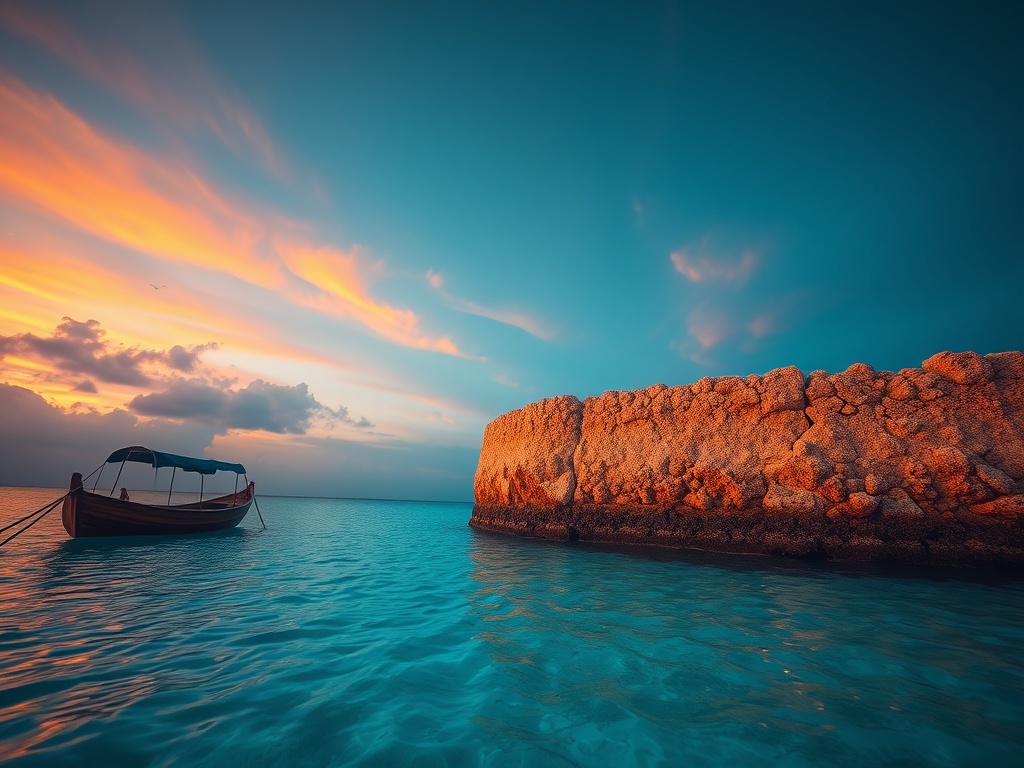
Islam as Citizenship: The Maldives' Unbreakable Religious Wall
The Maldives rises from the Indian Ocean as a fortress. Its turquoise waters and white sands form the visible facade; its true foundation is an unshakeable, singular faith. Islam is the bedrock of citizenship, the essence of national identity, and the immutable boundary of personal freedom. The constitutional declaration that all citizens must be Muslim is a societal covenant—a wall so fundamental that stepping beyond it means forfeiting one’s place within the nation.
This absolute stance creates a unique psychological landscape. In a world defined by debates over religious pluralism, the Maldivian position offers defiant clarity. There is no ambiguity, no space for competing dogmas. The recent arrival of scriptural translations in Dhivehi highlights the permanence of the barrier. They exist as prohibited artifacts, reinforcing the wall's height by demonstrating what must remain outside.
This internal unity of faith projects outward, coloring the nation's view of a fractured global Muslim community. Discussions about distant tragedies or theological purity are filtered through this lens of secured, homogenous belief. Suspicion falls on external interpretations. A Shia politician's rise in a Western city is seen not as a Muslim victory, but as a potential dilution—a confusion sown by the 'other.' The triumph lies in preserving perceived doctrinal integrity against external influence.
This defensive cohesion is framed as a bulwark against moral decay observed elsewhere. High divorce rates and shifting family structures in other nations serve as warnings of what happens when the wall is breached. The Maldivian social contract, despite current socio-economic strains—the crippling cost of living, the housing crisis in Malé, the specter of corruption—holds at its core the promise of moral preservation through singular religious identity.
Yet the fortress demands a profound sacrifice: the renunciation of the individual's right to choose in matters of ultimate conscience. It creates a society where freedom of religion is conceptually nonexistent—an alien notion with no purchase on these shores. The national identity is so wholly fused with Sunni Islam that to challenge one is to threaten the other. In private, some may wrestle with questions of justice and faith echoed in global conflicts, but the public, national answer remains monolithic.
The Maldivian example stands as a powerful counter-narrative. It testifies to the belief that true strength and social stability are born not from diversity of belief, but from its absolute unity. It is a conscious, collective decision to prioritize preserving a specific identity above all else, building a nation not as a mosaic, but as a single, unbroken piece of stone. The wall holds. Within it, a people navigate modernity, their gaze turned inward, forever defined by the boundaries they keep.
— Source fragments: Maldives religious law: "lose citizenship if you dare attempt to convert"; "Islam is the official and only religion; all others are illegal." Contrast with global pluralism: "in every Christian nation everyone...is allowed to practice." Internal Muslim discourse: Debates on theological purity (Shia vs. Sunni), perceptions of moral decay elsewhere, and questions of divine justice. Context: Maldives as 100% Muslim nation with significant socio-economic pressures (corruption, housing, cost of living).