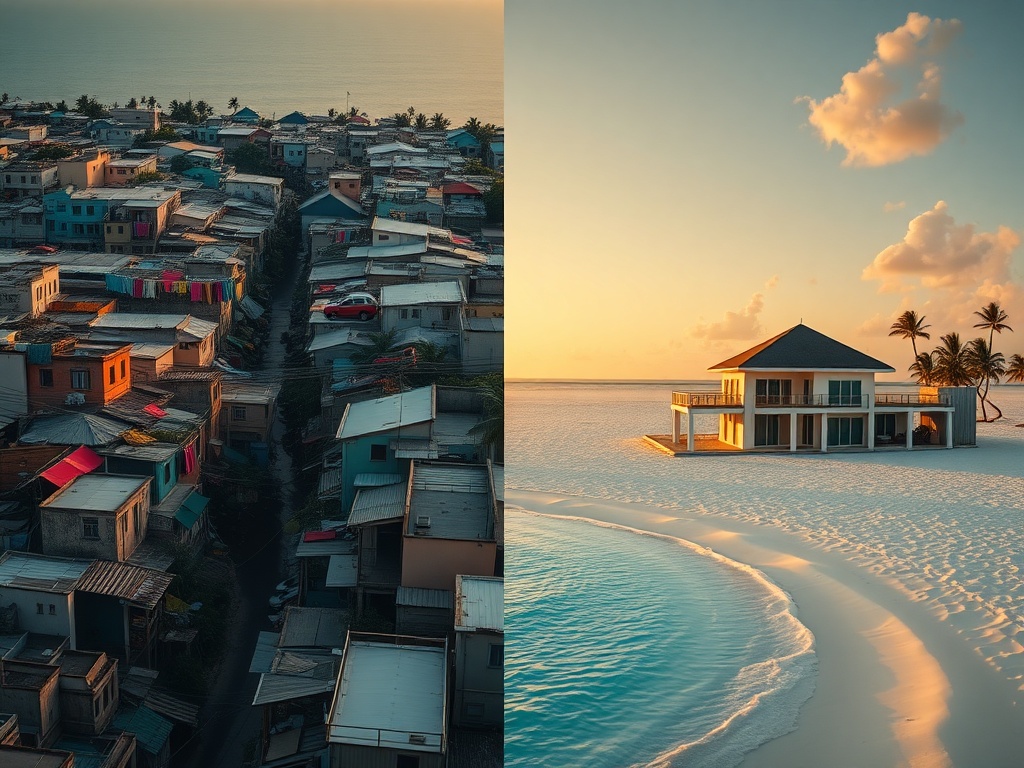
Laundry Lines Over Malé, Private Beaches on Empty Islands
Across the scattered islands of the Maldives, a quiet but persistent conversation is unfolding—one that questions the very architecture of opportunity and access in our nation. At its heart lies a recognition that certain systems, however well-intentioned in their framing, often serve to reinforce the very divides they claim to bridge.
The Binveriya Scheme and permanent address system have become lightning rods in this discussion. Critics argue these mechanisms don't merely allocate land or housing; they encode historical privilege into contemporary policy. When distribution appears tied to ancestral claims or geographic origins, it creates what one observer termed 'state-sponsored level-ups'—where bloodline or spawn point determines life chances in a nation where land represents both economic security and social standing.
This isn't merely about material disparity. It's about the psychological landscape of a society where, as the conversation notes, 'a poor man will never be taken seriously enough.' When wealth commands more respect than character or policy substance, the very metrics of worth become distorted. The result is a self-perpetuating cycle where those with existing advantages consolidate them, while ordinary Malé residents and those from remote atolls watch opportunity recede like the tide.
The discussion reveals a sophisticated understanding of systemic injustice. Participants recognize that labels like 'RT' and 'MM'—referring to specific geographic origins—are not the root cause but reinforcing factors. The deeper driver, many suggest, is human greed institutionalized through policy. When land distribution becomes politicized, when housing projects become election commodities, the system begins to serve the interests of the powerful rather than the needs of the people.
What emerges from these fragments is not just criticism but a call for consciousness. The push to '#EndVaanuvaa' represents more than opposition to a single policy; it's a demand for systemic accountability. It's the recognition that injustice, once embedded in policy, becomes inherited trauma—something that, unchecked, will be passed to 'our children and their children.'
The emotional weight of these exchanges—from the raw pain of 'Balaafa mi bunee' to the weary recognition that 'only the victim suffers'—points to something deeper than political disagreement. It reveals a society grappling with its moral compass, questioning whether our systems reflect our professed values of fairness and shared destiny.
As this conversation continues to evolve, it challenges us to imagine a different architecture—one where access to wealth and opportunity isn't determined by ancestry or address, but by our common identity as Maldivians navigating the same waters, under the same sun, toward a more equitable horizon.
— Source fragments: We must stop the permanent address system and Binveriya Scheme; The average Malé and RT meehaa are living in tough conditions; Scheme breaches multiple fundamental rights, is discriminatory; A poor man will never be taken seriously enough; We talk about it to remind you why it was wrong, and who paid the price; If you look closely, it is greed that sits at the root of most systemic issues