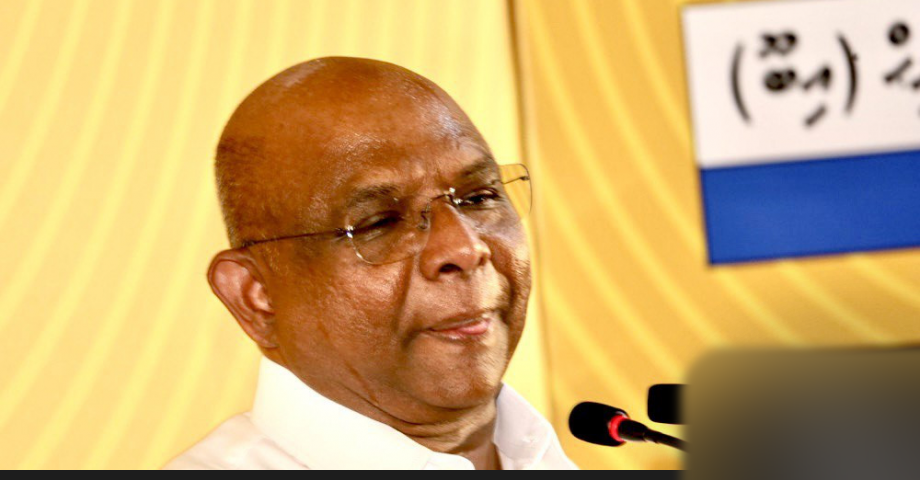
Legal Experts Question Whether Denying Biological Fatherhood Can Shield Shahid from Child Abuse Charges
Questions are being raised over whether former Foreign Minister Abdullah Shahid can escape sexual abuse charges by denying that the child involved is his biological child.
The defense has argued against the prosecution's characterization of the child as Shahid's biological child and has claimed that no marriage between Shahid and former State Minister Zifleena Hassan is registered in the Family Court.
However, legal analysis of the law on special procedures for dealing with those who sexually abuse children shows that the law does not require a biological relationship to establish a "position of trust." Article 13 of that law identifies 13 types of relationships that can place an adult in a position of trust in relation to a child, including the child's mother or father, a lawful guardian, a caretaker, persons of degrees prohibited from marriage in Islam, persons providing services or care to children, members of the household in which the child lives, and persons to whom the child's care has been entrusted.
The law does not state that a person must be the child's biological father or a legally recognized biological father to hold a position of trust. If it is proven that Shahid and the child lived in the same household, the provisions concerning being a member of the child's household would apply. If the state can prove another of the relationships expressly stated in Article 13, proving a biological father relationship is not mandatory.
The Maldives Family Act, which governs marriage, registration, and lineage, requires marriages to be in accordance with Islamic Sharia. Article 13 states that a marriage not meeting Sharia conditions is void, Article 14 requires permission from the Registrar of Marriages, and Article 19 sets principles for certain special marriages. Nowhere in the law is it stated that a marriage can be ended unilaterally by denying that one has a biological child. Under Islamic principles, marriage is a contract, and dissolution occurs through legal standards such as talaq, khul', or faskh. Denying a biological child is not a recognized way in Sharia to dissolve a marriage.
There is also a distinction between denying that an original marriage took place and dissolving an existing marriage. Statements by close associates that Zifleena and Shahid are a married couple, as well as evidence about how they lived together, could be relevant.
The article also cites the UK's Sexual Offences Act 2003 and the UN Convention on the Rights of the Child, which recognize modern family arrangements and require states to protect children from all forms of violence, including sexual abuse.
It concludes that investigators and prosecutors must consider the other relationships under Article 13, including whether Shahid was a member of the household, whether the child's care was entrusted to him, and whether he fulfilled a role requiring a position of trust. Simply saying there is no registered marriage cannot answer these questions. It states that Shahid, like any other citizen, must be held accountable before the law without exception, and that a dispute over marriage does not by itself erase the existence of a position of trust.