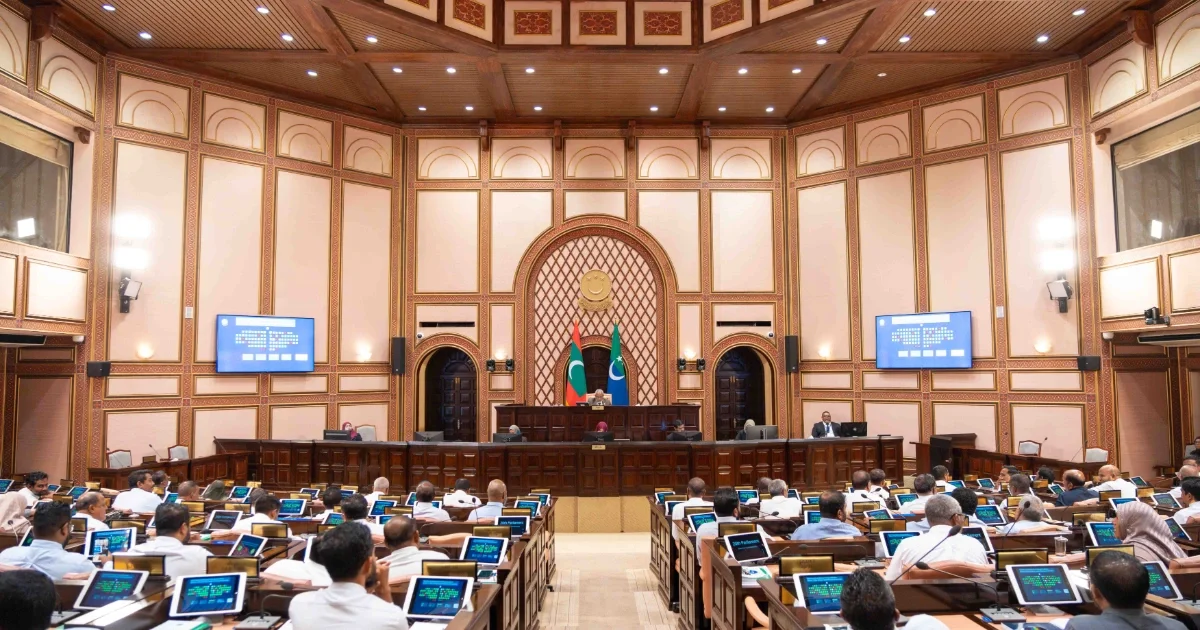
Majlis to Debate Four Bills Including Controversial Ras Malé Real Estate Bill
The preliminary debate on four bills, including the Real Estate Bill submitted to the People's Majlis by the government, has been scheduled for tomorrow's sitting. The bill includes a provision allowing lease agreements to be renewed indefinitely to enable the Ras Malé project to proceed, and was submitted through Hinnavaru North Constituency Member Ahmed Aifan.
Tomorrow's agenda also includes debate on the bill on the imposition and implementation of the death penalty, the bill on the right to protect reputation, and the Maldives Immigration Bill.
Clause 89 of the Real Estate Bill states that leasehold of apartments and properties in special zones may be sold to foreigners for 99 years. When a foreigner buys a property from the master developer, they do not receive the remaining period of the previous lease.
Through the "surrender and re-grant" model under the Real Estate Bill, the government has proposed an arrangement whereby leases granted to foreigners are renewed each time, making it possible to own land indefinitely. It is believed that this change would cause the protection under the Constitution, which states that the longest period for which land may be leased is 99 years, to be lost. The government describes this as an easing brought to the real estate market.
Instead, by surrendering the previous lease to the government, the authority must issue a new 99-year lease directly to the purchasing party. As stated in Clause 78 (b) of the bill, even if the master developer's term expires, a lease granted in that manner shall remain in effect.
Under this model, foreigners who purchase are given the full right to resell the property to other parties and to mortgage it to banks. Therefore, it is believed that this is an arrangement brought to remove constitutional protections and to create a way for foreigners to own land indefinitely or in a manner that does not expire.
In addition, the bill includes a provision that of the 500 hectares of land to be released from Ras Malé to Eagal Hills, the people of a single country may purchase no more than 25 percent of the land.
The reputation bill submitted to the Majlis by Vilimalé Constituency Member Mohamed Ismail includes many matters that would be considered acts of defamation. Accordingly, the bill includes that a defamation claim may be made because of certain words, or because of a photograph or drawing that is shown. In addition, the bill includes that a defamation claim may also be made through objects shaped to resemble a particular person, or through a film or drama that is made.
According to the bill, a defamation claim may be made if, through a gesture made by a person or an action taken by a person, something capable of defaming a particular party is depicted or perceived and understood. Under the bill, a defamation claim arises only if any of the matters described as acts of defamation is false, containing no truth in it.
The bill states that if a defamation claim is proven, compensation of an amount between MVR 50,000 and MVR 500,000 may be awarded. Under the bill, defamation is a civil offence.
The next item on tomorrow's agenda, the bill on the imposition and implementation of the death penalty, states that the death penalty shall be carried out by hanging, and that the instruments and items used to carry out the sentence, and the manner in which it is to be done, must be in a manner and with instruments and items that cause the least pain to the convict and enable the sentence to be carried out as quickly as possible.
According to the bill on the implementation of the death penalty, the death sentence in the Maldives shall be carried out by hanging, with regard to causing the least pain. This sentence shall be carried out after all judicial stages are completed and the consent of the heirs is obtained, under the supervision of a special panel assembled by the Corrections Service.
Accordingly, the items and instruments that may be used for hanging, and the detailed rules and procedures of hanging, must be stated in regulations made under the law on the imposition and implementation of the death penalty. After all judicial stages are completed and with the consent of the heirs as well, the matters of carrying out the death sentence on the convict shall be managed by a panel consisting of seven members. That panel shall be assembled separately for each case by the Maldives Correctional Service.