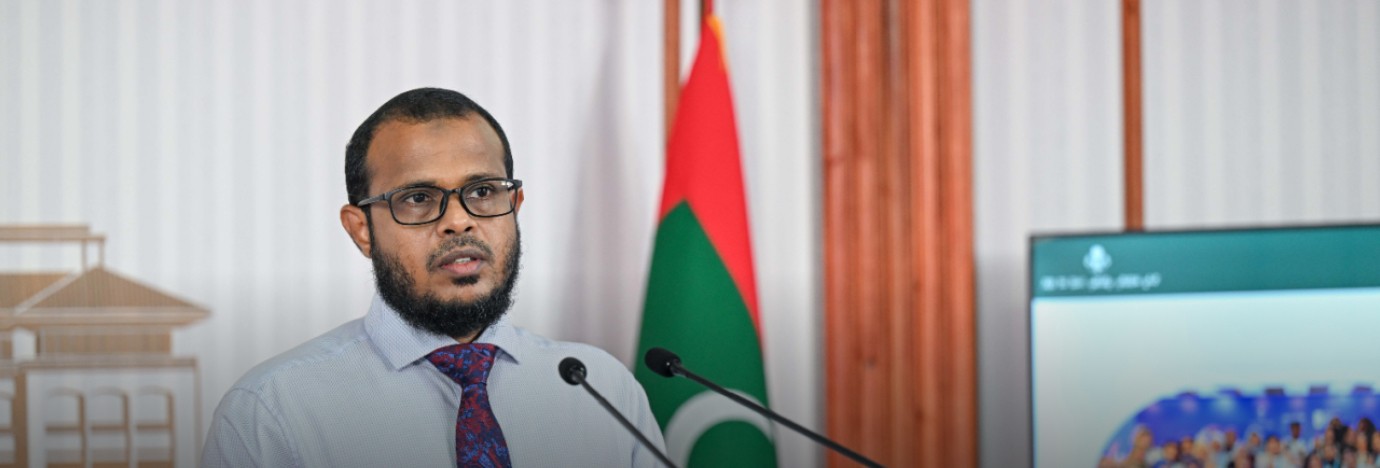
Maldives Cannot Go Dark for Climate Goals, Says Environment Minister Ali Shareef
Environment Minister Ali Shareef has said small island nations like the Maldives cannot achieve climate goals without being provided adequate alternatives, stressing that Maldivians do not want to live in darkness, as international discussions continue on halting the use of oil and gas that contribute to global warming.
In an interview with Germany's DW, Shareef said the Maldives is already bearing the burden of adverse climate change. He said that in the weather disaster that struck the Maldives last month, some families' homes were damaged and the public suffered income losses beyond measure.
Shareef also said that due to heating of the sea's salt content, fisheries have declined, and the adverse effects of coral bleaching are directly affecting tourism.
The Maldives has been represented at the international climate summit (COP) for 31 years, and the Minister said the Paris Agreement is a hopeful beginning that united the whole world as one. However, expressing concern over the speed at which things are being achieved under these agreements, Shareef said that although the Maldives' contribution to global warming is very small in proportion, it is fragile countries like the Maldives that have to face its greatest damage.
Shareef said that due to the small land area of the Maldives, solar panels installed only on rooftops cannot produce enough energy for the entire country. Therefore, he said the only solution is to establish "floating solar" systems in the ocean, and that unlike foreign countries, this technology must be used in the Maldives amid large waves and strong currents.
"We do not want to remain in darkness. That era has now passed. The entire population needs electricity for living and progress. Keeping the public in darkness by merely stopping the use of oil is not a way for things to proceed toward becoming carbon neutral," Shareef said.
The Minister said that while the Maldives is ready to reduce its dependence on oil, that can only happen by providing alternative systems.
The Minister said that although bringing countries with different interests to an agreement is a difficult task, reaching agreements in this work done jointly by the whole world is very important. Shareef also said that instead of a new system, reforming and strengthening the existing system is more important.
The Minister said it is important to establish ways for fragile countries like the Maldives to easily obtain international financial assistance. Shareef also said that, in addition to assistance from governments, unless paths are facilitated for large private businesses and the private sector to invest easily, these difficulties cannot be overcome.