Maldives Delegation Heads to COP31 with Demands for Grant Aid and Loss and Damage Support
This year's COP Summit is being held at a critical juncture, as fears arise that the effects of El Niño developing in the Pacific Ocean could also bring changes to the Maldives' climate. This is a difficult time where rising sea temperatures have put coral bleaching and marine life at risk, and the country's economy has been affected by disruptions amid ongoing conflicts in the Middle East. Consequently, it has become necessary to once again raise the voice of the threat facing the Maldives' fragile ecosystem to the entire world.
At this time, when oil prices have risen due to global economic instability and geopolitical tensions, causing significant challenges for businesses and public life, small countries like the Maldives are bearing the brunt of these disruptions.
This year's meeting of the UN's largest annual global climate conference, COP31, is taking place from today until the end of the 20th of this month in Antalya, Turkey. A special delegation from the Maldivian government will also participate in this meeting.
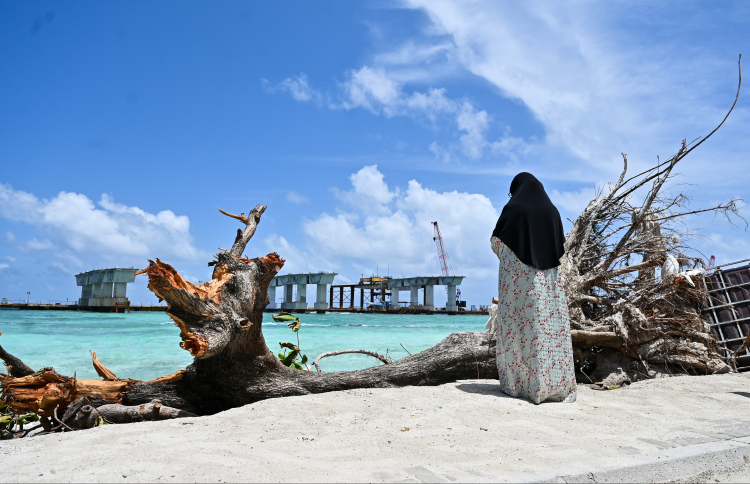
COP31 is particularly important for a low-lying island nation like the Maldives not merely because it is a political or diplomatic meeting, but because the survival of such nations is linked to it. The Maldives is the lowest-lying country in the world. On average, its land elevation is only about one meter higher than sea level. Therefore, even a slight change in global temperature poses a severe threat to this country.
Although the "Paris Agreement" signed 11 years ago aimed to keep global temperature rise within 1.5 degrees Celsius, calculations from Europe's "Copernicus Climate Change Service" now confirm that this year too, global temperatures will exceed 1.5 degrees Celsius. This marks the second year since 2024 that the global average temperature has risen above 1.5 degrees Celsius.
The Maldives has always been an active country at the forefront, raising the voice for island nations at COP Summits. This year too, the Maldivian delegation is attending this summit, which brings together leaders of nations, with clear objectives and important demands. These include seeking climate finance as direct grant aid to prevent the country from becoming indebted, and calling for the establishment of a formal system for "Loss and Damage Support." Alongside this, the Maldives will propose a specific framework for implementing robust measures to practically protect the islands.
In response provided to Hiyyaa by the Climate Change Department of the Ministry of Environment, it was stated that during the consultations of COP31, Small Island Developing States (SIDS), including the Alliance of Small Island States (AOSIS) comprising 39 countries, along with other participants, will work very closely with the Maldives to present its perspectives, priorities, and desired outcomes.
Under the Maldives' latest main climate policy, the "Nationally Determined Contribution (NDC 3.0)," protecting coastal areas has been established as the primary foundation of national development plans. NDC 3.0 is a ten-year national master plan designed to reduce greenhouse gas emissions and protect islands from climate change impacts.
"The government has always prioritized finding sustainable solutions to protect coastlines as part of enhancing island resilience," the Ministry said.
As part of preparations for this year's COP Summit, the "Youth Track to COP31" organized by UNICEF last September saw the Maldivian youth submit specific proposals to the Maldivian delegation. Participants stated that efforts against climate change must remain a priority at both national and international levels, and that the voices of young people must be included in policy and solution-making processes.
"Our ocean is our food, income, culture, and our unique identity. When discussing coral bleaching, loss of marine habitats, coastal erosion, or damage to marine ecosystems, we are talking about things deeply connected to communities and our future," it was stated in the youth proposals.
Participants stated that marine ecosystems must be protected before restoration is required, noting that restoration is expensive, difficult, and uncertain in success. Although regulations exist, they are often not fully implemented, and environmental fines are frequently treated as insignificant.
"We want a double-eyed system to ensure that promises regarding development projects, environmental decisions, and the use of environmental fines are truly fulfilled," participants said at the meeting.
Building upon the leading role played by the Maldives in creating the "Fund for Responding to Loss and Damage (FRLD)" to compensate for irreversible losses caused by climate change, the Ministry stated that the Maldives will prioritize at COP31 expediting arrangements for receiving direct assistance from this fund.
Ministry officials said that establishing arrangements for direct assistance from this fund would pave the way for accelerating the launch of projects to protect coastlines.
Key issues the Maldives will prioritize regarding financial assistance at COP31 include:
- Raising the issue of the disparity in financial assistance given by developed large countries to small countries for recovering from climate change losses.
- Working to accelerate the implementation of measures outlined in the new target for climate finance, the "New Collective Quantified Goal," decided at COP29 in 2024.
- Fully conveying the Maldives' situation and vulnerability during consultations on securing climate funds.
- Highlighting the importance of requiring grant aid to prevent small countries from becoming indebted while recovering from climate change.
The success of this summit for Maldivians cannot be measured solely by political statements and speeches; it depends on the results achieved. COP31 will be considered successful if practical steps are taken to uphold the agreement to keep global temperatures from rising above 1.5 degrees Celsius, alongside ensuring certainty of receiving grant aid, knowing specific dates for receiving funds, and facilitating easy access to support from the "Loss and Damage" fund.
Securing financial assistance to recover from environmental damage has been one of the most significant advocacies made by the Maldives at COP Summits over the past few years. It is also the biggest demand of other small countries like the Maldives.
This year's COP Summit, described internationally as the "Blue COP," will also be a very important and historic meeting for protecting the world's oceans. While discussions about oceans in international consultations on climate changes previously occurred in informal sidelines of this summit, this time the main objective is to determine formal decisions requiring countries to act to protect the oceans.
With more than 80 percent of the Maldives' land lying just about one meter above sea level, flooding and island erosion will increase drastically as sea levels rise. Alongside this, fishing and tourism, which are the pillars of Maldivian life and the economy, are entirely dependent on a healthy marine environment. Therefore, strong decisions taken at this summit to protect oceans and the financial assistance received will be the strongest force available to pass the Maldives' islands to future generations without them disappearing from the world map.