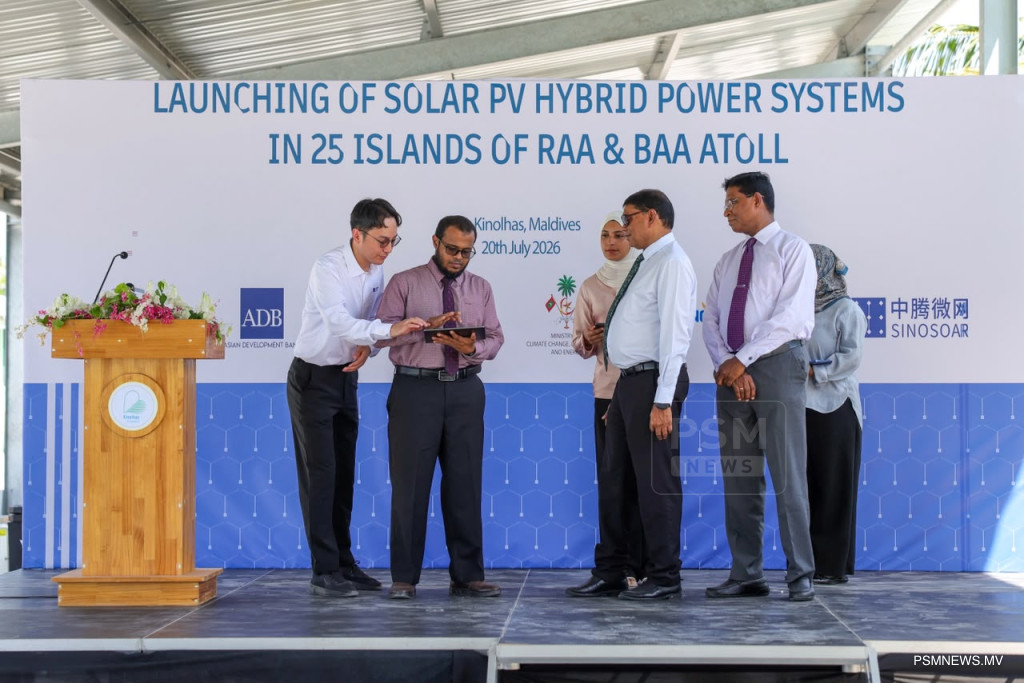
Maldives Deploys Solar-Hybrid Systems Across 25 Islands to Slash Diesel Imports
The Government of the Maldives has inaugurated a 6.4-megawatt (MW) solar photovoltaic-hybrid electricity system across 25 islands in the Raa and Baa atolls. The project, launched during a ceremony in Kinolhas, is a collaborative effort with the Asian Development Bank (ADB) and the European Investment Bank (EIB).
Presided over by Minister of Climate Change, Environment and Energy Ali Shareef, the initiative is a key component of the Preparing Outer Islands for Sustainable Energy Development (POISED) project. The program aims to bolster national energy security, reduce the financial burden of costly diesel imports, and accelerate the country's progress toward its climate targets.
Minister of State for Climate Change, Environment and Energy Dr Muaviath Mohamed emphasized the project's immediate economic and environmental impacts. The new systems are expected to generate approximately 10.4 gigawatt-hours of clean electricity annually. This shift will save over three million litres of diesel and reduce carbon dioxide emissions by roughly 8,400 metric tonnes every year.
"The shift to solar reduces our fuel bill year after year, easing pressure on the national budget and strengthening the Maldivian economy," Dr Muaviath stated, noting that the rollout will expand to further islands in the coming years.
The technical infrastructure includes 6.36 MW of peak solar PV capacity supported by a 10 MW battery energy-storage system (BESS) to ensure stability. Under the wider POISED framework, the government plans to equip a total of 160 islands with solar-hybrid systems, totaling 19.8 MW of solar PV and 20.6 MW of battery storage. Currently, 23 islands are under construction with a completion target of 2027, while 72 islands have already successfully transitioned to the new systems.
This energy transition is central to the Maldives' national ambition to source 33 percent of its electricity from renewable energy by 2028. This goal is a cornerstone of the nation's Nationally Determined Contribution (NDC) under the Paris Agreement, reflecting a commitment to global climate action while securing a sustainable energy future for its remote island communities.