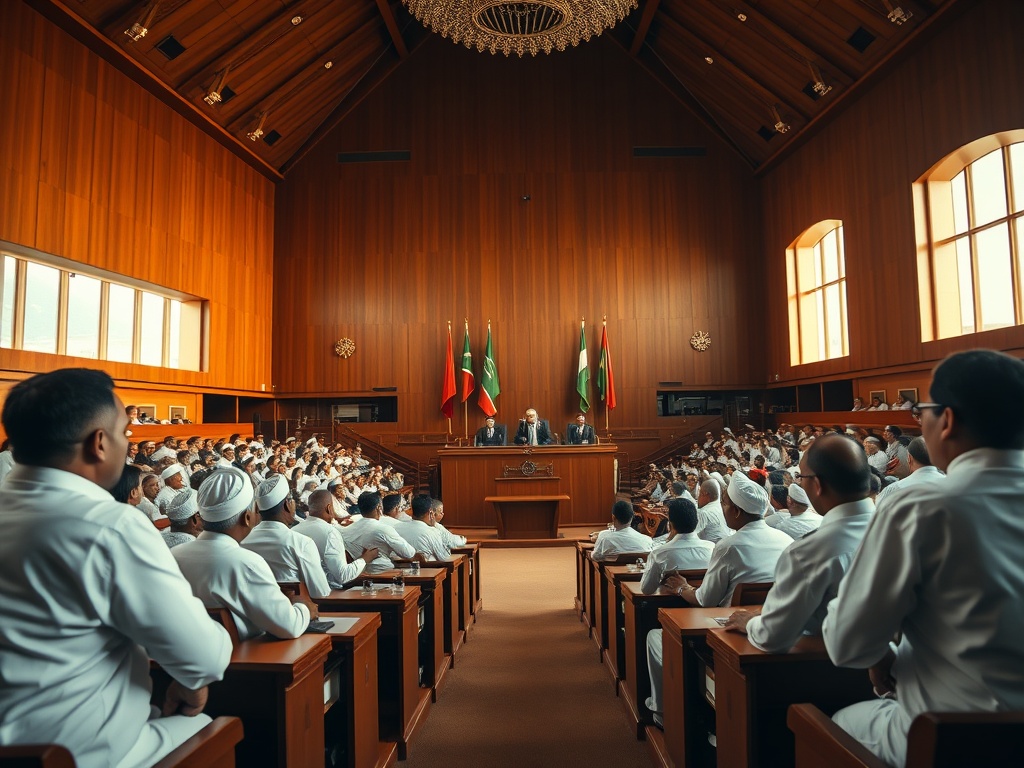
Maldives Parliament Debates UK Treaty with US Support
The Maldivian Parliament sits at a crossroads of international relations, debating legislation that would cement a bilateral agreement with the United Kingdom—a treaty reportedly backed by American support. This moment underscores the delicate balancing act required of small island nations navigating the treacherous waters of global geopolitics.
Behind the parliamentary proceedings lies a critical understanding of territorial status. The Chagos Archipelago, central to regional maritime discussions, was administratively separated from Mauritius before its independence in 1968 under the British Indian Ocean Territory framework. This historical fact becomes particularly relevant as Maldivian lawmakers consider the implications of new international agreements and their alignment with established principles of international law.
Simultaneously, Maldivian diplomacy maintains its consistent position on global justice mechanisms. The nation has reaffirmed that accountability should never be held hostage by unilateral refusal, particularly criticizing the use of the UN Security Council veto as a political tool rather than a safeguard for effective multilateral action. This stance reflects the vulnerability small states feel when facing power imbalances in international institutions.
The diplomatic landscape grows more complex with regional considerations. While some voices question permissions from neighboring India regarding certain actions, others engage with international parliamentary forums, such as the Inter-Parliamentary Speakers' Conference in Pakistan, suggesting a diversification of diplomatic relationships beyond traditional partners.
These developments occur against a backdrop where hypothetical questions about other liberation movements—such as Kurdish independence—highlight the interconnected nature of global justice causes. For the Maldives, each diplomatic move carries weight beyond immediate bilateral benefits, potentially setting precedents for how territorial integrity, self-determination, and international law are interpreted and applied.
The current parliamentary debate represents more than just treaty ratification—it's a statement about how the Maldives positions itself in an increasingly polarized world. The outcome will signal whether the nation prioritizes strategic alliances with Western powers, maintains its independent voice on global justice issues, or seeks a careful middle path that acknowledges the realities of power while championing the principles of equitable international relations.
As the bill moves through legislative processes, Maldivians watch closely, understanding that these decisions will shape not only foreign policy but the nation's ability to navigate the complex interplay between great power politics and the pursuit of justice on the global stage.
— Source fragments: REMINDER 🚨 The ‘treaty’ will be law. It is an agreement between the Maldives and UK . It has American backing.; Chagos was not part of Mauritius at its independence in 1968. It had been detached in 1965 under BIOT. This fact is critical as Parliament debates the Bill. Territorial status must be understood from the actual record, not assumptions. #InternationalLaw; #Maldives reaffirms that justice must never be subjected to the refusal by a single power & that the #veto must not be used as a political choice to avoid accountability, but as a safeguard that ensures effective delivery from the #UNSC. #MDVatUNGA80